All posts by musingsofanaspie

Taking the The Systemising Quotient (SQ)

This week for Take a Test Tuesday I took the revised Systemising Quotient (SQ-R) test.

Systemizing refers to the drive to understand, construct, predict and/or control the rules of a system. Simon Baron-Cohen, in his desire to wedge autistics into his extreme male brain theory, contrasts systemizing with empathizing as the two primary ways in which humans make sense of their worlds.

The basic premise of the extreme male brain theory is that neurotypical males are better at systemizing and neurotypical females are better at empathizing. Hence, brains can be classified as either male or female according to these aptitudes. Autistic males and females are both better at systemizing, therefore, autistic people have “male brains” and autism is a condition of extreme male neurology.

Using that logic you could also make the case that female basketball players have “male bodies” (i.e. male bodies are on average taller than female bodies, female basketball players have taller bodies on average than females in general, therefore, female basketball players have “male bodies”).

Setting aside the extreme male brain theory, what can we learn from the SQ? The SQ is the subject of several research papers and each time the data show people with ASD generally scoring lower on the EQ and higher on the SQ.

The SQ attempts to measure systemizing in daily life, asking questions about how organized you are when it comes to your financial records, collections or favorite books/music. While the creators tried to avoid introducing bias in terms of subject matter, the test is still vulnerable to this. For example, I want to know the specs of new computer because that’s a topic I’m fairly familiar with.

I’m less interested in the specs of my car’s engine because that’s a subject I know (and care) little about. The same goes for knowing the species of animals and trees or the make-up of committees and governments. Those aren’t subjects I find highly interesting so regardless of how much of a systemizer I am, I’m only going to have a passing curiosity about them

Much of this still relies on personal interests, though perhaps it balances out in the end. The questions about how I bag my groceries and what my closet looks like made me laugh. I bag groceries by type because that makes them easier to put away at home. I hang my clothes in the closet by type so I can find what I’m looking for quickly.

My theory about systemizing? It all comes down to the fact that when you’re autistic, systemizing isn’t simply a preferred way of thinking, it’s a survival mechanism. Without systems and routines, we’d be constantly getting lost in the details.

One final note before we take the test. A lot has been written about gender bias in the EQ and SQ. It struck me as very telling that when the SQ was revised to remove some of the questions that were in “traditionally male domains” and add more questions that might be relevant to females, they removed questions related to investing, religion and culture and added questions related to shopping, cleaning, music and clothing.

Taking the Test

You can take the SQ-R (2005 revised version of the SQ) at the Aspie Tests site. Click on The Systemising Quotient (SQ) link and follow the prompts to get to the test page. I’m assuming you know the drill by now. There are 75 questions and you’re required to choose among strongly agree, slightly agree, slightly disagree and strongly disagree. Positive “strongly” answers score two points and “slightly” answers score one point. Possible scores range from 0 to 150.

It took me a little over 10 minutes to complete.

Scoring the Test

I scored an 85. Not surprising. I’m super organized, have a good memory for details and am insatiably curious about how things work.

I don’t think the SQ is binary in the way that EQ is. For example, on the EQ a positive answer to “I get emotionally involved with a friend’s problems” suggests empathizing. A negative answer suggests remaining detached or perhaps taking a logical problem-solving approach to the friend’s problems. This could be roughly construed as systemizing if we continue to look at it in a strictly binary way.

On the SQ, a negative answer to “I do not follow any particular system when I’m cleaning at home” suggests that one prefers using a system for housecleaning. But what does the opposite answer suggest? Certainly not anything to do with empathizing.

However, the EQ-SQ model sets the two tests up as “complementary” and goes so far as to demonstrate that a composite of EQ-SQ scores is steady across all groups (i.e. my EQ+SQ will be relatively equal to yours and everyone else’s, across all neurotypes). That suggests a strong negative correlation between the two tests.

When you look at the relationship between the AQ, EQ and SQ, it becomes evident that both the EQ and SQ act as a sort of proxy for AQ scores. In other words, they aren’t tests of empathizing and systemizing so much as they’re tests of the traits of autism. Of course autistic people will score higher than average on a test that asks a lot of questions closely related to core autistic traits and lower than average on a test that asks a lot of questions about social skills.

For reference, here are the mean scores from the 2005 SQ-R study:

ASD Male 77.8
ASD Female 76.4
ASD Total 77.2

Typical Male  61.2
Typical Female 51.7
Typical Total 55.6

(I prefer looking at the means from the original studies because the means provided by the Aspie Test site are based on self-reported neurological status, which may not be accurate.)

The Bottom Line

The SQ is an interesting measure of how dependent an individual is on routine, systems and categorization, but the use of the SQ as “proof” of the extreme male brain theory is highly suspect.


Adult ASD Evaluation: The Diagnostic Interview

This is Part 8 in the I Think I Might Be Autistic series

The morning of my appointment, I was incredibly nervous. My biggest fear was that I would go through this process and be told that I was officially not autistic–that I wouldn’t come across as “autistic enough” for a clinical diagnosis.

Fortunately, it turned out that I’d found a doctor who has worked with adults enough to know that we have many coping mechanisms and workarounds. He didn’t expect me to present the way a five-year-old boy would. He acknowledged that being an adult autistic doesn’t necessarily mean not attending your cousin’s baby shower; it can mean going to the baby shower and spending a good part of the afternoon hiding out in the kitchen (one of his examples).

The Diagnostic Interview

The first part of my evaluation was a diagnostic interview. I turned in my questionnaire to the receptionist and when Dr. H called me into his office, he’d obviously reviewed it. He started off by asking me to talk about why I suspected I have Asperger’s. I was nervous so I rambled around a lot. Looking back, I probably should have looked at my notes and used them as a guide, but my brain was going a hundred miles an hour.

Once my initial thoughts fizzled out, Dr. H. started working through the questionnaire, confirming symptoms I’d answered positively and asking clarifying questions. As I relaxed a little, the conversation became less structured. We talked a lot about my childhood, with the doctor encouraging me to give examples or tell stories to illustrate certain points. Gradually, he began inserting comments about Asperger’s, explaining how some of my symptoms were typical and how they fit into the diagnostic picture.

The interview lasted about an hour. By the end of it, I felt like we’d hit on all of the key points I wanted to talk about as well as some that I hadn’t considered important. Dr. H concluded the interview by explaining that he wanted to evaluate me for ASD, ADHD and Social Anxiety Disorder. The second one was a surprise but I was glad that he was forming his own hypotheses in addition to the one I’d presented.

He then explained a little about how cognitive testing works and about the qualifications of B, the ASD testing specialist who would administer the tests.

The Part Where I Provide Plenty of  Autistic Behavior for Observation

When we moved to B’s office, I got a chance to demonstrate two of the symptoms I’d described in the interview: face blindness and delayed auditory processing. Dr. H introduced me to B and she cheerfully said, “Yes, we already met–you asked me where the restroom was when you came in.”

Completely thrown by the fact that I didn’t recognize her, I said “Really? Okay.”

As I was kicking myself for that useless reply, Dr. H asked, “Got plurdled gabbleblotchits on a lurgid zoo?”

I reflexively replied, as I always do when I have no idea what someone has said, “Sorry?”

“What would you like to be called?” he repeated.

I probably could have gone home at that point because not recognizing that I’d already met B, not being able to smooth over the awkwardness that followed, not greeting her with my name, not understanding what Dr. H was saying, being more focused on orienting myself in the room than connecting with the person I was going to work with–in less than 60 seconds, I’d exhibited a boatload classic autistic behavior, much of it as a result of struggling to switch activities/environments, which is in itself textbook.

To her credit, B quickly put me at ease. She spent about ten minutes “getting ready” while I sat, mostly silent, and studied the colorful barcode prints on her wall. Honestly, I wouldn’t be surprised if the time she’d spent puttering around with her supplies was more for my benefit than hers. By the time we started on the cognitive testing, I was feeling reasonably focused again.

Next up: Cogntive, ADHD and Psychological Screening Tests

Autistic People Are Everywhere

This post is a part of today’s “Autistic people are . . .” flashblog. You may have seen the news this week that Google has promised to eliminate the problematic “Autistic people should” autocompletes in response to last week’s flashblog. They’ve said it will take time to engineer, so while the hateful autocompletes are still appearing, hopefully they’ll soon be gone.

We can make a difference by speaking up.

——-

Autistic people are everywhere.

We sit next to you at school and on the bus. We give your dog his rabies shot, teach your kids, make your latte and sweep the floor at your grocery store. We pass you on the sidewalk and stand beside you on the subway. We eat in the same restaurants, shop in the same stores, go to the same gyms that you do.

We are mothers and fathers, husbands, wives and partners. We are sons and daughters, sisters and brothers, aunts, uncles and grandparents.

We are everywhere, all around you.

*

If you don’t see us, it’s because we’ve mastered the art of hiding in plain sight.

We don’t come neatly labeled. Many of us don’t “look” autistic. You can interact with us and not realize you’ve talked to, worked with, studied with, played with, cursed out, fallen in love with, or are related to an autistic person.

We often don’t share our neurological status unless we feel that we absolutely have too, and even then sometimes we don’t.

There is no payoff for calling attention to our differences. There is no reward for being openly autistic. The risks are real.

Many of us remain quietly, even silently, autistic.

We are everywhere, sitting beside you, walking past you, interacting with you. Do you see us?

My Anxiety is Not Disordered

Bringing this post back for this month’s Down Wit Dat T21 Blog Hop

—–

I’ve been thinking and reading a lot about anxiety recently. When I was diagnosed with Asperger’s, I was also diagnosed with Social Anxiety Disorder.

Here’s how I feel about that: Social Anxiety? Yes. Disorder? Not so much.

Disorder implies that my social anxiety is irrational. Is it? Consider this:

“Anxiety at appropriate levels is important for adaptive functioning. There are many environmental hazards that must be avoided and these are often learned through the process of anxiety induction. The resultant anxiety response is learned through the association of certain stimuli with unpleasant consequences.” (from “Autism and the Physiology of Stress and Anxiety”, Romanczyk and Gillis)

Anxiety, like fear, protects us from danger. It raises our guard and makes us wary. In this way, it’s healthy. Without it, we might be less motivated to get an education, to work, to care for our loved ones and ourselves.

blueanxiety

What is Anxiety?

Anxiety is a state of worry, concern or dread related to something that hasn’t yet happened and may, in fact, never happen. Think about some things that we typically feel anxious about:

  • committing to a relationship
  • giving a major presentation for school or work
  • becoming a parent
  • meeting a partner’s family
  • starting a new job
  • learning to drive
  • flying on an airplane for the first time
  • traveling in a high crime area

When you feel anxious about an upcoming event, you spend more time thinking about it and preparing for it than you would for a more mundane activity. You examine the possible consequences and give extra attention to your actions to ensure the best possible outcome. Anxiety heightens your awareness; heightened awareness sharpens your focus, increasing your safety.

It’s important to note that here and throughout this piece, when I talk about anxiety, I’m referring to appropriate levels of anxiety, not paralyzing anxiety. An appropriate level of anxiety is one that is manageable. I feel nervous in the days before giving an important Powerpoint presentation, but I manage my anxiety and complete the presentation to the best of my ability. An inappropriate level of anxiety is one that prevents a person from completing a necessary or desired activity. For example, if I got so anxious about the presentation that I ended up sick in bed, fainted in the conference room, or lied to avoid presenting.

Not all anxiety is healthy and it’s important to recognize where your anxiety falls on the healthy/unhealthy continuum.

The Function of Social Anxiety in ASD

So that’s how anxiety works in the typical brain. But what about in the autistic brain?

From childhood, autistic people know that we’re missing key information in social situations. We often have difficulty interpreting facial expressions, tone of voice, body language, and non-concrete speech. Some people also struggle with auditory processing and sensory overload in public or group settings.

The results of our social communication challenges can range from inconvenient (missing a joke or not following a conversation) to dangerous (being bullied, taken advantage of or assaulted). There are also negative health consequences–many autistic people need hours or days to physically recover from prolonged or intense social interaction.

Over time, “through the process of anxiety induction,” we realize that certain social situations are “environmental hazards that must be avoided” (as Romanczyk and Gillis described). In other words, because of a very real hazard, we develop anxiety that for us has a very real cause. It isn’t disordered. It’s a defense mechanism, developed through “the association of certain stimuli with unpleasant consequences.”

Social anxiety is, therefore, not only “important for adaptive functioning” in autistic people, it’s essential.

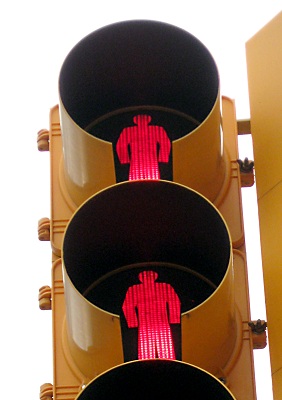
traffic lightRed Light, Green Light

Autistic social anxiety is not the same as neurotypical social anxiety. If a person with intact social communication abilities has severe anxiety about social situations, then they have a disorder because their fear is irrational. When a person with impaired social communication abilities has anxiety about social situations, they are like a poor swimmer who is anxious about boarding a boat. The perceived risk is real and rational.

If fear is a red light–a glowing “stop” signal in our brain–then anxiety is a yellow light. It’s the feeling that says, “slow down, caution, stop and pause a moment before continuing down this road.”

We should heed this feeling, not cure ourselves of it.

Appropriate vs. Inappropriate

But, some will say, too much social anxiety and you’ll become a recluse! A hermit! The little old lady shouting at those darn kids to get off her lawn!

Well, yes and no. First of all, allow me to horrify the more socially oriented among you by saying this: people aren’t all that interesting and the rewards of socializing are sometimes overrated. Consider the possibility that all of the following (fictional) people are meeting their needs for social interaction:

  • the person who lives alone, works at home and in the evening participates in role-playing games, an acting workshop and a drumming circle
  • the person who lives with a partner and has lunch once a week with a close friend
  • the person who attends classes full-time and prefers to socialize online in text-based formats outside of class hours
  • the person who chooses to spend time at home with family and only goes out for necessary errands or events
  • the person who works around people all day and likes to spend their evenings alone

The social preferences of these people may differ from the majority of their peers, but they aren’t exactly in Grey Gardens territory.

Being anxious about socializing is not the same as completely avoiding social situations. It’s possible to manage social anxiety in the same way we manage anxiety about other things. Someone–NT or autistic–might feel anxious about starting a new job, but that doesn’t mean they won’t do it. Most people have strategies for managing anxiety and autistic people are no different.

What is different is that our social anxiety is automatically pathologized and then “treated” with therapy or medication. We’re told that our fear is irrational and we need to change the way we “think about” social interaction. We’re told that if we just “relax a little” we’ll find social interaction much more enjoyable.

What would be far more helpful is to acknowledge our anxiety as valid and support our right to socialize at our preferred level, in our preferred ways, without being stigmatized for it.

What Anxiety Tells Us

So how does social anxiety keep us safe?

First there is the obvious example: when you have difficulty interpreting nonverbal cues, it can be hard to know when another person is a threat. This can be especially true for autistic women and girls, increasing our chances of becoming the target of sexual assault, sexual abuse or domestic violence. The autistic woman who feels anxious about dating, intimate relationships or venturing into unfamiliar situations has good reason to–the statistics for violence against autistic women are alarming.

Autistic people are also often victims of bullying. The autistic boy or girl who is anxious about recess or the school bus has a large databank of negative interactions feeding that anxiety. Their anxiety tells them that unstructured activities with limited adult supervision are a potential danger zone.

Those are both reasonable examples, right? But what about the anxiety-inducing holiday party, trip to the mall, or vacation? Surely that’s irrational?

Not if you’re forced to think about every social activity in terms of cost. There are many analogies for this concept: spoon theory and the social cup vs. bucket analogy are the most popular. I’ll spare you a new analogy and give you an example instead.

Last spring my nephew and his wife came to visit for a long weekend. He’s one of my favorite nephews and I was looking forward to meeting his new wife. Still, I was anxious. Having two additional people in the house for three days would mean a disrupted schedule, unfamiliar noises and smells, a loss of my precious alone time and lots and lots of talking.

The Scientist and I came up with a schedule–scheduling is essential for me to get through three days of company–and then I set about thinking of ways to conserve my resources. I volunteered to drive because I find it relaxing.  We scheduled downtime for me on Saturday afternoon while everyone else went out. I suggested we visit a historical site that I knew well, because it would mean a familiar environment plus the chance to infodump in a socially acceptable way.

We had a great time. They enjoyed the places we visited and the meals I cooked. We laughed a lot and had meaningful conversations. Things couldn’t have gone better. And still, Saturday night as everyone sat around the dinner table talking for hours after the meal was finished, I found myself shaking uncontrollably.

Even with all of my planning, even though I was enjoying myself, the day’s socializing had overwhelmed me. I knew it was coming, had felt myself shutting down as the evening wore on, but I ignored the warning signs. I didn’t want to end a great day on a bad note.

Unfortunately, it’s not about what I want. Social interaction has a real physical cost for autistic people. If I don’t listen to the voice of caution in my head and limit my interactions, my body will eventually take over and limit them for me.

When I’m in a situation where I feel comfortable, I can handle longer interactions. If I have to deal with unstructured activities, unfamiliar places, new people, rapid shifts in conversation partners or topics, or any of a long list of other things I find challenging, I’ll hit my limit sooner. An hour might be all I can deal with before I start feeling a strong need to escape.

Since being diagnosed with Asperger’s, I’m getting better at “reading” myself. The anxiety, the need to escape, the withdrawal that precedes the uncontrollable shaking–these are not things I need to be cured of. They are signs that I need to take care–yellow lights to be heeded–and I’m learning to listen to them.

Taking the CAM Face-Voice Battery

This week for Take-a-Test Tuesday I took the Cambridge Mindreading Face-Voice Battery (CAM) which is another test of the ability to recognize emotions in others.

The Cambridge Mindreading Face-Voice Battery (CAM)  tests recognition of complex emotional states. It consists of short audio and video clips in which actors convey 1 of 20 different complex emotions through either their voice or their facial expressions.

The theory behind the CAM is that autistic people are able to read basic emotions but have difficulty interpreting complex emotions. Basic emotions are the ones that we learn early in life: happy, sad, angry, surprised. Most people learn these by age 6.

Complex emotions are sometimes described as combinations of basic emotions or as basic emotions plus cultural conditioning. They include mental states like stern, intimate, guarded, admiring, submissive and vibrant. There are hundreds of complex emotions and it takes us years to learn them. Generally, most people can recognize the majority of complex emotions by the time they reach adulthood.

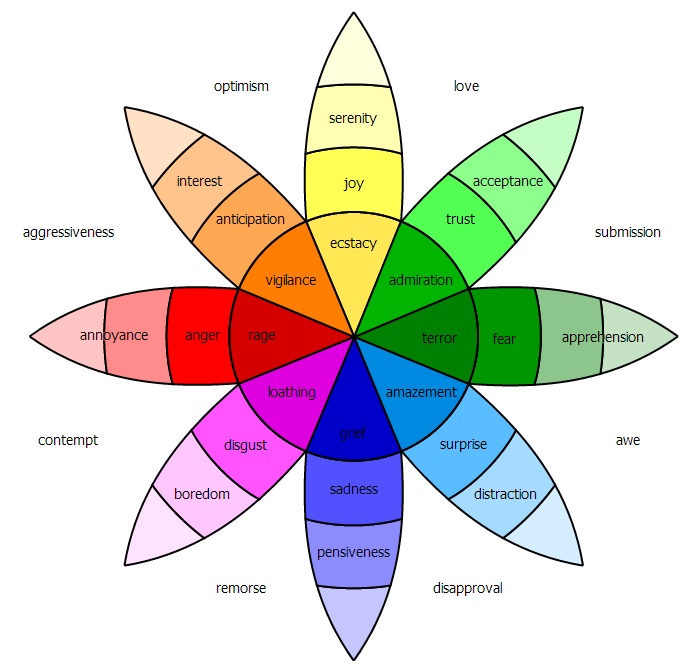
Robert Plutchik's Wheel of Emotions is one of many ways of thinking about the relationships between basic and complex emotions
Robert Plutchik’s Wheel of Emotions is one of many ways of thinking about the relationships between basic and complex emotions

According to the CAM creators, the emotional states presented in the clips are “higher order” emotional concepts:

  • 6 concepts from level 4 (concepts understood by typical 15–16 year olds)
  • 13 concepts from level 5 (understood by typical 17–18 year olds)
  • 1 concept from level 6 (words understood by less than 75% of typical 17–18 year olds)

The purpose of the test is to examine whether autistic people grasp these more complex emotional states. It includes both negative and positive emotions as well as subtle and intense emotional states. Each of the 20 emotions is repeated 5 times.

Taking the Test

The Face-Voice Battery has two parts. Part 1 consists of listening to 50 short clips of actors saying a phrase or sentence. You’re given 4 options for describing the emotional content of the clip. Part 2 consists of watching 50 3-5 second videos of actors silently portraying facial expressions. Again you’re given 4 options that describe the emotional content.

You can take the Cambridge Mindreading (CAM) Face-Voice Battery at aspietests.org. To begin, click on the The Cambridge Mindreading Face-Voice Battery – Part 1 (Voices) link. After entering your age and diagnostic status and accepting the terms, you can proceed to the voice clips. As you take the test, keep in mind that speed counts. In addition to a %-correct score, the test returns an “average time to answer” score. Part 1 took me about 10 minutes to complete.

Once you finish Part 1, click the “back to the homepage” link and then click the Cambridge Mindreading Face-Voice Battery – Part 2 (Faces) link to begin Part 2. Again, speed counts. This part took me about 10 minutes to complete as well.

Scoring the Test

I did well on this test–in fact, I matched the mean score of neurotypical females in the original research study. Here is my score:

You scored 90.0% in 5.7 seconds. Faces: 84.0% (42 correct) Voices: 96.0% (48 correct)

Here are the average scores from the study:

ASD Faces task: 32 correct (64%)
ASD Voice task: 35 correct (70%)
ASD Total: 68 correct (68%)

NT Faces task: 44 correct (88%)
NT Voice task: 43 correct (86%)
NT Total: 86 correct (86%)

I’m not surprised by how well I did on the voices portion of the test. “Voice data” is my primary means of reading social situations. It helped that the informational content of the phrases matched the emotional content of the voices. For example, when I heard “that is horrible” I took into account the information being conveyed by the statement as well as the tone of voice to settle on my choice of “appalled.” This is considered a “strategy” by the test creators, so basically, once again, I’m “cheating.” But it works, so hooray for adaptations.

The video clips were a mixed bag. I think I did better on the ones that had a dissimilar set of possible answers (i.e. appalled, vibrant, blank, or intimate) and the ones that I remembered to glance at the answer choices before the clip played.

As an experiment, for some trials I watched the clip and tried to form an answer before looking at the choices. On one video, I was certain the answer was “sarcastic” but that wasn’t one of the choices; I think the correct answer was “reassured.”

A few other random thoughts:

  • Am I the only one who thought most of the voice clips sounded like they were straight out of Dickens novel?
  • The use of live action videos is more realistic than static photos, but I still didn’t feel like the test results were reflective of my real life ability to read emotions.
  • I liked seeing the contrast in my voice vs. facial expression reading skills.
  • Some of the video clips made me incredibly uncomfortable to the point that I had to glance away.
  • I couldn’t find any data on the “time to answer” scores. From background reading about this type of test, I know that researchers often use the average time to answer as a metric to gauge competency. The assumption is that the longer it takes to answer, the more processing your brain is doing to produce an answer.

The Bottom Line

CAM feels more realistic than Reading the Mind in the Eyes, but it’s still far from an accurate test of the fluid way that emotions present in real life interactions.

Adult ASD: Preparing for Your Evaluation

Part 7 in the I Think I Might Be Autistic Series

As I mentioned previously, there are different ways of getting diagnosed. Depending on what route you choose, your evaluation may involve questionnaires, cognitive tests and/or a diagnostic interview.

My evaluation was done by a neuropsychologist, so I’m going to talk about that here. I hope other autistic individuals who’ve been professionally diagnosed will continue to share their stories in the comments to create a more diverse picture of what diagnosis can look like.

Neuropsychology is a field that looks at behavior in terms of brain function. Autism is a developmental disorder, not a mental illness, so diagnosing ASD is one of the areas that neuropsychologists specialize in. Clinical psychologists and psychiatrists who work with autistic patients will also use many of the same tests and procedures described here.

When I made my initial appointment, I was told that testing would take 4-8 hours and might be split over two or more appointments, depending on how fatiguing I found the tests.

A few days later I received a 17-page questionnaire in the mail. The instructions said to complete it and bring to my evaluation. The questionnaire covered personal and family mental health history, cognitive symptoms (memory, daily function, auditory/visual/balance, etc.), childhood development and an open-ended question about why I was seeking an evaluation.

I used the open-ended question to make my case. I started out with “I suspect I have Asperger’s Syndrome” and then listed my major symptoms as I understood them at the time: social awkwardness, rigidity, attachment to routine, intense interests, difficulty reading facial expressions and body language, clumsiness, etc. I tried to focus on the symptoms that fit the DSM categories first and then listed other less universally recognized symptoms after that.

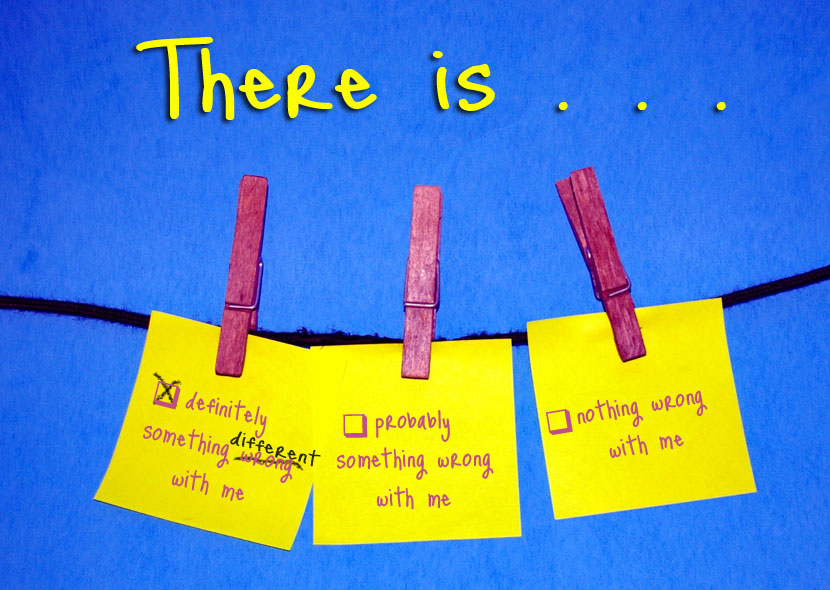
Beneath the open-ended question was a set of check boxes that said:

Overall I think that there is:

  • nothing wrong with me
  • probably something wrong with me
  • definitely something wrong with me

wrongwithme

In true aspie fashion I checked the “definitely” box, crossed out “wrong,” wrote in “different,” then annotated it with a few descriptive sentences. In fact, I annotated a lot of the “ticky box” questions. By the time I was done, my questionnaire was a scribbled-on mess.

Whether you receive a history questionnaire or not, I strongly recommend making notes to bring to your appointment. The time you’ll spend with the doctor conducting your evaluation will be limited; it’s important to bring up everything you think will be helpful in getting an accurate diagnosis.

If you find speaking about your symptoms difficult, prepare a concise (no more than 1 page) written summary to give to the doctor at the start of your appointment. Autism causes communication difficulties. There’s nothing wrong with telling the doctor that you prefer to use a brief written description of your concerns as a starting point.

Most importantly, as you prepare for the appointment, try to relax. I know it feels like there’s a lot riding on the outcome, but all you have to do at the appointment is be yourself. This is one time when being your own hot mess of an autistic self is encouraged.

Preparing for your Evaluation

  • If the doctor’s office sends you a history and/or symptom questionnaire, take it seriously. Fill it out as completely as possible, providing specific examples where you can. Don’t hesitate to add additional information that you feel is relevant.
  • Make notes regarding what you want to talk about as part of your diagnostic interview.
  • If necessary, prepare a written summary of your symptoms/signs/traits for the doctor.
  • If you have questions, write them down and bring them to the appointment so you don’t forget.
  • Try to relax and remember to be yourself.

Up next: Adult ASD Evaluation – The Diagnostic Interview

Autistic People Should . . .

This post is part of today’s “Autistic People Should” flash blog where Autistic bloggers are writing about positive things that Autistic people should do. Why? Because if you type “Autistic people should” into either Google or Bing’s search engine query box, the autocomplete results–the most popular searches starting with those words–are disturbing and upsetting, especially if you’re Autistic or love someone who is.

Trigger Warning:  I’ve posted a screenshot of the text from Google’s autocomplete at the end of this post and as I said above, it may be very upsetting if you are Autistic or care for someone who is.

——

Autistic people should: question everything.

When we’re given an autism spectrum diagnosis, we’ve also given a model of what it means to be autistic.

Question the model.

Start here:

A wordmap of Autism Spectrum Disorder diagnostic criteria
A wordmap of Autism Spectrum Disorder diagnostic criteria.  The larger the word, the more frequently it appears in the diagnostic definition.

What does your word cloud for autism look like?

Question the assumptions.

Is there a right way to play?

To learn?

To think?

To love?

To communicate?

Question the research.

Who says?

How do they know?

Who paid for it?

Now what?

Question the stereotypes.

Nonverbal headbanger?

Idiot savant?

Inspirational angel?

Boy genius?

Lovable eccentric?

Unloveable recluse?

High-functioning aspie?

Dangerous loner?

Question the experts.

How do they know?

Are they sure?

What if they’re wrong?

Question the language.

Disorder, deficit, disability, difference?

Cured, recovered, coping, adapting, passing?

Label, slur, identity?

Person with autism, autistic, Autistic, aspie, autie?

Locked in, trapped, uncommunicative, nonverbal, nonspeaking, unvoiced?

Question the hype.

Epidemic?

Tragedy?

Burden to society?

Really?

Says who?

Question the fundamental fabric of humanity.

What is empathy?

What is love?

What is communication?

Question

every

single

should

must

can’t

won’t

never

always

Question this:

An excerpt from promotional material for a college textbook about Autism.
This textbook author says that Autistic people don’t recognize that other people have minds.

and this:

The lead for an article in a UK newspaper.
This Uk newspaper devoted an entire article to an autism expert who wants us to believe that autism is an “exaggeration of male habits.”

and this:

Excerpted from the "signs of autism" at a popular autism information website.
This popular autism information website wants you to believe that Autistic children play the wrong way because they lack imagination and creativity.

and this:

Autistic people rarely get married or have children? That's what these experts at Yale and  want you to think.
Autistic people don’t get married or have children? That’s what these experts at Yale and UC-San Francisco want you to think.

Question everything.

Question what you read, what you hear, what you see, what you are told.

Question what you think.

Most of all . . .

Question the hate.

If you type "Autistic people should" into a Google search box, these are the results that Google suggests based the most popular recent searches.
If you type “Autistic people should” into a Google search box, these are the results that Google suggests based the most popular recent searches.

My “NO” Reflex

It’s Monday morning and The Scientist is off from work:

Him: Do you want to go to the diner for breakfast?
Me: No.

We never go to the diner on Monday. It’s not part of The Plan.

We’re hiking through a new trail system:

Him: That trail looks interesting. Let’s try it.
Me: I think we should stick to the route I planned.

I don’t even consider whether the other trail might be more interesting. It’s not in The Plan.

We’re driving home from a quick trip to the mall on Sunday afternoon:
Him: Let’s go to the movies!
Me:  . . . .

That’s the sound of my head exploding. The Scientist, you see, is very spontaneous. I am not. He can decide on a whim to go to the movies. He’ll drive to the theater, pick something that looks decent and is playing soonish, and buy a ticket. Then he’ll find a way to kill time until the movie starts. And he might enjoy the movie or be a little bored or end up thinking it sucks, but he’ll have a good time regardless.

I don’t understand this. At all.

A movie is not part of my daily routine. It requires contingency planning. It raises many many questions that have to be answered before A Plan can be put into place. What will I see? When? Where? Can I get there in time? Will I have to wait? Will I be early enough to get The Right Seat? Do I want popcorn? How long will the movie run? Should I eat before? After? Where? How much time will that require?

And my response to all of these questions?

noNO!

Do not want.

Too hard.

Let’s go home and sit quietly and think about maybe going to the movies tomorrow. When we have A Plan.

Yes, that’s much better.

I have a very strong NO reflex.

Do I want to do something that isn’t part of The Plan? NO

Do I want to unexpectedly deviate from the schedule? Serendipitously try something new? Alter, vary or disrupt my routine at the last minute? NO, NO , and NO

I don’t cope well with unexpected anything. With adequate warning, I manage change pretty well. I vary my schedule, go new places, and try new things without excess trepidation. I need enough lead time so I can mentally prepare myself but once I have a contingency plan, all systems are go.

Without enough warning, however, my instinctive response to anything not in The Plan, is NO. Often an emphatic and even angry NO. Yes, unplanned change makes me irrationally angry.

I don’t stop to consider whether the change might be better than what I’ve planned. I don’t weigh the pros and cons. I’m not easily persuaded. In fact, the more you try to persuade me, the more panicked I’ll start to feel.

And the stupidest part of my NO reflex is that the change often is better. Going out for breakfast with my husband on a Monday morning? That’s actually a great idea. The food would be good. We’d have enjoyable relaxing conversation. What’s not to like about it? Why does the fact that it’s Monday preclude me from enjoying something, well, enjoyable?

There is no good logical answer to this. My fictional Plan isn’t an etched-in-stone prescription for a happy life. It’s a coping mechanism. At times it’s helpful and at times it’s an impediment.

I suspect my NO reflex is related to the weak central coherence that’s a part of Asperger’s. Aspies tend to see the details where others see the whole. The Scientist perceives going to the movies as one cohesive thing. He’s a top-down kind of guy who expects the details to fall into place along the way.

Me? I see going to the movies–or any unexpected event–as a massive overwhelming collection of details. Each detail seems to set off a cascade of more details, creating a complex matrix of endless details, into which I’ll be sucked and never return . . .

Okay, so it’s not quite that bad. But it can feel that way at times.

Being Okay

Consciously thinking about my resistance to unexpected change has led to the idea of “being okay” with things.

When someone asks me to do something unexpectedly, I momentarily shush the NO reflex. I let my initial panic at this unexpected request subside, then I try to consider the options objectively.

Breakfast at the diner on a Monday?

okayEvidence in favor: spending time with my husband, good food, a relaxing start to the week, variety can be refreshing

Evidence against: cuts into my planned work time, higher fat/sugar breakfast might affect my mood temporarily, there may be some sensory overload to deal with

As much as I’m tempted to, I don’t allow myself to include “not in The Plan” as evidence against anything. I remind myself that I can “be okay” with doing something different. I don’t have to feel uncomfortable with an out-of-the-ordinary event.

I’ll admit, this doesn’t always work. Often I’m 80% okay and 20% uncomfortable. But that’s better than not going and beating myself up about it, which is also a strong reflex. It’s not like I enjoy raining on everyone’s parade. The other option–the one I used to force myself into–was reluctantly going and being 100% uncomfortable. Given how unhealthy both of my previous responses were, 20% uncomfortable looks pretty good.

I’m not ready for any unplanned trips to the movies, but I’m happy with the day-to-day decisions I make lately that aren’t an automatic NO. Sometimes I say yes and sometimes I say no. Each response is a conscious, mindful decision, not a reflexive reaction.

I used to feel guilty about my constant string of NOs. There were many and they had a negative effect on my life. I didn’t want to be a terminal spoilsport. I didn’t want to be so rigid about everything.

It wasn’t until I started to understand more about Asperger’s that I was able to make sense of my NO reflex. Before, I saw myself as negative and controlling. A lot of other people saw me that way too. Now I know that difficulty with change is an aspie trait and one that I don’t have to be confined by.

I can choose to say yes and I can choose to say no.

It’s not as simple as it sounds, but it’s worth the effort and the more I practice, the more natural it’s becoming.

Taking the Friendship Questionnaire (FQ)

This week I took the Friendship Questionnaire (sometimes called the Friendship Quotient).

The Friendship Questionnaire (FQ) was developed in 2003 as part of Simon Baron-Cohen’s ongoing quest to prove his “extreme male brain” theory of Asperger’s. Consequently, the FQ measures a very specific model of friendship to prove a point about people on the spectrum.

The developers of the FQ say that an individual will score highly on it if they:

  • enjoy close, empathic supportive friendships
  • like and are interested in people
  • enjoy interaction with others for its own sake
  • find friendships important (Baron-Cohen and Wheelwright, 2003)

The questions are based on assumed gender differences in forming friendships. The FQ developers hypothesized that NT women would score highest, with men scoring slightly lower than NT women, and ASD individuals of both genders scoring significantly lower than NT men.

The average FQ scores from the 2003 study were:

  • NT females: 90.0
  • NT males: 70.3
  • ASD females: 59.8
  • ASD males: 53.2

The fundamental basis for the gender-difference hypothesis seems to be that men and people on the spectrum prefer activity-based friendships. Neurotypical women, on the other hand, are assumed to prefer interaction-based friendships, where the act of connecting is of primary importance.

Since every friendship I’ve had as an adult has grown out of a common interest, it’s safe to say I fall into the activity-based preference. Honestly, I have no real idea how friendship works in most cases, so let’s take the test.

Taking the Test

You can take the FQ at the Aspie Tests website. Click the link for the Friendship Quotient and then complete the first three questions (you don’t need to create an account unless you want to) and click the submit button to start the quiz.

There are 34 multiple choice questions.

I found some of these questions hard to answer because there was no “neither” option. For example, on #6 I literally don’t have a wide enough social circle that it requires me to choose between asking someone to meet first or thinking of an activity then choosing a person to do it with. #9: I have no idea. Neither? Why is there no neither option?!

For some questions, I ended up choosing answers based on how I’ve interacted with friends in the past because I couldn’t come up with a current example to base my answer on.

Scoring the Test

After submitting your answers, you’ll get your FQ score. The possible scoring range is 0 to 135. I got 39.

Average scores by gender for the FQ (aspietests.org)
Average scores by gender and neurotype for the FQ (aspietests.org)
FQ score distribution by neurotype
FQ score distribution by neurotype (aspietests.org)

I’m not sure what to make of my 39. I’m not surprised by it. Going down the list of qualities that the FQ tests for:

  • I enjoy close, supportive friendships, but I don’t need more than a couple at a time to feel that I have supportive connections in my life.
  • I don’t really like or have an interest in people as a general rule (sorry, human race).
  • I don’t generally enjoy interaction with others for its own sake, which is different from not enjoying interaction with others at all.
  • I find friendship moderately important, but again I don’t need many friends to feel like I have a satisfactory level of social interaction in my life.

The Bottom Line

The research I read on the FQ doesn’t imply that a low FQ score is “bad”, which is good to see, because I think the FQ is testing for a very specific model of friendship. The research does say that those with low FQ scores tend to have high AQ and low EQ scores.

Adult ASD: Seeking a Professional Diagnosis

Part 6 in the I Think I Might Be Autistic Series

—–

There are a number of reasons that an adult might want to seek out a diagnosis by a professional:

  1. To become eligible for services
  2. To obtain supports or accommodations at work or school
  3. To increase the likelihood that therapy or counseling takes aspie/ASD traits into account
  4. For peace of mind and/or validation of a self-diagnosis

Primarily, I fell into the last category. I needed to know that it wasn’t “all in my head” and getting a diagnosis by a professional seemed like the most conclusive way to do that. However, if I ever go to graduate school (or–gasp–get a job), I like the idea of having an official diagnosis to back up any requests for supports that I might choose to make.

So, how do you go about getting evaluated for Asperger’s or autism as an adult? First, be prepared to face some significant challenges:

  • You’ll need to find a psychologist, psychiatrist or neuropsychologist who does adult ASD evaluations. Depending on where you live, this task ranges from difficult to nearly impossible.
  • You’ll probably have to pay for the evaluation yourself. Most insurance companies in the US don’t cover adult ASD evaluation. Be forewarned, a full evaluation can cost anywhere from $1500 to $3000. I’ll talk about other, potentially less costly options below.
  • The process of getting diagnosed may take months or years and you may encounter misdiagnoses and misinformation along the way.

With all of the discouraging stuff out of the way, let’s look at some of the options for getting diagnosed:

Finding a Provider

A good place to start if you’re in the US is the Pathfinders for Autism Providers Directory. Plug in your zip code, how far you’re willing to travel (further will give you more options–I chose 50 miles when I did my search) and select the “Getting Diagnosed” option in the Categories list on the right.

You’ll be given a (hopefully) long list of results to comb through, including psychologists, psychiatrists, neuropsychologists and licensed clinical social workers. I know of people who have been diagnosed with ASD by all of these types of professionals except the last. Read the provider descriptions, visit their websites and/or call providers to narrow down your results to those who do adult evaluations.

Some other options for finding providers who do adult evaluations:

  • Word of mouth: If you can locate autistic individuals or parents of autistic children in your area, ask them for referrals.
  • State, provincial or local autism group: Google “[your state/county/province/major city] autism services” and look for .org website addresses in the results. You should find at least one local nonprofit or community autism services organization in your area. Call and request a referral for an adult evaluation. If you find more than one, call all of them. Different organizations have different missions and their resource lists vary. You can also find a good but not exhaustive list of state-by-state resources on the GRASP website.
  • Local university: Call the medical school or teaching hospital for a large public university in your area and speak with someone in the neurology department. You may get transferred around a lot and have to explain your question repeatedly but this can be a way to find an adult specialist if you’re coming up empty in other places.

The Role of Your Primary Care Physician

Surprisingly, one source that probably won’t be helpful is your primary care physician. I explained my concerns to my doctor and his reply was to offer to write me a prescription for a beta blocker for anxiety. When I turned that down, he suggested counseling.

What he didn’t suggest was that I get evaluated for ASD. His approach was focused on treating the symptoms; he seemed to think the source of the symptoms was irrelevant. That’s not to say he’s a bad doctor. He probably wasn’t trained to handle this type of question. Autism is still seen by many as a childhood disease.

If you live outside the United States or if your insurance covers ASD evaluation, a referral from a primary care doctor might be required to qualify for insurance coverage (or rebates or whatever form subsidized health care takes in your country). In this situation, you may need to approach your doctor armed with information about adult autism/Asperger’s.

This is where your discovery process and perhaps self-diagnosis will come in handy. While there is increasing awareness of the existence of undiagnosed adults, many primary care doctors aren’t well-informed about the subject. You may find that you’re more knowledgeable than your doctor. Don’t be afraid to advocate hard for a referral.

Lower Cost Alternatives to a Private Provider

If the cost of a full evaluation is prohibitive, there are other options to consider:

  1. Ask your community autism services organization if they have a staff or consulting psychologist who can do an evaluation. Depending on your financial situation, they may offer this service at reduced cost or as part of their services to the community.
  2. Some universities with teaching hospitals or clinical centers offer ASD evaluation conducted by supervised graduate students on an ability-to-pay basis.
  3. You may be able to obtain a diagnosis as part of ongoing therapy with a psychologist or psychiatrist. Sometimes a therapist will raise the possibility of ASD or be willing to commit to a diagnosis on the basis of information you share during therapy sessions.

(If you obtained your diagnosis in a way that I haven’t mentioned, please let me know in the comments and I’ll update this section with additional options. I apologize for the lack of information about getting diagnosed outside the US. Hopefully commenters can help out there as well.)

Making the Appointment

After doing extensive research, including everything listed above plus some fruitless things not included here, I came up with exactly two possibilities within a 50-mile radius of my major metropolitan city.

Armed with my very short list, I called the first provider on it–a psychiatrist whose name I’d obtained from a major university. This didn’t go as well as I’d hoped. The doctor was extremely condescending and basically said, “Adult evaluation is really expensive and I doubt you can afford it and why do you want it anyway?”

I gave a brief stuttering answer, hung up the phone shaking, and spent two weeks working up the courage to call the second and only other name on the list.

The second option was a private neuropsychology practice specializing in cognitive testing for children and adults. To my great relief, the person who answered the phone didn’t find it strange that I was calling to schedule an evaluation for myself without any sort of referral. She didn’t treat me like an idiot or become impatient with my questions.

I gathered the information about the testing process and said I’d call back after thinking about it. The evaluation was going to be a big investment and taking that final step was intimidating. Bizarrely, my biggest fear was that the tests would prove I didn’t have Asperger’s or that the psychologist would think I wasn’t autistic enough to merit a diagnosis. Then I’d be back to having no explanation for all these atypical things about me.

After a couple of days of thinking it over, I decided that I definitely wanted to go forward. My husband was supportive of my decision and offered to come with me to the appointment if I wanted him to. I didn’t take him up on the offer, but it felt good to know that he was 100% behind me.

Going At Your Own Pace

Whatever path you take to finding someone who can evaluate you, know that it won’t likely be a direct route. It’s perfectly okay to feel like the biggest first step you can manage is to bring up a list of results on the Pathfinders website. Maybe your next step is reading about the providers and a few days later you might gather the energy to start making a list of providers to call. It may take weeks or months to start making those calls and yet more months to commit to meeting with a professional or scheduling an evaluation.

Take your time. Ask for support from a trusted person in your life if you feel comfortable doing so. Getting diagnosed can be an uphill climb. Pace yourself.

Finding a Professional who Works with Adults

  • Be prepared to do a lot of research.
  • Look for psychologists, psychiatrists or neuropsychologists who are experienced in diagnosing adults with ASD.
  • If you have to get a referral from a primary care doctor, be prepared to advocate for yourself.
  • If the cost of diagnosis is prohibitive, look for alternatives to private providers.
  • Be patient and go forward at your own pace.

Next in the series: Preparing for your ASD Evaluation