All posts by musingsofanaspie

Scenes from an Autistic Childhood

Through the magic of old home movies (actually DVD transfers of grainy super 8 footage), I’ve been able to study bits of my childhood, looking for typical early childhood signs of autism.

Hindsight is not only 20/20 it’s very entertaining. I decided to liveblog scenes from my autistic childhood, so you can share in the fun.

Let’s go back in time . . .

DVD #1: The Early Years

Through most of the first disc I look like an average baby and toddler. Maybe a little hard to engage at times. I’m often staring intently at something off camera. I’m interested in objects as much as people. Give me a baby doll and I’ll probably hug her. Or wield her like a club. It’s a toss up.

I’m not the most expressive baby. I more often look panicked or confused or grumpy than happy. Hmmm, when I do look happy it tends to be the shrieking, hand flapping sort of happiness.

Then this happens:
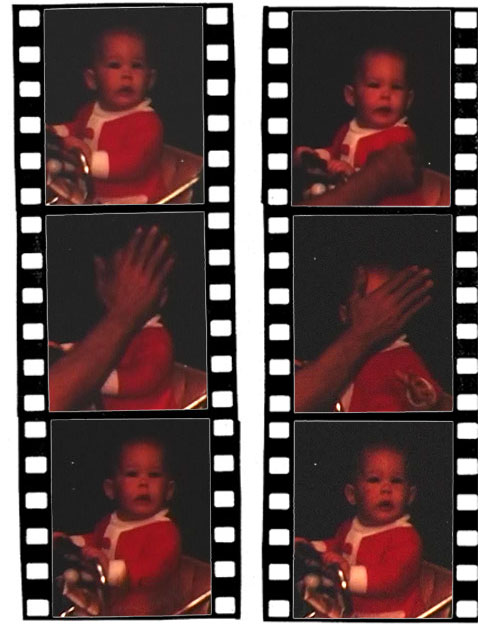
filmstrip1
My dad is on the floor in front of me, just outside the cropped frames. At first he’s making noises and I’m laughing. After a few seconds of that, I look up toward the camera, suddenly oblivious to him. Frustrated, my dad puts his hand between me and the camera. Note the unchanged expression on my face before and after. He shakes my shoulder, tickles me, calls me, tries the hand thing a couple more times. Nothing seems to get through to me. I’m still staring at whatever’s caught my attention when the frame goes dark.

Doesn’t respond to his or her name or to the sound of a familiar voice.

Soon I see more clues:

51:55 – I’d rather sit and bounce on my ball than throw or kick it.

53:01 – The first of many shots of me happily swinging on my backyard swing set.

filmstrip2
54.35 – I’m intensely interested in hammering nails into a piece of scrap wood. With a real hammer! There’s an entire reel of hammering. Perseveration R Us.

58:38 – A little hand flapping for the goats at the petting zoo.

1:04:14 –  Here I am getting a haircut. I loved going to the hairdresser because it meant I got to play with the rollers and hair clips. And by play with, I mean sort by size and color.

Doesn’t play “pretend” games, engage in group games, imitate others, or use toys in creative ways.

DVD #2: Vacation!

Being away from home causes me to stim nearly nonstop. In the first twenty minutes, I’m 3 to 4 years old and still an only child. I wonder if being the first child–with no siblings to compare my behavior to–makes my autistic traits less obvious to my parents.

3:40 – Here I am rocking back and forth in my stroller at Santa’s Land.

5:21 – My parents prompt me to wave to the camera. Again. I rarely wave unless they tell me to.

Uses few or no gestures (e.g., does not wave goodbye)

8:12 – An entire reel of me sitting beside my inflatable pool, washing the grass off my feet. I’m still doing it when the camera shuts off. I seriously did not like having grass stuck to my feet. Or grass in my pool.

9:40 – Happily swinging on a porch swing.

9:52 – Really happily swinging on a chain link fence. Okay, more like happily full body slamming the chain link fence.

Flaps their hands, rocks their body, or spins in circles

10:39 – Staring intently at an animatronic display. So intently that I have my face pressed flat up against the glass.

11:40 – Swinging on a glider. A disproportionate amount of these movies are of me swinging on things.
filmstrip4
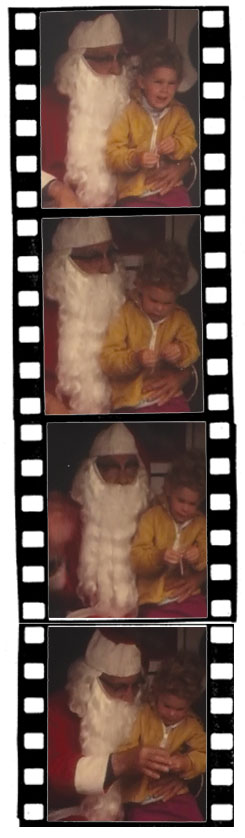
11:55 – Stimming with Santa! Here’s how my 4-year-old visit with Santa goes: I get on his lap. I sit facing away from him and never once look at him. I fiddle with the candy cane wrapper in my hand, examining it like it’s the most interesting thing I’ve ever seen. Santa says something to me. I pretend he doesn’t exist. I fidget with the wrapper some more. Santa says something and waves at the camera. I enter a state of serene bliss in which nothing exists but the wrapper. Santa waves some more. Santa tries to take away my candy cane wrapper. The screen abruptly goes dark.

Exhibits poor eye contact

12:42 – More rocking, this time while posing in front of a statue of a giant pig.

12:56 –  More intense staring at animatronic gnomes.They’re rocking gnomes. I love them. In fact, I love them so much, I’m rocking in time with them.

13:20 – More staring. This time at dwarves.

14:18 – Here I am rubbing Humpty-Dumpty’s egg-shaped body. Over and over again, my parents pose me on or next to something and I immediately start rubbing my thumb or palm over the closest surface.

Engages in repetitive gestures or behaviors like touching objects

15:49 – Swinging from the rope of the school bell in an old fashioned schoolhouse.

16:32 – Bouncing up and down with the White Mountains in the background.

You get the idea. Ten more minutes of vacation footage and I’m constantly in motion. Bouncing, rocking, fidgeting with my windbreaker zipper, kicking my feet, flexing my knees, jiggling my feet, rubbing surfaces, hand flapping.

Moves constantly

I’m thinking it’s time to shut the DVD off, assuming I’ve made my point, when I see my sister do something I haven’t done once in more than 90 minutes of video: she points. She’s about a year old, and she’s pointing at the petting zoo animals. That’s when it hits me. I have one of the classic early childhood autism symptoms–a failure to point at objects.

Doesn’t point, wave goodbye or use other gestures to communicate

Soon we’re at Disney World with a family friend. She and my sister point again and again at things they’re excited about. I don’t point at anything. Not once.

30:06 – I’m about six here and I’ve learned to wave at the camera without being reminded. I’m riding on a carousel and wave at the camera every single time I go by. Yep, I’ve got the waving thing down good.

35:36  – We’re at Gettysburg. I’m around seven years old. My mother and sister are posing by a canon, waving at the camera, chatting away. I’m climbing on the canon, rubbing the canon, pretending to ride on the canon, paying no attention to them or the camera.

Appears disinterested or unaware of other people or what’s going on around them

It’s interesting to see footage of my sister and I at similar ages. I see how much more likely she was to engage with the camera, to wave spontaneously, to be smiling or talking or paying attention to the people around her.

I also see that I took a lot of cues from her. She’s four years younger, but at times–like when we’re interacting with characters at Disney World–I’m obviously watching her and following her lead.

And now that I’m no longer the sole focus of the camera’s attention, I’m a lot more likely to just wander out of the frame.

DVD #3: A Slew of Holidays with a Dash of Empathy on the Side

12:10 – Back in time again, to my 2nd birthday party. It’s a huge one. Every cousin, aunt, uncle and grandparent wedged into our basement rec room. I’m looking a little overwhelmed, circling a pole in the background as my cousins mug for the camera. When it’s time to blow out the candles I bravely poke a finger into the icing, lick it off my finger and immediately grab a napkin to clean my hand. Some things never change.

17:51 – Halloween. I’m six years old and for the first time I see evidence of my inability to tell if anyone is paying attention when I’m talking. As I scoop the seeds out of my pumpkin I’m rambling on about something to my sister who is too young to understand and my mother who is bustling around the kitchen, not even in the frame half the time. I’m blissfully undeterred.

Tends to carry on monologues on a favorite subject

20:12 – A bunch of Halloweens flash by. I’m Raggedy Ann. I’m a nurse. I’m a cat. Every costume has a stiff plastic mask which I pull off repeatedly. After yanking off the cat mask, I tug at my hair with both hands. Even today, my single most vivid memory of Halloween is the warm wet sensation of plastic against my face as my breath condensed on the inside of those masks.

29:50 – It’s snowed! My eighteen-month-old self is skeptical. I touch the snow with one mitten. Look at my hand. Immediately begin flapping. Cut to a shot of me a few months later, enjoying a fine spring day by toe-walking up the driveway. Yet another thing I’d say I never did if I hadn’t seen it here.
filmstrip9
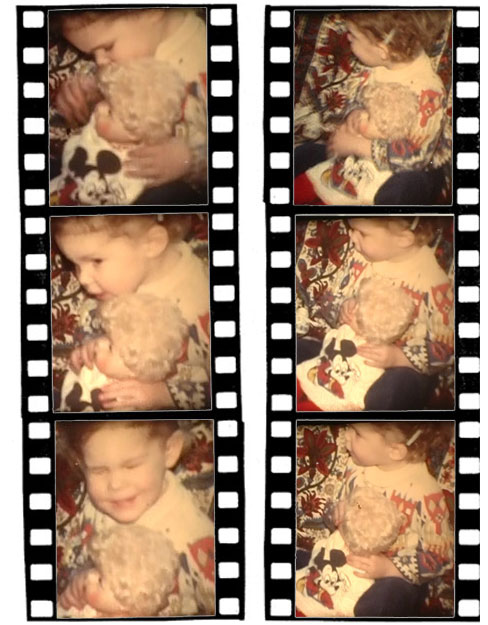
32:50 – I’m sitting on the couch with a doll. My parents have mounted a light on the camera to improve their movies. I peek toward the camera, grimace in shock (or pain?) and close my eyes. I not only don’t look at the camera again, I turn my doll’s head away too. Empathy! Does it still count if it’s for an inanimate object?

May be unusually sensitive to light, sound and/or touch

40:19 – My sister and I are playing with my dolls in my room. By playing I mean I’m lining them up against the wall by height while preventing her from touching them. She enjoys this about as much as you’d expect a toddler to.

Obsessively lines up or arranges things in a certain order.

Looking back at these old films through the lens of autism is really enlightening. I had telltale signs of Asperger’s syndrome at a time when AS didn’t exist. I don’t remember much of what I’ve related here, but I do remember being a generally happy kid in my preschool years. Because I didn’t attend nursery school or daycare, I guess spent my first five years in a bit of a bubble, happily stimming my way through Santa’s Land.
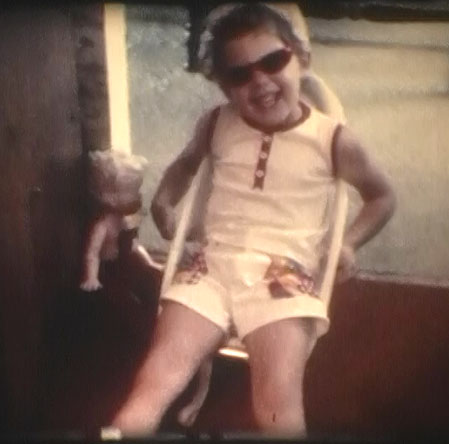
Was I a happy kid or what?

Signs of Autism in Early Childhood

While I’ve highlighted many of the early signs of autism in my observations of my younger self, each child is different. You can find comprehensive lists of early signs and symptoms at  Mayo Clinic: Autism Symptoms and/or the CDC’s ASD Signs and Symptoms.

Two-Factor Imagination Scale (TFIS) Test

This week I took the Two-Factor Imagination Scale (TFIS) test. It was developed to identify the predominant imagination style used by alexithymic and non-alexithymic individuals. I have a couple of questions at the end of this write-up for those who take both TFIS and the Alexithymia Questionnaire.

Imagination–or the alleged lack of imagination in both autistic and alexithymic individuals–seems to be a hot topic around here lately.

Impoverished imagination is often included in the list of traits for alexithymia. Restricted imagination isn’t explicitly included as a diagnostic item for Asperger’s or autism, but it is part of the common ASD stereotype.

People see autistic kids lining up Hot Wheels or sorting Legos by color and assume there isn’t a whole lot going on in the imagination department. As someone who spent a lot of time in organizational-type play as a kid, I can assure you that I had a vivid imagination.

The thing is, it mostly took place inside my head. All that time I spent wandering around aimlessly in the yard or staring off into space? I was often playing with my imaginary friend Will, pretending to be somewhere else entirely. Will and I spent a lot of time on other planets because he was modeled on Will Robinson from “Lost in Space.”

I didn’t need toys to act out my imaginary scenarios. The possibilities that existed in my mind were more interesting than the pretend food my friends wanted to pretend cook or the pretend store they liked pretend shopping at. Sometimes I joined in, but often it just seemed like a less interesting version of real life. I get bored really easily. Picking some berries and pretending to cook and eat them didn’t hold my attention for long.

Spontaneous vs. Controlled Imagination

The Two-Factor Imagination Scale questions are supposed to gauge whether you have a more spontaneous or more controlled imagination process.

  • Spontaneous imagination is defined as effortless, surprising and instantaneous. For example, you’re washing the dishes and suddenly have a great new idea for a drawing. It feels like your idea literally “came out of nowhere.”
  • Controlled imagination is defined as a process that is consciously initiated, guided and terminated. For example, you’re washing the dishes and consciously decide to think about how to resolve a conflict with your roommate. You intentionally stay on task, brainstorming ideas and refining until you have an answer, at which time you stop thinking about it.

That’s not to say that spontaneous imagination is always creative while controlled imagination is always practical. You could suddenly have the perfect solution to your roommate crisis appear out of nowhere. You could also intentionally brainstorm and plan a new drawing.

The theory behind the TFIS is that people with high alexithymic traits are controlled imagination-dominant. The speculation about imagination in autistics is similar–that our imaginations are less flexible or less productive when it comes to generating novel ideas.

While the TFIS isn’t a measure of how imaginative an individual is, it may shed some light on how we use our imaginations. Keep in mind that neither type of imagination is superior–they simply represent different thinking styles.

Taking the Test

You can take the test at Aspie Tests. Once you click the “click here to start” link, you’re taken to a page that asks for age, gender, and diagnostic status. You also have to tick the box agreeing to the terms, but you don’t have to fill in the user name info.

TFIS consists of 22 statements, which you  rate as “more often true” or “less often true”.

I had a lot of trouble choosing an option for many of the statements because I regularly have both controlled and spontaneous imagination experiences. I found myself answering questions in ways that directly contradicted each other, which got frustrating.

Once you’re satisfied with your answers (or can’t stand to look at the questions any longer) click the “Get Results” button to get your score.

Scoring the Test

There are three possible outcomes:

  • equal to or less than 45 = low spontaneous imagination
  • 46 to 59 = proportionate spontaneous/controlled imagination
  • equal to or greater than 60 = high spontaneous imagination

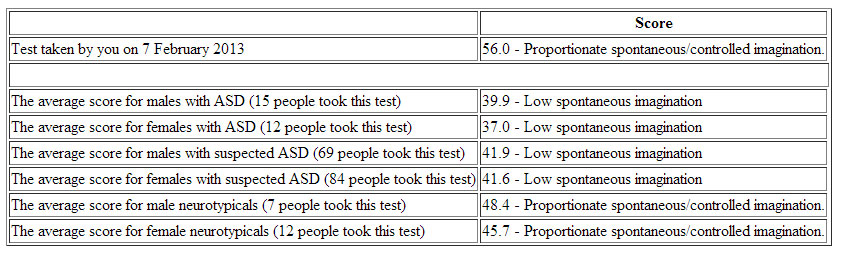
I scored 56.0 (proportionate spontaneous/controlled imagination), which isn’t surprising given how contradictory my answers felt. I think I use both types of imagination in tandem. Spontaneous ideas provide the start of a creative project or enrich the details. Controlled imagination fills in the gaps.

The Aspie Test site provides some interesting data on the scoring page. If you look only at the averages, it looks like people with ASD or suspected ASD have low spontaneous imagination and NTs have proportionate spontaneous/controlled imagination.

Average scores broken down by gender and neurotype

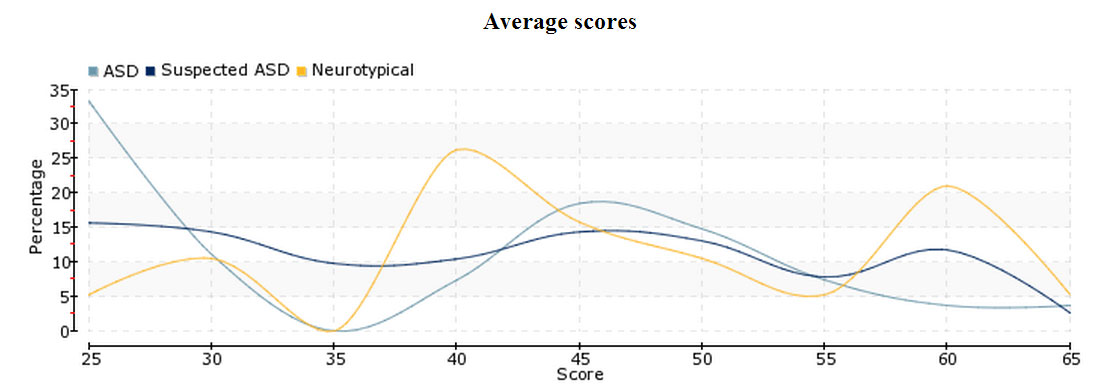
However, if you look at the graph, the data distribution isn’t “normal” which means the average scores don’t represent the majority of the people in each group. Look at where the yellow line peaks: the largest grouping of NT scores is at 40 (low spontaneous imagination) and the second largest is at 60 (high spontaneous imagination) making the average score of “proportionate” completely meaningless because the majority of NTs scored either low or high, not proportionate.

Distribution of scores by neurotype

The same holds for the ASD scores. There’s a peak at 45 (proportionate) and a larger peak at 25 (low). The suspected ASD scores are literally all over the map, with no clear peak.

The Bottom Line

I’m struggling to draw any conclusions from this test, so I have questions for those who took it and would like to share:

  • How hard was it to choose answers that felt accurate?
  • Was your score surprising or what you expected?
  • Did you TFIS score “agree” with your alexithymia quiz score? (high alexithymic = low spontaneous imagination)

A Little Perspective on Perspective Taking

Over and over again I’ve read that people on the spectrum struggle with perspective taking. I’ve even written that my own perspective taking skills suck.

I’m about to take that back.

This morning I was reading an article about teaching Autistic children. It emphasized that teachers are more effective if they take the perspective of the children they teach.

My first thought was can an allistic (non-autistic) teacher truly take the perspective of an Autistic child? They can try. They can educate themselves about autism and autistic traits. They can observe Autistic people and create situation-based rules. They can make assumptions about what an Autistic child is thinking or why they are behaving in a certain way. They can ask Autistic individuals for input and apply that input to their interactions with their Autistic students.

But they can never, ever truly take the perspective an Autistic child. Why? Because they aren’t Autistic. They can’t know what it feels like to be Autistic.

Do you see where I’m going with this?

When you think about it that way, Autistic people aren’t any more impaired than allistic people in perspective taking. We can take the perspective of other Autistic people quite easily.

It’s taking the perspective of the other 99% of the population that’s challenging. Why? Because allistic thinking doesn’t come naturally to us, no more than Autistic thinking comes naturally to an allistic person.

Experts say that Autistic people don’t realize that others have thoughts that are different from their own. If we’re talking about Autistic adults, this is just silly. Of course we know that other people have thoughts that are different from our own. We don’t always have a good idea what those thoughts (or feelings or motivations) are; for better or worse, we make assumptions based on our own thoughts, feelings and experience.

Allistic people do the exact same thing. Luckily for them, the majority of people around them are also allistic. By default, the odds are quite high that they’ll make a correct assumption about another person’s perspective based on their own perspective. And when a non-autistic person makes an error in perspective taking, we don’t say they’re impaired, we call it a misunderstanding.

If an allistic person tries to take the perspective of an Autistic person based on their own thoughts, motivations and experience, the results can be wildly off the mark. A good example is when teachers and caregivers treat meltdowns as an intentional behavior designed to elicit a specific response. Equating a meltdown with a typical temper tantrum is a massive failure in perspective taking. So much so, that from an Autistic perspective it would be funny if it wasn’t so sad and harmful.

If 99% of the population were Autistic, it would be easy to label the allistic minority “impaired” when they failed to instinctively grasp why their family members all regularly had meltdowns or why everyone on the bus except them was stimming or why their new landlord communicated by typing instead of speaking.

Does that sound like a scary world to live in? I suspect for some it might. It’s hard being surrounded by people whose behavior you don’t understand.

Welcome to the Autistic experience.

We are not born instinctively understanding the allistic world, any more than allistic people are born instinctively understanding the Autistic experience.

Adult ASD: Self-diagnosis or Professional Diagnosis?

Part 5 in the I Think I Might Be Autistic Series

Whether you choose to seek a diagnosis or not is a personal decision. As an adult, there’s a good chance you don’t need a diagnosis. You’ve done your research, come to the conclusion that you’re on the spectrum and that’s good enough for you.

This is commonly known as self-diagnosis and when done correctly, it’s largely a well-respected approach in the ASD community. The primary reason? Getting an official diagnosis as an adult is difficult:

  • Asperger’s Syndrome and autism present differently in adults than in children. Finding someone trained and experienced in adult diagnosis can be challenging.
  • Many adults face numerous misdiagnoses before getting correctly diagnosed with Asperger’s or autism.
  • Women in particular are often misdiagnosed because they present differently than male aspies on whom the traditional model is based.
  • Diagnosis can be expensive and an adult evaluation isn’t covered by most health insurance.
  • Diagnosis can lead to bias, stigma and/or create practical limitations, like not being able to join the military or having your parental rights questioned.

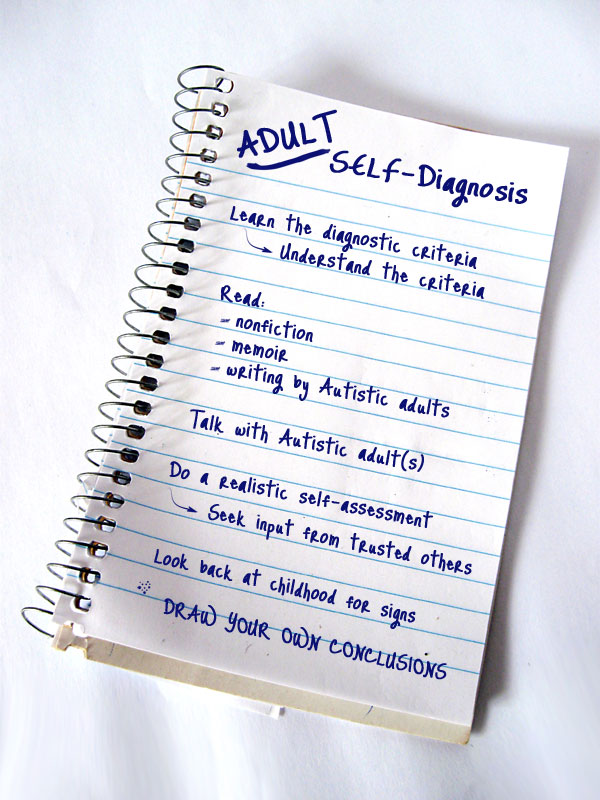
So how does self-diagnosis work? First, be prepared to do some work. Self-diagnosis isn’t as simple as taking the AQ and deciding you’re an aspie. Screening questionnaires can be a good place to start, but they’re just that: a first step.

(click on the graphic for a larger version)

Here are some additional steps you can take to verify, challenge or test out your belief/suspicion that you’re on the spectrum:

  • Look at the DSM and/or ICD criteria for ASD (DSM-IV-TR criteria for Asperger’s and ASD, DSM-V criteria for ASD,ICD-10 criteria for Asperger’s and ASD).
  • Be sure you understand what each of the criteria means. ASD criteria manifest differently in adults than in children, so look for examples of adult traits when considering whether the diagnostic criteria applies to you. It may also be helpful to think back to your childhood and try to determine whether you met the early signs of autism.
  • Read books on the subject, both nonfiction (like The Complete Guide to Asperger’s Syndrome) and personal narratives (like Pretending to Be Normal or The Journal of Best Practices).
  • Read about the experiences of Autistic adults (scroll to the bottom of the linked post for a list of Autistic bloggers). If possible, talk with one or more Autistic adults. Comparing experiences with diagnosed adults can be validating. Also, there are many Autistic adults online (Tumblr, Twitter, Facebook, bloggers) who are happy to answer questions about specific aspects of autism and being autistic. Just keep in mind that Autistic adults are people too and we have a broad range of opinions as well as differing comfort levels when it comes to sharing our personal experiences.
  • Make a realistic assessment of your AS/autistic traits based on your reading.
  • Talk with one or more trusted persons in your life about your self-assessment. Do they see the same traits that you’re perceiving? Share a list of ASD traits (female ASD traits) with them. Do they see traits that you haven’t considered?
  • If you have access to childhood materials like report cards, school work, a baby book or old home movies/videos, review them in light of the childhood symptoms of AS/autism.
  • If possible (and if you feel comfortable) ask your parents about your childhood. If you don’t want to frame your questions in terms of autistic symptoms, you could simply ask things like “Did my teachers say I [did X or behaved like Y]?” or “Do you remember me doing [X, Y or Z] when I was a toddler?”

As you do your research, keep in mind that not everyone has every symptom. Symptoms can change in severity and presentation over a lifetime, becoming either more or less noticeable with age. In fact, it’s not unusual to find that as you age, one trait (like sensory sensitivities) becomes more manageable while another (like executive dysfunction) increases in severity.

By the time you’ve completed your research, you should have a good idea of whether Asperger’s syndrome or autism is a good fit for you. Many adults are content with this and choose to self-identify as aspie or autistic based on their self-discovery process. Others feel the need (or have a specific reason) to seek out a professional diagnosis, which can be a long and difficult journey.

Even if you choose to pursue a professional diagnosis, you may want to work through the self-discovery process first. Often, getting diagnosed as an adult requires making a solid case for why you think an autism diagnosis fits you.

Weighing Self- vs. Professional Diagnosis

  • Obtaining a diagnosis as an adult can be very difficult.
  • Not everyone needs or wants a professional diagnosis.
  • Self-diagnosis is widely accepted in the autism community when done with diligence.
  • Self-discovery is a good first step toward professional diagnosis if you choose to pursue it.

Next in the series: Seeking a professional diagnosis

Alone

From childhood’s hour I have not been

As others were;

“Alone” ~ Edgar Allen Poe

I’ve spent a good portion of my life alone.

I don’t mean alone in the sense of being unattached; I’ve been married for more years than I’ve been single. By alone, I mean in a solitary state. I’m tempted to say not in the company of other people, but I can be alone in a crowded room as well as in an empty room.

If you’re not an aspie, this might make you feel sad for me.

Don’t. I enjoy being alone. I know this can be hard to understand. The Scientist often tells me that I should go out more, that it’s not good for me to be home alone all day. One of the enduring themes of my childhood was that I needed to make more friends. It showed up on report cards and in parent-teacher conferences. At one point my parents discouraged me from visiting my best friend, in the hopes that it would force me to make other friends.

Mostly it all made me angry. I didn’t see the point of interacting with a lot of people. Having a couple of friends left me plenty of time to do the things I liked to do alone: riding my bike up to the reservoir, walking in the woods, listening to music, reading, organizing my collections, shooting baskets, rollerskating, throwing a tennis ball against the wall, playing board games.  Continue reading Alone

Taking the Alexithymia Questionnaire

This week for Take-a-Test Tuesday we’re taking the online alexithymia questionnaire.

Alexithymia refers to people who have difficulty identifying and describing emotions as well as differentiating between physical and emotional sensations. It’s not a formal diagnosis, but a way of describing a common set of experiences related to emotional dysfunction.

Some descriptions of alexithymia also include impoverished imagination and a tendency toward externally oriented (concrete) thinking. I found it interesting that both studies I cite below omitted these last two characteristics. Many of you who commented on the emotional dysfunction post last week questioned the inclusion of impoverished imagination, saying that you personally felt the opposite was true. I have to agree with this. My imagination is, if anything, overactive. Perhaps there is an autistic subtype of alexithymia?

Alexithymia is extremely common in autistic individuals. About 50% of people diagnosed with ASD have severe alexithymia, however nearly all people on the spectrum experience it to some degree. Among the general population, about 10% fit the alexithymia profile and parents of autistic children are more likely to be alexithymic than parents of nonautistic children.

When it comes to social communication, the line between autistic traits and alexithymic traits is blurry. Two recent studies (Bird et al, 2010 and Silani et al, 2008) suggest that alexithymia, not ASD, is responsible for impaired affective empathy.

The 2008 study looked at brain activity in autistic and nonautistic people with and without alexithymia. It found a correlation between a person’s level of alexithymia, brain activity in one of the regions believed to be responsible for identifying one’s own emotions, and scores on an empathy questionnaire. This was true of both the autistic and nonautistic participants, suggesting that impaired processing of emotion, not autism, is the source of impaired affective empathy.

The brain uses the same neural pathways for perceiving and interpreting our own  emotions as well as the emotions of others, so it makes sense that if we cannot process our emotions easily, we’ll also struggle to process emotions demonstrated by others..

One question that remains unanswered is why autism and alexithymia occur together so frequently.

Many commenters on last week’s post recognized themselves in my description of my own emotional dysfunction, so I thought it would be interesting to take the Online Alexithymia Questionnaire. While not a clinically recognized measure of alexithymia, it is based on commonly used clinical screening questionnaires.

Pros and Cons of the Online Alexithymia Questionnaire

Pros

  • Self-scoring
  • Provides subscale scores with cutoffs
  • Overall score is presented on a simple visual “severity” scale
  • Includes questions phrased as self-observation (I feel . . .) and other observation (People tell me . . .)

Cons

  • Not clinically tested or validated
  • Unclear how cutoffs were derived
  • Includes questions on topics that are not a part of generally accepted alexithymia definition

Taking the Test

The alexithymia questionnaires used in clinical research (TAS-20, BVAQ) aren’t available online, so I took the Online Alexithymia Questionnaire (OAQ-G2).

Take the test here. There are 37 questions. You have to answer at least 20 to get a result, meaning you can skip any you find overly invasive. The answers for each question become “grayed out” once you make a selection but you can go back and change your answer if you want to.

Scoring the Test

When you’re satisfied with your answers, click the “Evaluate Test” button and you’ll be given an overall score as well as 7 subscale scores. Here are mine:

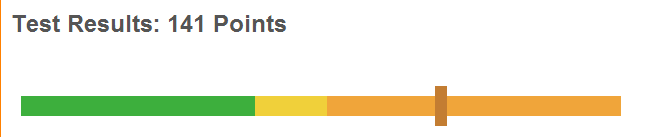
Test Results: 141 Points.
Alexithymia: You show high alexithymic traits.

The yellow area indicates "some alexithymic traits" and the orange area indicates "high alexithymic traits"
The yellow area indicates “some alexithymic traits” and the orange area indicates “high alexithymic traits”

Difficulty Identifying Feelings: 23 Points <15 – 18> high alexithymic traits

Difficulty Describing Feelings: 17 Points <10 – 12> high alexithymic traits

Vicarious Interpretation of Feelings: 13 Points <8 – 9> high alexithymic traits

Externally-Oriented Thinking: 29 Points <18 – 21> high alexithymic traits

Restricted Imaginative Processes: 19 Points <18 – 21> some alexithymic traits

Problematic Interpersonal Relationships: 29 Points <15 – 18> high alexithymic traits

Sexual Difficulties and Disinterest: 11 Points <10 – 12> some alexithymic traits

The subscale scores in parentheses appear to be equivalent to the yellow area on the slider bar, meaning “some alexithymic traits.” A score below the range in parentheses indicates the absence of alexithymic traits (green area) and a score above indicates high alexithymic traits (orange area).

Keep in mind that the last two subscales, problematic interpersonal relationships and sexual difficulties/disinterest, aren’t specifically part of the formal definition of alexithymia. It’s possible that the sexual difficulties subscale could be impacted by whether a person is in a long-term relationship and feels comfortable with their partner.  Also, externally-oriented thinking and restricted imaginative processes are not always included in clinical definitions of alexithymia. The first three subscales are the best gauge of the core deficits of alexithymia.

I was surprised by my score on externally oriented thinking. This item refers to a tendency to think in concrete, nonintrospective terms. I don’t view concrete and nonintrospective as synonymous, but that could be my autistic brain.

I think in concrete terms, but I also spend a lot of time examining my thoughts and feelings. I might spend more time on the latter because I have to consciously “check-in” with my feelings to identify them. However, neurotypical people may be spending more time considering their feelings as part of decision making or social interaction. My introspection usually tends toward “what the heck is going on?”

The Bottom Line

The Online Alexithymia Questionnaire is the only freely available alexithymia  test. Although not scientifically validated, it appears to be a reasonable “amatuer” measure of alexithymic traits and a useful starting point for better understanding how you process emotions.

Sunday Thoughts on Writing

As promised, here is the second of the blog awards I’ve been tagged for. MCS Gal at Cooking for the Chemically Sensitive tagged me for the Reality Blogging award. Her blog is a mix of practical kitchen/household tips and recipes for those who have chemical sensitivities, so if that’s you (or someone in your family) check it out.

The rules for this one are simple and I’ve pasted them at the bottom. I’m going to prompt twist and use my “7 things about me” to talk about one specific thing: writing.

1. Between my junior and senior years in high school I applied to a summer writing program at Yale. I submitted the required piece of short fiction and soon received an acceptance letter. . . to the nonfiction program. Because my fiction was so good that they thought I should be writing nonfiction? After reading the brief program description, I declined. There was no way I was going to go on “experiential” field trips every Saturday and then spend the week writing about them. That would have required talking to strangers. Seriously.

2. I have always written Autistic characters. I haven’t always known that I was doing it.

3. Early last year, I tried to talk my way into a creative nonfiction class. I was an econ major; the class was an upper division course for writing majors. It sounded interesting and fit my schedule so I asked the prof for an exemption from the many prereqs. I talked up my published short stories and my nonfiction editing experience. “Have you ever written any memoir?” she asked. And my first thought was, who would want to read about my life? I didn’t get into the class. Life is funny like that.

4. I have a phantom word problem. Sometimes I skip over a word when I’m typing–usually a short word like at or not–and when I proofread, my brain “sees” the missing word. It’s frustrating. I worry that people think I don’t proofread, when in fact I often read posts a half dozen times or more before publishing. I read in gdocs, on paper and in the post window. Sometimes reading in a different format or taking time away from a piece reveals the missing words, but not always.

5. When I can’t find just the right word, I worry that the right word doesn’t exist. I worry about this in the way that some women worry that their soulmate doesn’t exist.

6. Over the years I’ve been fortunate to have three writing buddies–Mary, Michelle and Kathryn–talented writers willing to look over my drafts and make suggestions. It’s rare thing to find someone who is closely matched in skill level and willing to slog through hundreds of thousands of words to let me know that I might want to put a comma here or explain myself better there. I can only hope they’ve gotten as much out our writing partnerships as I have.

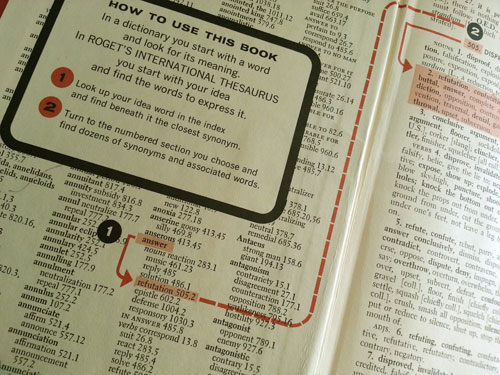
7. One of my most cherished  possessions is my 1962 third edition of Roget’s International Thesaurus. The words are grouped by ideas rather than alphabetically, which is a beautiful thing. I stole it from a nun. Sister Laurette. I think she stole it from someone else because she inscribed her name over a different set of initials.

My Roget's Theasaurus, yellowed, stained and falling apart
My Roget’s Theasaurus, yellowed, stained and falling apart

realityThere are, of course, rules:

  • show appreciation of the blogger who nominated you and link back to them in your post;
  • add the award logo to your blog;
  • share 7 things about yourself;
  • nominate 5 – 10 or more bloggers you admire;
  • contact your chosen bloggers to let them know.

And now, in keeping with my theme, I’m going to tag some bloggers who I admire as writers. Don’t feel pressured to do anything with this, folks. I know one of you isn’t even blogging any more. This is my way of saying I like what you write and I also like how you write it.

  • Aspie Writer who is blogging her excellent memoir, Twirling Naked in the Street. I don’t comment on it nearly enough but I’m always excited to see a new installment pop up in my reader.
  • Adrienne at Eat Me, Drink Me, Bite Me, because it was her honest, gutsy blogging that planted a seed in my head.
  • Unstrange Mind who is fearless and whose courage makes me want to reach deeper.
  • Ariane, who writes at Emma’s Hopebook, where amidst the smart, thoughtful commentary you will find beautiful sentences like this: “Different sized flakes whirl about as though unaware that gravity will eventually win out.”
  • Lori at A Quiet Week in the House, who I am putting last because once you go look at her gorgeous artwork, you will forget to come back here.

I Think I Might Be Autistic (Part 4)

This is the 4th part in an ongoing series about being diagnosed as autistic at the age of 42.

Mourning the Loss

Eventually reality set in. I’m autistic. 

Not the happy “Yay! I’m different! I’m unique! I’m special!” autistic.

More like “Holy crap . . . I’m defective . . disabled . . . challenged . . . never going to get any better” autistic.

This was when the mourning began. Once the bright shiny new this-explains-everything stage wore off, I started thinking about the other side of being autistic. I wasn’t going to “outgrow” my social awkwardness. I wasn’t going to wake up one day and suddenly have a balanced emotional life. The challenges I faced weren’t imagined and they weren’t going to magically disappear. They were with me for life.

This is me. This is always going to be me. Forever.

Talk about hard realizations.

The questions that arose were mostly  variations of “how would my life have been different if I wasn’t autistic?” As I tried to envision taking away this or that autistic part of me, it became obvious that Asperger’s was responsible for a lot more than what makes me weird. It’s responsible for many of my strengths, too. Take it away and I’m no longer me.

That person I was mourning? She doesn’t exist.

Mourning the Loss

  • Don’t be afraid to acknowledge your anger, disappointment, sadness or other negative feelings.
  • Recognize your strengths along with your weaknesses.
  • You’ve always been autistic and always will be. However, that doesn’t mean you can’t work on learning social skills, developing coping mechanisms or changing your lifestyle/environment in ways that support you.

girl

Healing the Child (or Younger Self)

Growing up undiagnosed is hard. There is a lot of pain that comes from knowing that you’re different but not knowing why. Asperger’s gave me an explanation, but more importantly it gave me a starting point for healing that scared, confused kid inside me.

As I worked back through the more difficult aspects of my childhood, I felt like I was somehow mothering my younger self–revisiting each moment, looking at it in a new light and telling that younger version of me that it wasn’t my fault, that I’d done the best I could, that to expect more from me in the absence of support would have been unreasonable.

I wasn’t “obviously” autistic as a child–girls manifest ASD traits differently than boys in many cases and Asperger’s didn’t exist as a diagnosis in the 1970s.

I was, however, a handful. I was overly smart, easily bored, very curious and constantly in motion. Consequently, I got a lot of guidance from adults on how to behave properly. This reined in my more problematic behaviors, but it also made me feel like I was forever in danger of doing something “wrong,” especially when I “wasn’t trying hard enough.”

Being able to look back at my childhood and see that my behaviors were a result of my brain chemistry and not a result of “not being good enough” allowed me to begin to heal some of those lingering insecurities.

Learning more about Asperger’s helped me understand that I was bullied not because I was weird, but because I was socially inept. Reading about selective mutism gave me an explanation for my largely silent elementary school years–the ones where I never spoke in class unless forced to. Finding information about how ASDs manifest in girls shed light on why I had so much trouble maintaining friendships.

Each new bit of information absolved me of some perceived failure as a child and helped me begin healing some very old wounds.

Healing

  • Learning more about Asperger’s/autism in children can help you understand challenges you faced in childhood.
  • As an adult, you can choose to forgive the people in your life who hurt you as a child.
  • It may help to imagine your adult self sharing your new information with your child self as a way to offer comfort or explanations for unhealed childhood wounds.
  • If you find yourself having distressing reactions that are difficult to cope with, consult with a mental health professional or a trusted friend/mentor for help.

Coming next: Self-Diagnosis or Professional Diagnosis

Emotional Dysfunction: Alexithymia and ASD

A typical aspie-NT conversation about feelings:

NT: What’s wrong?

Aspie: I don’t know.

NT: You look upset.

Aspie: . . .

NT: Are you sad? Angry?

Aspie: I don’t know.

NT: It’s okay. You can tell me.

Aspie: . . .

NT: Fine. Don’t tell me. I was just trying to help.

When an aspie says they don’t know what they’re feeling, it’s a literal statement. We aren’t trying to dodge the conversation. We aren’t withholding information. We aren’t being rude, mean, cold coy or vindictive.

I’ve had variations on the above conversation many times and it’s as frustrating for me as it is for the person who wants to know what’s wrong. The reason? I have difficulty identifying my emotions and even more trouble verbalizing them. Working through my emotional constellations has helped me identify some of the specific issues I–and many autistic people–have in processing and identifying feelings.

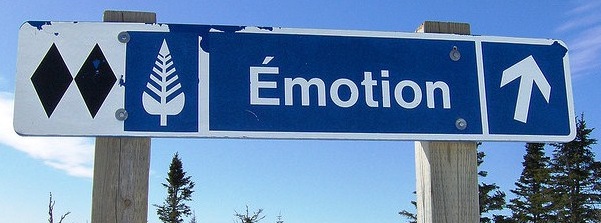
emotion
(Photo: Joe Shlabotnik / Creative Commons)

Predictably, I’ve grouped the issues into three general categories:

  • modulation (moderating the strength of my own emotions)
  • determination (identifying emotions in others)
  • discrimination (separating emotion directed at me from general expression of emotion)

Modulation: The Glitchy Volume Control

There is a common misconception that autistic people are unemotional. You’ll often hear this refuted by autistics themselves, who say they are too emotional. So which is it? For me, it’s both. My emotions gravitate toward the extremes of muted or intense; few emotional experiences fall in the midranges.

My default emotional state is neutral. I don’t feel especially good or bad. I’m present in the moment and content to be so. Externally, I may come across as serious or subdued, but reduced expressiveness shouldn’t be confused with a negative state of being or a lack of feeling.

The feelings are definitely there. Most of the time they quietly mind their own business and I need to consciously check-in to see what they’re up to. When they decide to fully surface on their own, however, they’re intense.

Unlike most neurotypicals, I don’t have a lot of ability to modulate the strength of my emotions.  Imagine a radio with an on/off switch and a glitchy volume control.

If you think about this in terms of the weak executive function associated with Asperger’s, it makes sense. Humans use reasoning, rationalization and labeling to modulate emotion. All of these methods fall under the umbrella of executive function. Labeling emotions, in particular, seems to be hard for aspies.

Determination: The Broken Mirror

Just as I have difficulty labeling my own emotions, I have trouble identifying what others are feeling. I struggle with interpreting facial expressions and body language. I’m weak at perspective-taking. Basically, when it comes to reading emotional clues, I’m like one of those old-time detectives who had to solve murders without any forensic evidence. There’s only so much information you can gather from what people tell you outright.

This difficulty determining what others are feeling is a big contributor to the stereotype of the empathy-deficient aspie. If someone is giving off “I’m sad” cues that I fail to recognize, when I don’t console them, they’ll assume I’m cold and unsympathetic.

For neurotypical people, emotional interaction is like looking in a mirror. They expect to see a reflective emotion looking back at them and when they don’t, they assume the mirror is broken.

This isn’t to say I’m oblivious to other people’s emotional states. I get the obvious ones and the ones that I can derive from contextual clues. What I tend to miss are the subtle or unexpected emotional states.

Discrimination: Missing the Target

I’ve always been disturbed by confrontation and conflict, even when I’m only a bystander. By default, The Scientist is in charge of “confrontation with others.” If something needs to be argued over or complained about–a botched repair job or an over-cooked restaurant meal–that’s his department. While he’s making that phone call or waiting for the manager to appear, I go off and hide.

As an adult, I’m not proud of this. Why do I desperately need to flee a situation to which I’m nothing more than an observer?

Because, I recently realized, I don’t discriminate between anger that is aimed at me and anger in general. When someone is angry, I invariably feel like I’m the cause or the target, even when I rationally know that I’m not.

If The Scientist calls me after a bad day, I hear how upset he is and immediately feel distressed. Not distressed as in “I should console my husband because he’s had a bad day.” I feel distressed in a “this is incredibly stressful and I want it to stop” kind of way. My brain immediately goes into “fix it” mode, searching for a way to make the other person feel better so I can also relieve my own distress.

Of course, a conversation with an upset spouse is upsetting to most people. But what about a conversation between two strangers that I’ve merely overheard? Twice in the past two weeks I’ve witnessed one person berating another for an etiquette infraction at the swimming pool. (Yes, we take our lap swimming seriously around these parts.) Both times I felt my heartbeat skyrocket, as if the anger was directed at me. In reality, I’m sure neither of these people even noticed I was standing nearby.

Even now, as I’m sitting here in Starbucks typing, the woman at the next table is telling a story about how mad she is at her sister-in-law; I can feel my blood pressure rising at the tone of her words. Words that are completely irrelevant to me. Words that, thanks to my funky brain wiring, I find impossible to tune out.

Yes, not only does my autistic brain not know how to interpret the emotional content of other people’s conversations, it also refuses to tune them out. And people wonder why we aspies like to spend a lot of time alone.

It took me a long time and a lot of thought to figure out why I respond to secondhand distress like this. Why should I feel emotionally assailed when the angry words are aimed at another person?

In part it’s related to my upbringing, but there is also an element of weak executive control at work. In theory, I should be able to rationalize away my overreaction by telling myself that I’m observing generalized anger (or frustration or sadness), not anger directed at me. I should be able to put myself in the other person’s shoes and direct my emotions at the target of their distress, rather than feeling like the target myself.

Alexithymia

The three areas where I have difficulty–modulation, discrimination and determination–are actually core traits of alexithymia.

Alexithymia (literally: having no words for emotions) is impairment in identifying and describing emotions. Specifically, it’s characterized by:

  • difficulty identifying feelings
  • difficulty distinguishing between feelings and bodily sensations related to emotional arousal
  • difficulty describing feelings to others
  • impoverished imagination and fantasy life
  • a stimulus-dependent, externally oriented cognitive style

When I look at the list of alexithymic characteristics, I also realize that when I’m emotionally uncomfortable, I’m more likely to have physical complaints. I’ll be feeling frustrated or sad, but  complain that I’m uncomfortably cold or intolerably sleepy. This isn’t a connection I would make on my own, but once I see it described as part of alexithymia–like so much about my autistic self–it suddenly makes perfect sense.

There is a lot of overlap between alexithymia and ASD, both in the perception of emotions and the difficulty in verbalizing feelings. Not only are autistic people very likely to exhibit the characteristics of alexithymia, their parents are as well. However, many non-autistic people also have alexithymia, so it isn’t exclusive to ASD.

Alexithymia isn’t a clinical diagnosis like autism. It’s a construct (theory) used to describe the traits of people who have difficulty verbalizing emotions. It’s also a helpful way of thinking about some of the challenges that aspies have with processing feelings.

—–

More on Alexithymia and ASD:

  • Next Tuesday, we’ll be doing the Alexithymia Questionnaire for Take-a-Test Tuesday.
  • Alexithymia and Grief at Unstrange Mind is a challenging and insightful piece about the mourning process 
  • Great example of an Alexithymia cheat sheet in the form of a flow chart at Radical Neurodivergence

Thinking on your Feet: A Trio of Cognitive Tests

Thinking on Your Feet is a new test at Test My Brain. I was planning to do the creepy Face in the Branches test today but it’s no longer available. Instead I took Thinking on Your Feet, which isn’t an Asperger’s test but does test some of the cognitive areas that can be impacted by ASD.

Thinking on your Feet consists of three short tests:

  1. Find the flickering dot: You’re shown a set of blue and yellow dots that flash intermittently and you have to find the dot that’s changing color. There are sixteen sets of dots.
  2. Visual working memory: You’re briefly shown a set of four shapes arrayed around a plus (+) sign. The set disappears and one shape reappears. You press “s” if the shape is the same as the one you saw in that position in the set and “d” if it is different. There are 42 sets of shapes.
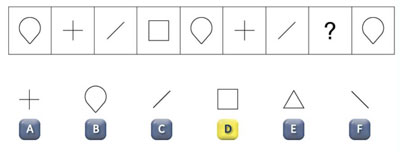
  3. Visual reasoning: You’re shown a matrix of shapes and have to identify the “missing piece” from 5 possible choices. There are 35 matrices and they become increasingly difficult.
Example of a nonverbal reasoning matrix

As I was taking the tests, they reminded me of some of the cognitive tests I took during my Asperger’s evaluation.

The first and third tests measure components of executive function: attention and working memory. Executive function is way of describing our brain’s command and control center. It encompasses things like planning, problem solving, and verbal reasoning as well as starting, stopping, switching and monitoring tasks. Many aspies, including me, have impaired executive function.

The second test–visual reasoning–relies on nonverbal reasoning. Many aspies excel at tasks requiring nonverbal reasoning, either because they think visually or are skilled at pattern recognition.

Working with those general assumptions, individuals on the spectrum are probably more likely to score above average on the second test and average or below average on the other two.

Taking the Test

First a warning: One section of this test has a set of colored dots that flash at a steady rate. The flashing isn’t rapid, but the dots are quite bright and you have to study them as they flash to find one that is different. Is this sounds like it may be uncomfortable or triggering for you, don’t take this test.

The test guidelines say it takes about 30 minutes to complete. I finished in a little over 20. The first and third tests go pretty quickly, but you may want to spend more time on the visual reasoning section, depending on how quickly you can solve the harder puzzles and how much you care about your score.

When you’re ready to give it a try, go to the Test My Brain site and click the Go! button next to the Thinking on Your Feet test. You’ll be asked to agree to the consent form and provide some demographic information (age, handedness, primary language, etc.) to help the researchers analyze the data they’re collecting via these tests. It’s all anonymous and you won’t be asked for any personally identifying data.

Before each section of the test, you’ll be given written directions as well as two practice trials to be sure you understand what to do. After the three tests are complete, you’ll be asked for your SAT scores. If you don’t remember them or never took the SAT you can skip this section. It has no impact on the results you receive.

Scoring the Test

You’ll get three separate scores. Here are mine:

Find the Flickering Dot:  I got 14.63, which is a measure of the average number of screen flashes it took me to find the dot. The average score on this test is 20.53.

My scores on the Find the Flickering Dot test
I scored better than 30% of other test takers

Visual Reasoning Test: I got 31 out of 35 correct. The average score is 25.76

My visual reasoning score is in the 90th percentile group

Visual Working Memory: I got 37 out of 42 correct. The average score is 33.91.

My visual working memory score is better than 60% of the other test takers

If we assume that the scores are normally distributed, then scores that fall between the 25th and 75th percentile are in the average range of ability. Or to put it another way, if your blue guy is standing somewhere in the middle of the pack, your scores are average. If he’s standing in the first two or last positions, you’re above or below average.

For the flickering dot and visual working memory scores, my blue guy is standing in the middle six, which means I have average scores . On the visual reasoning test, my blue guy is in the second to last position, meaning I have an above average score.

I went back and looked at my ASD evaluation report to compare the results of the comparable cognitive tests with these and they’re quite similar. My scores were above average for perceptual reasoning and average for attention. I didn’t take a visual working memory test so I don’t have a direct comparison there. I did take two verbal working memory tests and my results were “impaired” on both, meaning my little blue guy was standing in the first position in line.

It’s no surprise to me that I scored better on visual working memory than verbal. My verbal cognitive test scores are poor across the board and I’m much more comfortable working from printed or visual material than from oral directions.

The Bottom Line

This set of tests is an interesting look at some of the cognitive elements that are thought to be ASD strengths and weaknesses.