

This week for Take-a-Test Tuesday I took the Cambridge Mindreading Face-Voice Battery (CAM) which is another test of the ability to recognize emotions in others.
The Cambridge Mindreading Face-Voice Battery (CAM) tests recognition of complex emotional states. It consists of short audio and video clips in which actors convey 1 of 20 different complex emotions through either their voice or their facial expressions.
The theory behind the CAM is that autistic people are able to read basic emotions but have difficulty interpreting complex emotions. Basic emotions are the ones that we learn early in life: happy, sad, angry, surprised. Most people learn these by age 6.
Complex emotions are sometimes described as combinations of basic emotions or as basic emotions plus cultural conditioning. They include mental states like stern, intimate, guarded, admiring, submissive and vibrant. There are hundreds of complex emotions and it takes us years to learn them. Generally, most people can recognize the majority of complex emotions by the time they reach adulthood.
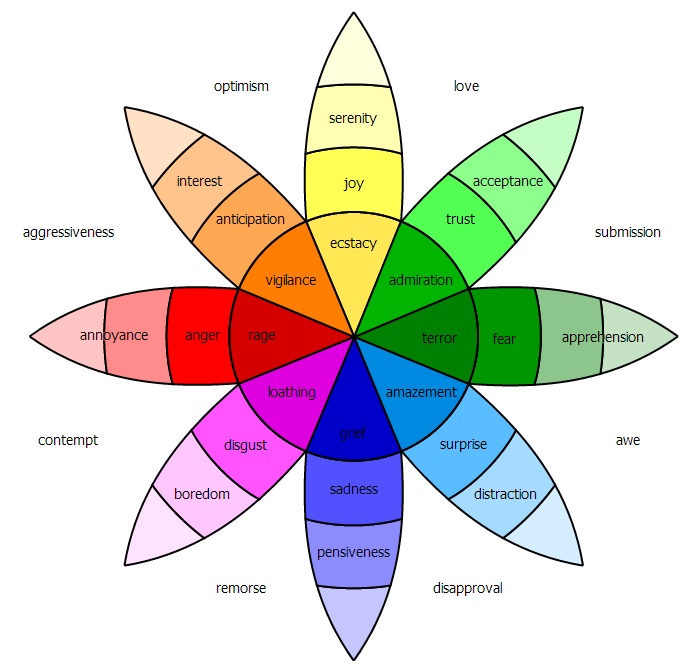
According to the CAM creators, the emotional states presented in the clips are “higher order” emotional concepts:
- 6 concepts from level 4 (concepts understood by typical 15–16 year olds)
- 13 concepts from level 5 (understood by typical 17–18 year olds)
- 1 concept from level 6 (words understood by less than 75% of typical 17–18 year olds)
The purpose of the test is to examine whether autistic people grasp these more complex emotional states. It includes both negative and positive emotions as well as subtle and intense emotional states. Each of the 20 emotions is repeated 5 times.
Taking the Test
The Face-Voice Battery has two parts. Part 1 consists of listening to 50 short clips of actors saying a phrase or sentence. You’re given 4 options for describing the emotional content of the clip. Part 2 consists of watching 50 3-5 second videos of actors silently portraying facial expressions. Again you’re given 4 options that describe the emotional content.
You can take the Cambridge Mindreading (CAM) Face-Voice Battery at aspietests.org. To begin, click on the The Cambridge Mindreading Face-Voice Battery – Part 1 (Voices) link. After entering your age and diagnostic status and accepting the terms, you can proceed to the voice clips. As you take the test, keep in mind that speed counts. In addition to a %-correct score, the test returns an “average time to answer” score. Part 1 took me about 10 minutes to complete.
Once you finish Part 1, click the “back to the homepage” link and then click the Cambridge Mindreading Face-Voice Battery – Part 2 (Faces) link to begin Part 2. Again, speed counts. This part took me about 10 minutes to complete as well.
Scoring the Test
I did well on this test–in fact, I matched the mean score of neurotypical females in the original research study. Here is my score:
You scored 90.0% in 5.7 seconds. Faces: 84.0% (42 correct) Voices: 96.0% (48 correct)
Here are the average scores from the study:
ASD Faces task: 32 correct (64%)
ASD Voice task: 35 correct (70%)
ASD Total: 68 correct (68%)
NT Faces task: 44 correct (88%)
NT Voice task: 43 correct (86%)
NT Total: 86 correct (86%)
I’m not surprised by how well I did on the voices portion of the test. “Voice data” is my primary means of reading social situations. It helped that the informational content of the phrases matched the emotional content of the voices. For example, when I heard “that is horrible” I took into account the information being conveyed by the statement as well as the tone of voice to settle on my choice of “appalled.” This is considered a “strategy” by the test creators, so basically, once again, I’m “cheating.” But it works, so hooray for adaptations.
The video clips were a mixed bag. I think I did better on the ones that had a dissimilar set of possible answers (i.e. appalled, vibrant, blank, or intimate) and the ones that I remembered to glance at the answer choices before the clip played.
As an experiment, for some trials I watched the clip and tried to form an answer before looking at the choices. On one video, I was certain the answer was “sarcastic” but that wasn’t one of the choices; I think the correct answer was “reassured.”
A few other random thoughts:
- Am I the only one who thought most of the voice clips sounded like they were straight out of Dickens novel?
- The use of live action videos is more realistic than static photos, but I still didn’t feel like the test results were reflective of my real life ability to read emotions.
- I liked seeing the contrast in my voice vs. facial expression reading skills.
- Some of the video clips made me incredibly uncomfortable to the point that I had to glance away.
- I couldn’t find any data on the “time to answer” scores. From background reading about this type of test, I know that researchers often use the average time to answer as a metric to gauge competency. The assumption is that the longer it takes to answer, the more processing your brain is doing to produce an answer.
The Bottom Line
CAM feels more realistic than Reading the Mind in the Eyes, but it’s still far from an accurate test of the fluid way that emotions present in real life interactions.














 Musings of an Aspie