The DSM-5 was released last week. It’s still impossible to find the full criteria online anywhere, but here’s a summary of the major changes, according to a short video on the APA website.
1. Merges Asperger’s syndrome, PDD-NOS, childhood disintegrative disorder and autism into a single diagnosis of autism spectrum disorder
2. Diagnosis is now based on two criteria instead of three:
Social communication (collapsing the formerly separate social and communication domains)
Restricted, repetitive behaviors
An interesting shift is that while social communication impairments are seen as lifelong and pervasive, RRBs are not. An adult can now receive an ASD diagnosis based on current social communication impairments and a history of RRBs.
3. The addition of specifiers like age at onset, type of onset (skill loss or not), intellectual disability, verbal impairment, and co-morbid conditions present (i.e. ADHD, anxiety disorders, epilepsy). There will also be a 3-level severity scale assigned to each of the two diagnostic criteria.
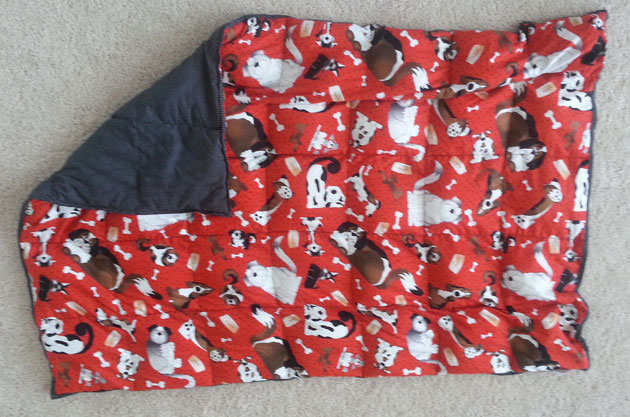
Last month my daughter surprised me with a weighted blanket for my birthday. Look how adorable it is:
It’s big enough to cover me from toes to mid-torso when I’m lying flat (or cover me entirely if I curl up on my side), which is plenty. I’ve been using it in the evenings while I’m watching TV, when I need a sensory break during the day or after a tiring outing.
It’s emotionally calming and it makes me feel more physically organized. An unexpected benefit is that my moods are less spiky since I’ve been using it daily.
From the “Change is Hard” File
My old apartment was on the 3rd floor and my new apartment is on the 2nd floor. The first few times I used the elevator here I automatically hit the 3 button, got out on the 3rd floor and was halfway to my apartment before I realized that the numbers were all wrong.
Now when I use the elevator (which isn’t often, because 2nd floor), I tell myself “2 not 3”. The funny thing is, apparently I’ve been saying it out loud. The things you don’t realize until another person is around to look at you funny. Oops.
Hearing Motion
In the comments on one of the surveys, Robin shared a cool video that can help you identify if you experience a certain kind of synesthesia in which visual motion generates sound. I didn’t hear anything when I watched it but some other folks did.
100,000 views!
Last week the blog topped 100,000 views and 3000 comments. Yay!
The summer before seventh grade I went to an amusement park with my cousins. Until that day, my amusement park experience had been limited to kiddie rides. My parents weren’t roller-coaster-riding types and I guess they assumed I wasn’t either.
So there I was, first time in a real amusement park with real rides and roller coasters and everything and I was . . . terrified. I felt sick to my stomach just looking at the rides. But my cousins, who had been to the park many times, grabbed my hands and made a beeline straight for a ride that looked like this:
It was called Strawberry Fields and as we waited for it to start, songs from “Sgt. Pepper’s Lonely Heart’s Club Band” blared from the speakers overhead. My memory of that moment is clear as if it happened yesterday. I can hear the scratchy version of “Lucy in the Sky with Diamonds”, feel the greasy vinyl of the safety bar beneath my sweaty palms and practically taste my fear as my heart galloped in my chest.
And then we started to move, slowly at first, gaining speed, a little more and a little more until the wind was whipping my hair across my face and the three of us were pressed in a bone-crunching heap against the outside of the car and I was screaming right along with everyone else through 90 seconds of pure, unadulterated joy.
When the ride stopped all I could think was, “holy shit, let’s do that again!” And again and again and again.
I’d discovered one of my favorite sensory experiences: going fast. Blindingly fast. Mind-numbingly fast. The speed was exhilarating. I rode everything in the park. The faster it went, the more I liked it. Spinning, falling, dipping, swinging–I had no idea why I liked the intense physical sensations that the rides created, but I did. When I went back to the park on a seventh grade field trip, I spent the morning riding a roller coaster, jumping off and running around to the entrance to get right back in line.
Sensory Seeking =/= Stimming?
Now that I know about sensory seeking behavior, my sudden intense love of amusement park rides makes sense. Autistic people are often sensory seeking in a big way. We have a strong need for intense sensory input and will deliberately seek out or create sensory experiences to satisfy that need.
Sensory seeking is often described as a way to either stimulate an understimulated nervous system or calm an overstimulated system. Which sounds a lot like the typical definition of autistic stimming.
That raises the question: is sensory seeking behavior a form of stimming? There is a lot of overlap between the two, but I don’t think they’re identical. Stimming provides sensory input so I think we can say that all stimming is sensory seeking. But stimming is generally repetitive, which isn’t always true of sensory seeking.
Going on a roller coaster once or twice? Probably sensory seeking. Going on a roller coaster twenty times in a row? Could be stimming.
Honestly, I have no idea. Feel free to weigh in with your own theory, opinion or confusion in the comments.
The Wild Ones
Much of my childhood play was sensory seeking in disguise. Some of my favorite activities as a kid:
Going as fast as I could down big hills on my bike, roller skates or sled
Jumping or diving off the high board
Hanging upside down and doing somersaults on the monkey bars
Jumping on the bed (broke my jaw doing this)
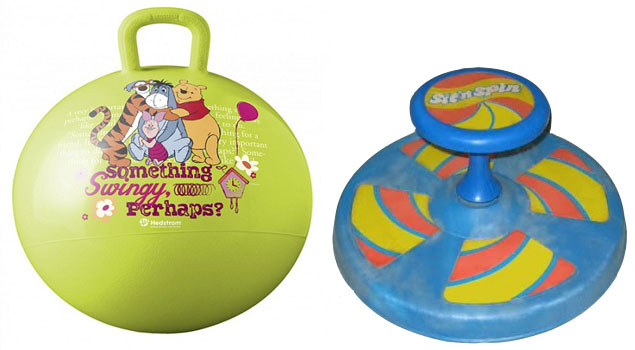
Bouncing on a trampoline or Hippity Hop
Sit ‘n spin!
Climbing trees and hanging upside down from the branches or jumping to the ground
Running into the padded gymnasium wall and bouncing off
Zipping my arms into my coat and playing crash dummies with a friend (this never ended welll)
Lying underneath my beanbag chair while watching TV
Swinging as high as I could on the swings then flying off
These are not especially “girly” pastimes. They’ll get you branded a tomboy and a handful. If you’re a boy, you’ll be seen as wild and unruly, maybe you’ll get an ADHD diagnosis.
My next door neighbor had a Hippity Hop and Sit ‘n Spin–neither of which my parents would buy me. I didn’t especially like my neighbor but I loved her toys.
As a teenager I took up martial arts, primarily for the self-defense aspect of it, but I discovered that I liked the contact that sparring involves. Getting hit while padded up with gear creates a very tangible kind of physical feedback. So does pounding a heavy bag or kicking a hand target hundreds of times in a row.
Although that may sound masochistic, it’s not. I don’t seek out pain. Let’s be clear about that. Although I often engage in activities that have a risk of injury and pain, what I’m looking for is a benign physical sensation–one of pressure or contact or movement–not pain.
There is sometimes a belief that people who engage in sensory seeking activities like headbanging, slamming into objects or biting themselves are doing it because pain is the desired outcome and I don’t think that’s always true. It may be true for some, but for others, those activities don’t hurt, either due to pain hyposensitivity or an ability to regulate the level of contact in a way that keeps it below our pain threshold.
64 Flavors of Sensory Seeking
While I’m primarily a proprioceptive and vestibular sensory seeker, there other types of sensory input that I’m strongly drawn to:
touching surfaces and objects
the feeling of sound resonating in my chest (Tibetan singing bowl, trains, explosions in IMAX movies, loud music)
the exhaustion after a hard workout
the smell of fire
being immersed/floating in water
Of course, that’s me. Everyone’s sensory seeking preferences are different. Some common examples by category:
Tactile: seeking touch from others; touching objects, textures or surfaces (either certain types or everything)
Visual: seeking visual patterns, moving objects, specific colors or shapes
Oral: seeking food or nonfood objects to taste, chew or suck on; seeking specific sensations like crunchy, spicy, or minty
Olfactory: seeking specific preferred smells; smelling everything
Vestibular: spinning, rocking, being upside down; seeking specific head or body positions; jumping from heights; seeking intense speed or movement
Auditory: seeking loud, repetitive or specific types of noises; making sounds because they’re pleasing
Interoceptive: seeking bodily sensations like hunger, thirst, urgency to use the bathroom, fatigue
Proprioceptive: physical contact, crashing into things, stretching, pressure, sound resonance
But Why?
What drives to seek out our preferred sensory inputs? I haven’t been able to find much scientific background, so I have only my personal experiences to share:
Regulatory: As a kid, I think my intense sensory seeking behavior was a way of soothing my overloaded brain. There were many many days when I couldn’t wait to get home from school and ride my bike to the top of the highest hill in the neighborhood. The hard climb up and brain rattling ride down were the only way I knew to soothe the angry anxious restless feelings that built up during the day.
As an adult, I’m better at regulating myself in more typical ways. Still, after a long day in the city I like to wedge my body into a seat on the train so my legs are pressed up tight against the seat in front of me. I do the same thing on airplanes and long car rides. The pressure calms me and helps downregulate my sensory overload.
I’ve read that stimming and sensory seeking behavior can be stimulating (hence the term stimming) but I’m rarely in need of any added sensory stimulation. I usually have more than I can handle.
Connection: Sensory input reminds me that I have a corporeal form. It connects my mind to my body and my body to my environment in tangible ways. Without touch, pressure and movement, I can easily get disconnected from my physical self.
Organization: Some types of sensory input help me feel more organized and integrated. At the end of the day, when I’m watching TV, putting my weighted blanket over my legs keeps me from turning into a squirmy mess on the couch. Without the added weight on my legs, I’ll change positions every five minutes trying to get comfortable because my body feels so disorganized and physically confused by the end of the day.
Physical dissociation and disorganization are things I’ve only recently realized that I experience. I was going to write about them to help clarify the “why’s” of my sensory seeking but I wrote so much that it will have to be a separate post.
Not Growing Out of This One Either
I’ve always had strong sensory-seeking tendencies. I think I always will. This isn’t a bad thing. It’s actually one of the things I like about being autistic. I have the ability to experience certain sensations in ways that most people don’t.
I like the intensity and immediacy. I like the pleasure I can find in mundane everyday things like the rumble of a passing train or the feel of a matte bookcover. It’s not exactly a superpower, but does give the world around me a vivid tangible realness that I can tap into whenever I need to reconnect myself with my self.
This week’s questions are about acceptance and gender/sexuality/body image. You can answer here or at Survey Monkey, wherever you feel most comfortable. (I’m going to break from pattern and answer anonymously this week, because . . . reasons.)
I’ve created two separate surveys at Survey Monkey:
As always, this is open to anyone, regardless of official diagnosis.
Acceptance
Do your friends and family ask you about your diagnosis? Do you feel supported by them?
Do you ever feel ashamed to be autistic/technically disabled/different? Especially after spending a big chunk of your life as a ‘normal’ person?
Do you all experience a lot of double standards regarding your autism, and how do you deal with this? For instance, it annoys me so much that an NT person can move their hands around, fiddle with clothing etc, but when I do it, it’s stimming and therefore A Bad Thing in the eyes of others.
If you could be neurotypical, would you want to be?
How often do you hear someone use autistic as a pejorative?
Before you realised you were autistic did you ever understand yourself as being somehow not human or not from your culture of birth? (e.g. an alien from the wrong planet or born into the wrong country, century or species etc)
Gender/Sexuality/Body Image
How do you relate to gender? What is your understanding of the word/concept?
Has there been a point in your life when you felt that you wanted to be, or were meant to be, a gender different to the one you were raised as? (If so, why do you think this was, how old were you, how long did this last?)
Do you currently believe in or follow gender roles and stereotypes? (for example, roles/rules about how you’re meant to dress and present yourself, what interests you’re meant to have, how assertive/emotional/nurturing/etc you’re supposed to be, what role you’re supposed to take in personal and professional relationships, etc)
If you are some variety of transgender or answered that you’re gender nonconformist in some way, do you think that this is in any way related to your autistic traits? Do you think you ‘do gender’ or ‘do transgender’ differently to other people because you’re autistic?
Is your sexuality, romantic orientation or preferred relationship structure different from our cultural norms in some way? If so how does this differ and do you think this is related to your being autistic?
Have you ever had any difficulties with your self image, if so how did these manifest? (such as physical/bodily gender dysphoria, body dysmorphia, eating disorders)
This might be a new regular or occasional feature. How’s that for a commitment? There are a lot of little things that come up during the week that I’d like to share but they’re too small to make a proper post about. Instead, I’m going to roll them all up into one hot mess of a post on Mondays.
News from the Melatonin Front
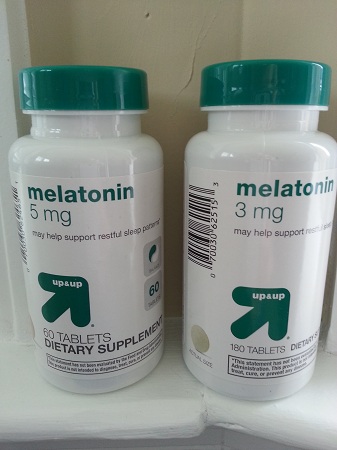
I accidentally bought 3 mg melatonin tablets rather than my usual 5 mg tablets. Cue three nights of bizarre dreams before I realized my mistake (followed by a frantic midweek trip to Target). Yikes. Now I see why some people can’t take melatonin. I didn’t have nightmares but I did have some freaky dreams and woke up feeling like the night had been about a week long.
Hey Target, think you could possibly make these bottles look any more alike?
Research on Using the Internet as a Communication Medium
Amy Woodham, a masters student in psychology in the UK is doing a study on how women with Aspergers and High Functioning (ack!) Autism use the internet for communication. It’s a short, mostly multiple choice survey that took me about 15 minutes to complete. To participate, you need to be a female over the age of 18 with an official diagnosis of AS or HFA (I know that rules a bunch of you out, sorry). If you’re interested, you can find details here.
**Updated to add that you’re welcome to participate in the study if you are self-diagnosed/suspected AS/HFA. See the comments for the source of this additional information.
A-dar is an Actual Thing
I live next to an elementary school now. It has a giant playground with a forest of colorful plastic playground equipment, as playgrounds do these days. Last Tuesday when I took the dog out for our midday constitutional, I saw just one girl on the playground. She was walking around the paved play area, making loud vocalizations while looking at the numbers and shapes painted on the ground (for playing hopscotch and such). There were four adults nearby, chatting and paying no mind to girl’s unusual behavior.
“Wow,” I thought, “best recess ever.”
As I rounded the corner of the playground and headed out into the nearby field, I noticed another girl, hunched over at the end of a slide, scraping up and sifting through the bark mulch. Then a boy, kneeling under another slide, doing something in the dirt I couldn’t make out. Oh, and a second boy, sitting in the middle of yet another slide, flapping his hands, which were hidden in his shirt sleeves.
This seriously looked like the best recess ever to me. As I walked by the fence, feeling happy for these kids who were getting to whatever they damn well pleased on the playground, the flappy boy slid down the slide and ran over to the chain link fence to watch me. I waved. He licked the fence.
This would be even more fun if you all had things to share too. What’s going on with your week? Find anything new or exciting or interesting you want to tell everyone about? Could be ASD-related or not. I have no idea how this might work, except that we should do what makes us happy.
One of my special skills is goading people into doing things that I think are great ideas. A few of you have been on the receiving end of this.
When it comes to getting my own stuff done, though, I have a tougher time making things happen. If you have impaired executive function courtesy of autism or ADHD (or some other neurodivergence), you know the feeling. How many times a week do I think “I really should spend some time on my novel” and “I’m way behind on responding to comments” not to mention “The kitchen counters could use a good wiping down” and “When was the last time I vacuumed?”
I’m super organized when it comes to work and bill paying and anything with a deadline. But those things that I should be doing regularly–which includes everything from housework to writing and keeping my blog in order–that stuff slips away from me so easily.
So when Slepa Ulica (who comments here under the username Anonymus) mentioned that they were designing a “smart to-do list” that would serve up tasks to do based on a whole list of customizable parameters, I got just a little excited.
A to-do list that understands crummy executive function! A to-do list that would give me one appropriate task at a time! A website for neurodivergent people created by a neurodivergent person! Much goading encouragement ensued on my part and much work on Slepa Ulica’s part.
1. The fish! I know that’s a silly thing to put first on my list, but the illustrations make me happy. More importantly, the interface is sensory friendly. Plenty of white space, no busy layouts, moving images, sounds or loud colors to assault my brain. Just the minimum of information that I need, accented with whimsical illustrations. (The website also has a boatload of accessibility features which you can read about in detail if you like.)
2. Unlike regular to-do lists, Goal-Fish understands that not all tasks are created equal and we don’t always feel up to tackling certain chores. The constraints feature allows you to limit tasks to what you’re capable of doing (based on energy level, time of day, etc.) and how much time you have. Once you’ve input your constraints (which will take less time to do than it took you to read about it here), you press a button and the software gives you an appropriate task.
For example, I set up a 15-minute time window, a pain (you can change this to spoons, energy, etc.) level of 4 and no helpers. The software gave me “change sheets” which I should probably go do now because I have no idea when I last did that. Increasing my pain level to 6, it told me to take out the trash. When I decreased my pain level to 1 and increased the time to 30 minutes, it told me to clean out the fridge (another task I should do more regularly).
3. What you see when you first start using Goal-Fish is Slepa Ulica’s tasks and categories. You can edit tasks to fit your needs, add your own tasks, assign them to categories, change/create detailed instructions for each task and modify the constraints. Depending on how much time you want to spend, you can do quite a bit of customizing.
The fish is doing laundry. The fish wants you to laundry, too. You don’t want to let the fish down, right?
4. It’s free. Wow, right? Of course, if you’re feeling generous and can afford to, you can throw a few bucks Slepa Ulica’s way. If you do, you’ll get an additional 20 tasks and 6 categories added to your account. Plus the good feeling that comes along with supporting a cool project by a member of our community. Just use that bright shiny donate button at the top of the screen.
5. The detailed instructions can include as many or as few steps as you need. Some of us may be fine with “do laundry” as a single instruction. Others may need a detailed list of steps to complete more complex tasks like doing the laundry. I can see this making a great independent living tool for pre-teens, teens or adults who need support in completing daily self-care tasks.
6. It almost makes doing chores fun. Clicking the button and getting a semi-random chore makes completing tasks feel like part of a game. Also, having a time limit on a chore makes mundane tasks less open-ended and onerous. If I decide I want to spend 15 minutes on a chore and the software tells me to go pick up stuff, then I feel good about spending 15 minutes or less picking stuff up, even if I don’t get every last thing put away. Without that limit, I’ll avoid even starting because I know I can easily end up spending an hour straightening up, getting distracted, drifting off into other tasks, etc. and then feel like I got nothing substantial done.
I’m going to close this out with Slepa Ulica’s description of why the software is called Goal-Fish, because it ties in nicely with #6 and it made me smile:
“I got to thinking that my todo list is kind of like one of those digital pets where you have to order it to do things, feed it, water it, and take care of it, except in reverse. I’m the digital pet, and the computer is the person telling me to clean my room.”
If you have questions or comments, Slepa Ulica (Anonymus) has promised to reply to them here or you can find an email link at the bottom of the software’s help page.
——-
Obligatory disclaimer: I didn’t receive any compensation for reviewing the software/website.
Tuesday!!!!!! I’m so excited. I’ve missed our interactive Tuesdays.
This week’s survey questions are all about special skills and fun things that didn’t quite fit in the other categories. You can answer here in the comments or answer anonymously at Survey Monkey. Question #10 has 4 parts because Survey Monkey only allows 10 questions on their free surveys and I didn’t want to break this into 2 surveys.
Answer as many as you like. Tell us about your awesomeness. Have fun!
Special Skills and Fun Stuff
What is your favourite thing about being autistic?
Do you have hyperfocus? Do you like it? How long do you focus for, on average?
If you like numbers, what’s your favourite number game?
What is your autistic superpower? (data processing, attention to detail, math, super-concentration, beautiful flapping, lucid dreaming, synasthesia etc)
What cool thing about being autistic do you wish that neurotypical people could experience?
Apparently, most people feel that their inner self has a particular age unrelated to their chronological age. How old are you inside? Are you older or younger than when you were a child?
If you have a photographic memory, how do you cope with physical locations becoming crowded with all of the history?
Do you have childish or otherwise ‘age inappropriate’ interests or did you at an earlier point in life, such as during your teenage years?
And a multi-parter for number 10 because Survey Monkey only lets me make 10 questions. Do you:
I told myself I’d get back to blogging the Monday after I moved into my new apartment. I figured a week to recover from moving, ten days to get over the jet lag and fatigue from my trip–that sounded like more than enough recovery time.
Six days past my imagined deadline, I’m finally opening up a new doc. Six days of staring at a blank page in my head (because I refuse to stare at an actual blank page). Six days of idea fragments running amok, refusing to settle. Unchecked, that could go on indefinitely, so I’m gonna do what Gertrude Stein advised:
“The way to resume is to resume. It is the only way. To resume.”
Here I am. Resuming. Filling up the page with words.
I’d like to say this is going to be a post about something but mostly it’s just me looking for a way back in, decompressing.
My executive function has been on the fritz for weeks. Wonky EF makes it hard to write because it messes with my organization and regulation–two things that are pretty fundamental to producing coherent writing.
I’ll spare you the gory details. No one wants to read about a writer moaning about not writing, yes? Yes.
*
After much backspacing in search of a theme, I think what I need to do before I can begin writing again is to clear my cache. So in no particular order, some of what’s rattling around inside my head this past week:
Self-care is a necessity, not a luxury. I’ve been lenient with myself these past few weeks. In the past, I’d considered “going easy on myself” an indulgence. That was a mistake. It led to a lot of unnecessary emotional and mental angst, sometimes even to physical illness, much of which could have been avoided if I’d been paying more attention to what my body needed and giving less weight to how I thought things should be. This deserves its own post.
I’m getting better at being okay with things. There have been a lot of events recently that I’ve had little control over. I’m learning how to struggle less with that lack of control, how to just be with it and how that can be okay.
The Scientist and I have come a long way in one year. We’re both better at understanding my autistic nature, at knowing when to push and when to give way. He does a lot of seemingly-little-but-actually-big-for-me things. I couldn’t ask for a better partner in life.
When I don’t exercise for a stretch of time, I forget how exercise stabilizes my moods. It’s only when I get back into my routine that I remember how much better I feel on the days that I exercise in the morning.
Somehow, even when we’re undiagnosed, we recognize each other. For years I wondered why I always felt a particular kinship with my nephew who is physically and developmentally disabled. Now I know. We have something very fundamental in common.
I can be mindful, but it won’t always work. Sometimes my discomfort rises to a detectable level and sometimes I can only spot it in retrospect.
Mindfulness works when I’m being hit with a sensory 2×4: On the fourth day of our trip, we went on a family picnic. We’d been with people 24/7 for four days and when we arrived at the picnic site, I suddenly felt an intense wave of toomuchtoomuchtoomuch. Recognizing that I was getting overloaded, I told The Scientist I needed to go for a walk. We spent about an hour walking around the park, just the two of us, and when we returned to the family gathering, I felt ready to enjoy the rest of the day (and did). Disaster avoided!
Not so much when sensory ninjas attack : On the flip side, one day soon after moving, I experienced a series of minor discomforts. They accumulated slowly, stealthily, until at dinner I had what The Scientist later characterized as a kind of meltdown. It took both of us until the next day to sort out what had happened and why. In the interim, we both felt that icky sort of remorse that makes you wish life had an “undo” button.
I need to rediscover how to make myself vulnerable enough to write. Some parts of me have closed down over the past few weeks; I need to tease them back open again. The closing down is a defense mechanism, the emotional armor that allows me to get through challenging situations. It’s kind of like living with the rest of the world on mute. If I don’t intentionally shed that armor, I can get comfortable in it.
Change is hard but I’m getting better at it. Better self-care + being mindful + learning to be okay with things = less stress when things change. I still feel disoriented by change. I still perseverate on pros and cons, what’s good and bad, and better and worse. I still find change exhausting. But I’m learning to like it too, to lean into the adventure and newness and discovery and give myself over to the process without needing to know and control everything. Which isn’t the same as not needing to know or control anything. Not the same at all.
*
I’ve been thinking a lot about what comes next here. We have two more weeks of survey questions. After that, I’m not sure what happens on Tuesdays. I think I’ve covered most of the tests but I could be wrong.
There has been so much good stuff happening in the comments. A reader and frequent commenter has developed and released a cool “to do” list website for folks on the spectrum and others who need some extra help with executive function. Look for a detailed review in my next regular post.
It makes me so happy when someone asks for help or mentions in a comment that they’re struggling and other people leave them some encouraging words. Y’all are awesome.
Also, the developer of the RAADS-R read our comments on the Take-a-Test-Tuesday post and left some comments of her own. How cool is that?
I have lots and lots of ideas for posts. I’ve been thinking for a while now about doing a series on being self-employed/freelancing. Is that something anyone is interested in? It’s a topic I have a lot of knowledge about and one that I think is applicable for aspies because we tend to prefer doing things our own way, often alone. Yeah? No?
I’ve also been toying with a novel that I started writing years ago because I miss writing fiction. Not sure if that will impact my posting frequency. I need to find my writing rhythm again. At least I’ve finally stepped back out on the dance floor.
Around the time I started blogging, a blogger that I was following made her 100th post and I was in awe. I wasn’t sure if I could stick with this blogging thing long enough to make it to 100. I wasn’t sure if anyone would read what I wrote or if I had enough ideas to make more than a few posts.
It turns out that I probably have enough ideas for a thousand posts. Even better, I have an amazing group of readers who I’m enjoying getting to know. I didn’t realize how interactive blogging can be. Again and again I’m humbled by the comments here, by the kind words and the trust. By your willingness to share and be open and support each other and make this journey with me.
And to those of you who read and lurk, I see you, pushing my post view count up day after day. I know you’re out there and I’m grateful. Don’t be shy about joining in the conversation if the spirit moves you.
A Change of Plans
I was going to post one more survey tomorrow before I leave for my Big Adventure, but I’ve decided to wait until I get back. My executive function has been in a downward spiral for the past week. Right now I have the EF of a squirrel.
So here’s The Plan:
100th post
Put blog on hiatus
Big Adventure Part 1: Go far far away
Big Adventure Part 2: Come home, immediately move to new apartment
Die a little
Recover
Post survey part 4
Start writing again
I have no idea how long 5 and 6 will take so I’m not sure how long the hiatus will last. Maybe close to a month? Hopefully my Big Adventure will give me lots to write about.
I’m sorry to keep messing with the survey schedule. I know unexpected change can be frustrating.
WTF Executive Function?
My Big Adventure is looming large. A major trip followed by a move is a lot to cope with. Massive change, lack of control, uncertainty, sensory triggers, major sleep disruption, yadda, yadda, yadda. I used to think that the uneasiness and disorientation I felt before a big event was anxiety but I’m starting to think it’s actually stress-induced deterioration of my executive function.
The degree of my uneasiness is directly proportionate to how stressful I anticipate an event will be. The next few weeks are 7-9 our of 10 on my stress-o-meter. Not just an evening or a day of level 7-9 stress, but a full two weeks of it. The anticipation I’ve been feeling over the past week has given me a chance to step back and observe my reactions to extreme stress.
Here’s what I’m discovering: the closer I get to the Big Adventure, the worse my executive functioning is becoming. About 10 days ago, I started to notice that I was having trouble concentrating on work. I made myself a detailed schedule, plotting out a reasonable number of tasks each day and allowing myself five days of no complex work leading up to my trip. That helped a lot.
Then I noticed that I was having trouble staying organized. Moving and preparing to travel overseas involves a lot of planning. Random details were constantly flying around in my head, especially things I absolutely shouldn’t forget. Turning the utilities on/off. Buying dog food. Changing my address on this account and that account and some other account. Packing tampons and melatonin and my laptop cord. Picking up moving boxes at the grocery store. My passport!
Finally, I took out a notepad and wrote everything down–lists, important dates, schedules, reminders. The notepad sits on the kitchen counter and every time I think of something, no matter how trivial, I write it down.
Gradually, I started to lose interest in communicating. I’ve mostly stopped keeping up with social media, email, etc. Soon after that, I started to struggle with writing. Just getting through this fairly straight forward post is taking me forever. I keep losing track of thoughts and going down blind alleys. (There also seems to be something wonky about the tenses here, but IDK.)
I’ve been spending a lot of time this week doing stimmy, low-cognitive-demand things, like playing Temple Run, taking long walks and being silly with the dog.
I’ve been double and triple checking everything I do, especially for work. Still, I find myself making a lot of little mistakes. Putting my empty cereal bowl in the fridge instead of the dishwasher. Putting clothes in the dryer but not turning it on. Not realizing I’m wearing my shirt inside out until the end of my run.
So this feeling I get–disconnected, disoriented, unfocused, withdrawn, restless–this thing I’ve been thinking all these years was anxiety is looking more like a deterioration of my executive function. Thinking about it in that way has removed a layer of stress. It also explains why my “anxiety” symptoms only match a small subset of typical anxiety symptoms (restlessness, difficulty concentrating, becoming less social, fatigue).
Instead of worrying about it and beating myself up for not coping well and powering through it like I’ve done in the past, I’m being kind to myself. I’m making accommodations, acknowledging that I shouldn’t be doing complicated work projects right now, taking more breaks during the day, asking for help/advice where I need it, reminding myself that it’s temporary.
By not pushing myself, I feel like I’ve deescalated my stress quite a bit. I’ve also been able to avoid negative coping mechanisms like perseverating, withdrawing or being controlling. This makes for a happier marriage and a happier me.
See You on the Other Side
Assuming all goes as planned, I’ll see you in 3-4 weeks. Until then, be well.
In addition to the new set of questions that my diagnosis raised, it’s also forced me to think about my identity and how I want to own being autistic. I wrote a bit about identity very early on in this blog. At the time I challenged myself to revisit the subject in the future, after I’d had more time to educate myself and think about the labels I’ve been given.
In the past couple of months, I’ve been using autistic and aspie interchangeably to refer to myself. Not because the DSM-V will be eliminating Asperger’s but because it feels more comfortable. I’ve also been learning about the social model of disability, which says that disability is created by the way society is organized rather than by a person’s differences.
My previous concept of disability had centered on the medical model, which says that people are disabled by their differences, which need to be fixed. Because I was resistant to the idea of being seen as someone who is “less” or “defective” I was resistant to thinking of myself as disabled. The social model of disability has given me a much more positive way of thinking about disability. It looks at a person’s disability and asks what kind of supports that person needs, not what’s wrong with them.
The social model feels like a good fit for Autistic people. I don’t want to be fixed but there are some things that would make my life easier.
Learning to be Autistic
Since I’ve begun blogging, I’ve noticed that I have a constantly evolving sense of self. The more I write and read and talk with other people, the more my understanding of who I am shifts and solidifies.
Little by little, I’m learning what it means to be autistic.
You may notice that I generally use “small a” autistic rather than “capital A” Autistic in my writing. That’s intentional, not an oversight.
Autistic refers to Autistic people as a cultural group. For example, I consider my blog Autistic space–a safe space where Autistic people can gather to share information about how we experience the world. I make an effort to participate in Autistic advocacy events online, like the recent flashblogs. But I don’t feel ready yet to be an advocate in the sense that many other Autistic people are.
The funny thing is, I never thought about being advocate at all until recently. I started blogging as a way to process this huge new self-discovery. Writing has always been my primary way of processing. Big thing to process equals a need to write hundreds of thousands of words in response.
As I got involved in the online blogging community, I slowly began to realize that like it or not, I am an advocate. That’s something that I’ve come take very seriously. Words have consequences. We can lob them like rocks or wield them like a scalpel; we can use them to soothe or incite. Mostly I want to use them to understand and to promote acceptance–self-acceptance and acceptance of Autistic people in general.
I feel like I’m still learning to be autistic. This is personal for me right now. Perhaps this is my way of being an advocate–the constant dissecting and researching and writing and explaining and oversharing.
At some point I’d like to also feel comfortably Autistic, but for now, discovering my “small a” autistic self is an all-consuming process.
Last November I wrote about my insomnia and nightmares. Since then, I’ve been conducting some experiments. Here’s an update on what I’ve learned:
Sleep Study
In early December I started taking melatonin and I immediately felt like I was sleeping better. To be certain I wasn’t just imagining that my sleep had improved, I conducted a 2-week sleep study on myself.
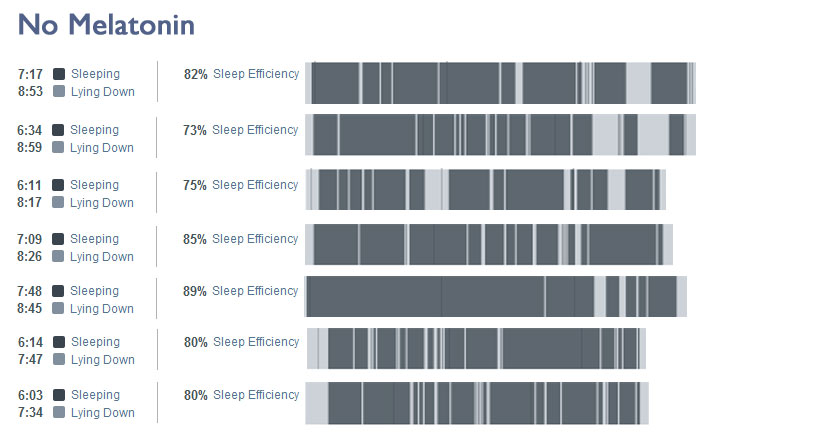
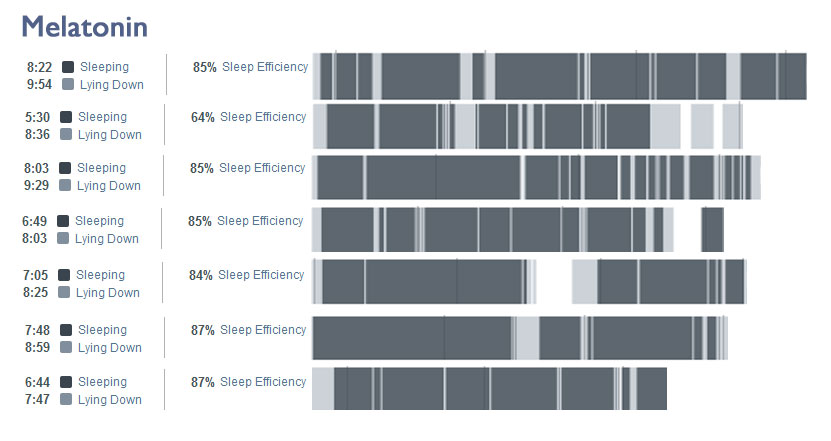
The Scientist hooked me up with an armband that monitors sleep quality. I wore it while I slept for two weeks, one week on the melatonin and one week off. Thanks to the software that came with the armband, here’s a graphic representation of how well I slept during each of the weeks:
Dark gray areas=sleeping; Light gray areas=lying down, not sleeping; White areas=not lying down/sleepingDark gray areas=sleeping; Light gray areas=lying down, not sleeping; White areas=not lying down/sleeping
I was surprised by how frequently my sleep is interrupted on any given night. There is one night out of each week that I got a long uninterrupted period of sleep. On most nights the longest period of continuous sleep is a couple of hours or ninety minutes. I knew that my sleep patterns were disrupted, but I didn’t know the problem was this bad.
I also found it interesting that I have to spend 9-10 hours in bed to get 8 hours of sleep.
So does the melatonin work? I averaged 25 minutes more sleep per night when I was taking it, which added up to an additional 3 hours of sleep for the week.
Melatonin
Since doing the sleep study two months ago, I’ve continued taking melatonin and it feels like my sleep has continued to improve. There are still nights where I only get 5 hours of sleep (last night, in fact) or I’m wide awake at 3:30 AM, but they’re less frequent. In general, I fall asleep more quickly. The melatonin creates a pleasant drowsiness that makes it easier to fall back asleep when I wake up during the night. Some days I feel a little sleepy in the morning, but that fades after I exercise, which I do first thing after getting out of bed.
If you’re considering taking melatonin as a sleep enhancer, there are some things you should know:
Melatonin makes you sleepy. Take it only at bedtime. I take 5 mg about 30 minutes before bed.
High doses of melatonin have been associated with increased depression and psychosis in people already suffering from these conditions. Also, women who are pregnant or trying to become pregnant, nursing mothers, and individuals with cancer, leukemia, lymphoma, multiple myeloma or Hodgkin’s disease should not take melatonin. It’s a good idea to consult with your doctor before starting the use of a melatonin supplement, especially if you are being treated for any other condition or taking any type of medication.
In the US, you can buy melatonin over-the-counter at stores that sell vitamins and supplements. It comes in 0.75 to 5 mg doses. Taking the smallest effective dose is safer.
Melatonin makes you feel drowsy and relaxed but not drugged, so you should still be able to easily wake if necessary, for example to respond to an emergency call from a family member.
It’s often recommended that you take melatonin every other day so you don’t inhibit natural production. (Personally, I think my natural production is already screwed beyond all hope and always has been, so I take it every day.)
Some people take melatonin for a few weeks then take a week off on the belief that it loses it’s effectiveness if taken continuously. I’ve been taking it for 5 months with only two weeks off (one due to illness and one for the sleep study). I haven’t seen a drop in effectiveness.
If you feel groggy in the morning, try reducing the dosage.
Some people experience nightmares when taking melatonin. (I’ve found that my nightmares have lessened–more on that in the next part).
Other side effects can include: mild headache, upset stomach, lower sex drive and depression. Again, reducing dosage can alleviate side effects. Most people don’t experience any side effects at a dosage of 1 mg.
Some people experience rebound insomnia when they stop taking melatonin. I stopped twice for about a week each time and didn’t feel like my insomnia was any worse than it had been before beginning the melatonin. One way to avoid potential rebound insomnia is to taper off, using lower dosages over 1-2 weeks if you decide you no longer need to take it.
My Nightmare Journal
When I wrote about nightmares, I suspected that they were connected to unprocessed bouts of anxiety. To identify trigger events, I started a log of my nightmares along with some details like possible triggers and whether I’d felt like I processed the triggering event. My goal was to become more aware of triggers and spend time working through them during my waking hours rather than letting my sleeping brain get creative with them.
According to my log, here is # of nights that I had nightmares each month:
Nov 15th-30th: 4 nights
December: 10 nights
January: 3 nights
February: 1 night
March: 0 nights
April : 0 nights
I know what you’re thinking: You did it! You learned to identify your triggers and process your anxiety!
Well, no. I tried that all through December and failed miserably. Then in January, I said “fuck you, anxiety” and I wrote this. And hey, the nightmares disappeared!
Two things seem to be at work here. First, melatonin helps me sleep more deeply, which makes my dreams harder to remember and less vivid. Of the 14 nightmares I had after starting on the melatonin, I rated 6 mild and 2 moderate. That alone is a relief.
The other thing that’s happening? I’ve become autistic in my sleep! On January 23rd, I got my flap back in a dream. After that, I had only 2 nightmares and 1 of them didn’t fit my typical nightmare profile at all. I’ve started dreaming in an entirely different way.
In my dreams now, I often tell people that I’m autistic or consciously think of myself of as autistic. That’s completely new. Twice, when it seemed like someone was going to attack me, setting off a typical nightmare scenario in which I had to physically defend myself, the police showed up and took the threatening person away! That’s never happened before. Another time, I was lost and couldn’t find my new (in the dream) apartment. I told some people who worked in the building that I was autistic and couldn’t remember where I lived and they all offered to help me. That never happens in my dreams either.
This is really exciting. I feel like the way I’m thinking about myself and my relationship with the world around me is changing in a profound way. The changes to my dream life are concrete evidence of this.
That’s not to say I don’t have any disturbing dreams. I have plenty. I dream that I’m late for important events. That I need to call 911 but no one answers or the phone doesn’t work. That I need to run but my legs don’t work. That I’m blind. That I’m in school but don’t know my class schedule. That I have a baby but keep forgetting to care for it.
I also still have weird, inexplicable dreams. That I’m playing golf, but in the opposite direction of everyone else on the course. That I’ve accidentally rubbed the ink from my tattoo off and when I check it in the mirror I notice that I’m also pregnant.
All of those dreams are unsettling, but they aren’t nightmares. I don’t wake up sweating with my heart pounding out of my chest. I don’t cry myself awake. I don’t startle awake because the dream has become so intensely physically painful that I can’t stand it anymore. I don’t spend most of the next day trying to forget frightening images. I’m not reluctant to go to sleep the next night.
I’m okay with having occasionally unpleasant dreams, as long as the really bad nightmares stay away. Will they? Who knows. I’m in a fairly stressful period right now, one that would have typically triggered a nightmare cycle in the past. So far, nothing.









 Musings of an Aspie