As promised, here is the second of the blog awards I’ve been tagged for. MCS Gal at Cooking for the Chemically Sensitive tagged me for the Reality Blogging award. Her blog is a mix of practical kitchen/household tips and recipes for those who have chemical sensitivities, so if that’s you (or someone in your family) check it out.
The rules for this one are simple and I’ve pasted them at the bottom. I’m going to prompt twist and use my “7 things about me” to talk about one specific thing: writing.
1. Between my junior and senior years in high school I applied to a summer writing program at Yale. I submitted the required piece of short fiction and soon received an acceptance letter. . . to the nonfiction program. Because my fiction was so good that they thought I should be writing nonfiction? After reading the brief program description, I declined. There was no way I was going to go on “experiential” field trips every Saturday and then spend the week writing about them. That would have required talking to strangers. Seriously.
2. I have always written Autistic characters. I haven’t always known that I was doing it.
3. Early last year, I tried to talk my way into a creative nonfiction class. I was an econ major; the class was an upper division course for writing majors. It sounded interesting and fit my schedule so I asked the prof for an exemption from the many prereqs. I talked up my published short stories and my nonfiction editing experience. “Have you ever written any memoir?” she asked. And my first thought was, who would want to read about my life? I didn’t get into the class. Life is funny like that.
4. I have a phantom word problem. Sometimes I skip over a word when I’m typing–usually a short word like at or not–and when I proofread, my brain “sees” the missing word. It’s frustrating. I worry that people think I don’t proofread, when in fact I often read posts a half dozen times or more before publishing. I read in gdocs, on paper and in the post window. Sometimes reading in a different format or taking time away from a piece reveals the missing words, but not always.
5. When I can’t find just the right word, I worry that the right word doesn’t exist. I worry about this in the way that some women worry that their soulmate doesn’t exist.
6. Over the years I’ve been fortunate to have three writing buddies–Mary, Michelle and Kathryn–talented writers willing to look over my drafts and make suggestions. It’s rare thing to find someone who is closely matched in skill level and willing to slog through hundreds of thousands of words to let me know that I might want to put a comma here or explain myself better there. I can only hope they’ve gotten as much out our writing partnerships as I have.
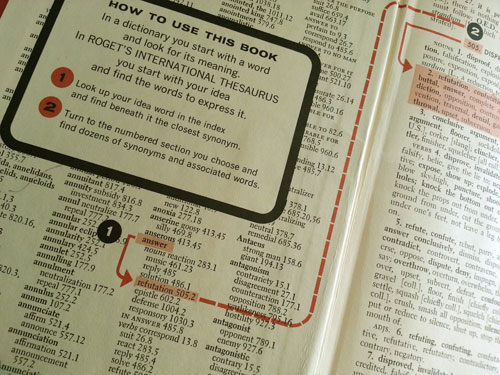
7. One of my most cherished possessions is my 1962 third edition of Roget’s International Thesaurus. The words are grouped by ideas rather than alphabetically, which is a beautiful thing. I stole it from a nun. Sister Laurette. I think she stole it from someone else because she inscribed her name over a different set of initials.
My Roget’s Theasaurus, yellowed, stained and falling apart
There are, of course, rules:
show appreciation of the blogger who nominated you and link back to them in your post;
add the award logo to your blog;
share 7 things about yourself;
nominate 5 – 10 or more bloggers you admire;
contact your chosen bloggers to let them know.
And now, in keeping with my theme, I’m going to tag some bloggers who I admire as writers. Don’t feel pressured to do anything with this, folks. I know one of you isn’t even blogging any more. This is my way of saying I like what you write and I also like how you write it.
Aspie Writer who is blogging her excellent memoir, Twirling Naked in the Street. I don’t comment on it nearly enough but I’m always excited to see a new installment pop up in my reader.
Adrienne at Eat Me, Drink Me, Bite Me, because it was her honest, gutsy blogging that planted a seed in my head.
Unstrange Mind who is fearless and whose courage makes me want to reach deeper.
Ariane, who writes at Emma’s Hopebook, where amidst the smart, thoughtful commentary you will find beautiful sentences like this: “Different sized flakes whirl about as though unaware that gravity will eventually win out.”
Lori at A Quiet Week in the House, who I am putting last because once you go look at her gorgeous artwork, you will forget to come back here.
This is the 4th part in an ongoing series about being diagnosed as autistic at the age of 42.
Mourning the Loss
Eventually reality set in. I’m autistic.
Not the happy “Yay! I’m different! I’m unique! I’m special!” autistic.
More like “Holy crap . . . I’m defective . . disabled . . . challenged . . . never going to get any better” autistic.
This was when the mourning began. Once the bright shiny new this-explains-everything stage wore off, I started thinking about the other side of being autistic. I wasn’t going to “outgrow” my social awkwardness. I wasn’t going to wake up one day and suddenly have a balanced emotional life. The challenges I faced weren’t imagined and they weren’t going to magically disappear. They were with me for life.
This is me. This is always going to be me. Forever.
Talk about hard realizations.
The questions that arose were mostly variations of “how would my life have been different if I wasn’t autistic?” As I tried to envision taking away this or that autistic part of me, it became obvious that Asperger’s was responsible for a lot more than what makes me weird. It’s responsible for many of my strengths, too. Take it away and I’m no longer me.
That person I was mourning? She doesn’t exist.
Mourning the Loss
Don’t be afraid to acknowledge your anger, disappointment, sadness or other negative feelings.
Recognize your strengths along with your weaknesses.
You’ve always been autistic and always will be. However, that doesn’t mean you can’t work on learning social skills, developing coping mechanisms or changing your lifestyle/environment in ways that support you.
Healing the Child (or Younger Self)
Growing up undiagnosed is hard. There is a lot of pain that comes from knowing that you’re different but not knowing why. Asperger’s gave me an explanation, but more importantly it gave me a starting point for healing that scared, confused kid inside me.
As I worked back through the more difficult aspects of my childhood, I felt like I was somehow mothering my younger self–revisiting each moment, looking at it in a new light and telling that younger version of me that it wasn’t my fault, that I’d done the best I could, that to expect more from me in the absence of support would have been unreasonable.
I wasn’t “obviously” autistic as a child–girls manifest ASD traits differently than boys in many cases and Asperger’s didn’t exist as a diagnosis in the 1970s.
I was, however, a handful. I was overly smart, easily bored, very curious and constantly in motion. Consequently, I got a lot of guidance from adults on how to behave properly. This reined in my more problematic behaviors, but it also made me feel like I was forever in danger of doing something “wrong,” especially when I “wasn’t trying hard enough.”
Being able to look back at my childhood and see that my behaviors were a result of my brain chemistry and not a result of “not being good enough” allowed me to begin to heal some of those lingering insecurities.
Learning more about Asperger’s helped me understand that I was bullied not because I was weird, but because I was socially inept. Reading about selective mutism gave me an explanation for my largely silent elementary school years–the ones where I never spoke in class unless forced to. Finding information about how ASDs manifest in girls shed light on why I had so much trouble maintaining friendships.
Each new bit of information absolved me of some perceived failure as a child and helped me begin healing some very old wounds.
Healing
Learning more about Asperger’s/autism in children can help you understand challenges you faced in childhood.
As an adult, you can choose to forgive the people in your life who hurt you as a child.
It may help to imagine your adult self sharing your new information with your child self as a way to offer comfort or explanations for unhealed childhood wounds.
If you find yourself having distressing reactions that are difficult to cope with, consult with a mental health professional or a trusted friend/mentor for help.
NT: Fine. Don’t tell me. I was just trying to help.
When an aspie says they don’t know what they’re feeling, it’s a literal statement. We aren’t trying to dodge the conversation. We aren’t withholding information. We aren’t being rude, mean, cold coy or vindictive.
I’ve had variations on the above conversation many times and it’s as frustrating for me as it is for the person who wants to know what’s wrong. The reason? I have difficulty identifying my emotions and even more trouble verbalizing them. Working through my emotional constellations has helped me identify some of the specific issues I–and many autistic people–have in processing and identifying feelings.
(Photo: Joe Shlabotnik / Creative Commons)
Predictably, I’ve grouped the issues into three general categories:
modulation (moderating the strength of my own emotions)
determination (identifying emotions in others)
discrimination (separating emotion directed at me from general expression of emotion)
Modulation: The Glitchy Volume Control
There is a common misconception that autistic people are unemotional. You’ll often hear this refuted by autistics themselves, who say they are too emotional. So which is it? For me, it’s both. My emotions gravitate toward the extremes of muted or intense; few emotional experiences fall in the midranges.
My default emotional state is neutral. I don’t feel especially good or bad. I’m present in the moment and content to be so. Externally, I may come across as serious or subdued, but reduced expressiveness shouldn’t be confused with a negative state of being or a lack of feeling.
The feelings are definitely there. Most of the time they quietly mind their own business and I need to consciously check-in to see what they’re up to. When they decide to fully surface on their own, however, they’re intense.
Unlike most neurotypicals, I don’t have a lot of ability to modulate the strength of my emotions. Imagine a radio with an on/off switch and a glitchy volume control.
If you think about this in terms of the weak executive function associated with Asperger’s, it makes sense. Humans use reasoning, rationalization and labeling to modulate emotion. All of these methods fall under the umbrella of executive function. Labeling emotions, in particular, seems to be hard for aspies.
Determination: The Broken Mirror
Just as I have difficulty labeling my own emotions, I have trouble identifying what others are feeling. I struggle with interpreting facial expressions and body language. I’m weak at perspective-taking. Basically, when it comes to reading emotional clues, I’m like one of those old-time detectives who had to solve murders without any forensic evidence. There’s only so much information you can gather from what people tell you outright.
This difficulty determining what others are feeling is a big contributor to the stereotype of the empathy-deficient aspie. If someone is giving off “I’m sad” cues that I fail to recognize, when I don’t console them, they’ll assume I’m cold and unsympathetic.
For neurotypical people, emotional interaction is like looking in a mirror. They expect to see a reflective emotion looking back at them and when they don’t, they assume the mirror is broken.
This isn’t to say I’m oblivious to other people’s emotional states. I get the obvious ones and the ones that I can derive from contextual clues. What I tend to miss are the subtle or unexpected emotional states.
Discrimination: Missing the Target
I’ve always been disturbed by confrontation and conflict, even when I’m only a bystander. By default, The Scientist is in charge of “confrontation with others.” If something needs to be argued over or complained about–a botched repair job or an over-cooked restaurant meal–that’s his department. While he’s making that phone call or waiting for the manager to appear, I go off and hide.
As an adult, I’m not proud of this. Why do I desperately need to flee a situation to which I’m nothing more than an observer?
Because, I recently realized, I don’t discriminate between anger that is aimed at me and anger in general. When someone is angry, I invariably feel like I’m the cause or the target, even when I rationally know that I’m not.
If The Scientist calls me after a bad day, I hear how upset he is and immediately feel distressed. Not distressed as in “I should console my husband because he’s had a bad day.” I feel distressed in a “this is incredibly stressful and I want it to stop” kind of way. My brain immediately goes into “fix it” mode, searching for a way to make the other person feel better so I can also relieve my own distress.
Of course, a conversation with an upset spouse is upsetting to most people. But what about a conversation between two strangers that I’ve merely overheard? Twice in the past two weeks I’ve witnessed one person berating another for an etiquette infraction at the swimming pool. (Yes, we take our lap swimming seriously around these parts.) Both times I felt my heartbeat skyrocket, as if the anger was directed at me. In reality, I’m sure neither of these people even noticed I was standing nearby.
Even now, as I’m sitting here in Starbucks typing, the woman at the next table is telling a story about how mad she is at her sister-in-law; I can feel my blood pressure rising at the tone of her words. Words that are completely irrelevant to me. Words that, thanks to my funky brain wiring, I find impossible to tune out.
Yes, not only does my autistic brain not know how to interpret the emotional content of other people’s conversations, it also refuses to tune them out. And people wonder why we aspies like to spend a lot of time alone.
It took me a long time and a lot of thought to figure out why I respond to secondhand distress like this. Why should I feel emotionally assailed when the angry words are aimed at another person?
In part it’s related to my upbringing, but there is also an element of weak executive control at work. In theory, I should be able to rationalize away my overreaction by telling myself that I’m observing generalized anger (or frustration or sadness), not anger directed at me. I should be able to put myself in the other person’s shoes and direct my emotions at the target of their distress, rather than feeling like the target myself.
Alexithymia
The three areas where I have difficulty–modulation, discrimination and determination–are actually core traits of alexithymia.
Alexithymia (literally: having no words for emotions) is impairment in identifying and describing emotions. Specifically, it’s characterized by:
difficulty identifying feelings
difficulty distinguishing between feelings and bodily sensations related to emotional arousal
difficulty describing feelings to others
impoverished imagination and fantasy life
a stimulus-dependent, externally oriented cognitive style
When I look at the list of alexithymic characteristics, I also realize that when I’m emotionally uncomfortable, I’m more likely to have physical complaints. I’ll be feeling frustrated or sad, but complain that I’m uncomfortably cold or intolerably sleepy. This isn’t a connection I would make on my own, but once I see it described as part of alexithymia–like so much about my autistic self–it suddenly makes perfect sense.
There is a lot of overlap between alexithymia and ASD, both in the perception of emotions and the difficulty in verbalizing feelings. Not only are autistic people very likely to exhibit the characteristics of alexithymia, their parents are as well. However, many non-autistic people also have alexithymia, so it isn’t exclusive to ASD.
Alexithymia isn’t a clinical diagnosis like autism. It’s a construct (theory) used to describe the traits of people who have difficulty verbalizing emotions. It’s also a helpful way of thinking about some of the challenges that aspies have with processing feelings.
—–
More on Alexithymia and ASD:
Next Tuesday, we’ll be doing the Alexithymia Questionnaire for Take-a-Test Tuesday.
Alexithymia and Grief at Unstrange Mind is a challenging and insightful piece about the mourning process
Great example of an Alexithymia cheat sheet in the form of a flow chart at Radical Neurodivergence
Thinking on Your Feet is a new test at Test My Brain. I was planning to do the creepy Face in the Branches test today but it’s no longer available. Instead I took Thinking on Your Feet, which isn’t an Asperger’s test but does test some of the cognitive areas that can be impacted by ASD.
Thinking on your Feet consists of three short tests:
Find the flickering dot: You’re shown a set of blue and yellow dots that flash intermittently and you have to find the dot that’s changing color. There are sixteen sets of dots.
Visual working memory: You’re briefly shown a set of four shapes arrayed around a plus (+) sign. The set disappears and one shape reappears. You press “s” if the shape is the same as the one you saw in that position in the set and “d” if it is different. There are 42 sets of shapes.
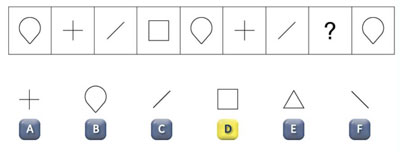
Visual reasoning: You’re shown a matrix of shapes and have to identify the “missing piece” from 5 possible choices. There are 35 matrices and they become increasingly difficult.
Example of a nonverbal reasoning matrix
As I was taking the tests, they reminded me of some of the cognitive tests I took during my Asperger’s evaluation.
The first and third tests measure components of executive function: attention and working memory. Executive function is way of describing our brain’s command and control center. It encompasses things like planning, problem solving, and verbal reasoning as well as starting, stopping, switching and monitoring tasks. Many aspies, including me, have impaired executive function.
The second test–visual reasoning–relies on nonverbal reasoning. Many aspies excel at tasks requiring nonverbal reasoning, either because they think visually or are skilled at pattern recognition.
Working with those general assumptions, individuals on the spectrum are probably more likely to score above average on the second test and average or below average on the other two.
Taking the Test
First a warning:One section of this test has a set of colored dots that flash at a steady rate. The flashing isn’t rapid, but the dots are quite bright and you have to study them as they flash to find one that is different. Is this sounds like it may be uncomfortable or triggering for you, don’t take this test.
The test guidelines say it takes about 30 minutes to complete. I finished in a little over 20. The first and third tests go pretty quickly, but you may want to spend more time on the visual reasoning section, depending on how quickly you can solve the harder puzzles and how much you care about your score.
When you’re ready to give it a try, go to the Test My Brain site and click the Go! button next to the Thinking on Your Feet test. You’ll be asked to agree to the consent form and provide some demographic information (age, handedness, primary language, etc.) to help the researchers analyze the data they’re collecting via these tests. It’s all anonymous and you won’t be asked for any personally identifying data.
Before each section of the test, you’ll be given written directions as well as two practice trials to be sure you understand what to do. After the three tests are complete, you’ll be asked for your SAT scores. If you don’t remember them or never took the SAT you can skip this section. It has no impact on the results you receive.
Scoring the Test
You’ll get three separate scores. Here are mine:
Find the Flickering Dot: I got 14.63, which is a measure of the average number of screen flashes it took me to find the dot. The average score on this test is 20.53.
I scored better than 30% of other test takers
Visual Reasoning Test: I got 31 out of 35 correct. The average score is 25.76
My visual reasoning score is in the 90th percentile group
Visual Working Memory: I got 37 out of 42 correct. The average score is 33.91.
My visual working memory score is better than 60% of the other test takers
If we assume that the scores are normally distributed, then scores that fall between the 25th and 75th percentile are in the average range of ability. Or to put it another way, if your blue guy is standing somewhere in the middle of the pack, your scores are average. If he’s standing in the first two or last positions, you’re above or below average.
For the flickering dot and visual working memory scores, my blue guy is standing in the middle six, which means I have average scores . On the visual reasoning test, my blue guy is in the second to last position, meaning I have an above average score.
I went back and looked at my ASD evaluation report to compare the results of the comparable cognitive tests with these and they’re quite similar. My scores were above average for perceptual reasoning and average for attention. I didn’t take a visual working memory test so I don’t have a direct comparison there. I did take two verbal working memory tests and my results were “impaired” on both, meaning my little blue guy was standing in the first position in line.
It’s no surprise to me that I scored better on visual working memory than verbal. My verbal cognitive test scores are poor across the board and I’m much more comfortable working from printed or visual material than from oral directions.
The Bottom Line
This set of tests is an interesting look at some of the cognitive elements that are thought to be ASD strengths and weaknesses.
Working my way through The Complete Guide to Asperger’s Syndrome, I found myself revisiting moments in my life that had been confusing, painful or traumatic. Suddenly, so much of my life made sense in the context of aspie traits.
Difficulty making friends? Impaired social communication skills
Clumsy? Motor planning deficit
Poor handwriting? Problems with fine motor coordination
Massive stamp/coin/doll/baseball card/Lego collections? Abnormally intense interests
Not a hugger? Tactile defensiveness
The odd reactions I get from people? Poor eye contact, flat affect, inability to read body language
and on and on and on . . .
When I got to Attwood’s description of the little aspie girl lining up her Barbie dolls and their clothes instead of playing with them, I literally shouted with joy. There are other people like me! I’m not defective. I’m not randomly weird. I’m an aspie. One of many.
I’d found my tribe and it was good.
This process of giving meaning to experiences is sometimes known as sensemaking or creating a sensemaking narrative. It happens when our current way of understanding ourselves or our situation is inadequate. Without the Asperger’s piece of the puzzle, I was forced to cobble together incomplete explanations for my developmental history and my life experiences.
Once I had a basic understanding of Asperger’s, I could apply that knowledge to “make sense of” my life in a new way.
Petroglyphs, Mystery Valley, Monument Valley Navajo Tribal Park, Arizona Bernard Gagnon (Creative Commons Attribution-Share Alike 3.0 Unported)
Sensemaking has a few key steps, most of which I found happening naturally as I processed my newfound identity.
The Sensemaking Process
Shift in identity – identification as aspie/autistic
Retrospection – looking back at key life events in the context of this new identity
Building narrative accounts – retelling the story of your life in light of AS/autism
Sharing your narratives – strengthening and preserving your stories by sharing them with others
Reflecting – the ongoing process of receiving feedback on your stories and reshaping them as your understanding of your narrative changes
Each person’s sensemaking narrative is unique. Mine takes several forms: thought, speech and especially writing. Right now, my blog–including your comments and my replies–is the cornerstone of my sensemaking narrative.
Making Sense
As you learn more about AS/autism, does it help you better understand difficult or confusing life events?
Can you retell those events in a new way now?
When you’re ready, share your new understanding with trusted people in your life.
Sharing can take many forms: oral, written, visual or mixed media. It can be factual, fictional, derivative or a combination. This is your story. Tell it your way.
Don’t be afraid to revise and refine your story as your knowledge expands or your perception changes.
Something is happening deep inside me, something unexpected and strange and fantastic. I’m not sure if I can describe in any sort of way that will make sense, but here goes.
*
Last night I had a dream. I was in a railway station, crossing the platform to the exit, when I came upon a woman and her pet goose. As I accidentally stepped between the woman and the goose, the goose nipped at my pants. Surprised, I yelped and flapped my hands.
*
Here’s the strange part: I haven’t flapped my hands since I was very young. From watching old home movies, I know that I flapped as a toddler and preschooler. I’m not sure when I lost my flap but my best guess is very early in elementary school.
Here’s the unexpected part: I’ve never consciously stimmed in a dream. I didn’t realize the lack of stimming in my dreams until I woke up this morning and was overpowered by the memory of my dream flapping.
Which brings me to the fantastic part: In the dream, in that moment when I flapped, I was flooded with the sensation of being connected to my original self.
*
Huh?
I know.
I don’t think there are words to describe that last part properly. It felt like a wormhole to the past opened up and for the briefest moment I was able to experience my self as a very young child. Not imagine or remember, but actually experience it.
It was unlike anything I have ever felt, imagined, or experienced as an adult. I can’t even say that I clearly remembering feeling that way as a child.
Perhaps it has nothing to do with childhood. Perhaps the concept of original self transcends age and hinges instead on access.
I don’t know and I don’t really care. I have to give it a name so I can tell you about it, but in my mind, it doesn’t need a name. It is a state of being, as clear as any I’ve ever experienced.
It felt like untainted joy and freedom. It felt infinite. It felt like I was connected to the absolute most original version of my existence.
I can’t explain how I know that, but I do.
And it was so strongly tied to that flap–that startled, instinctive response provoked by the angry little dream goose.
*
But it was a dream, right? Dreams trick us into thinking all sorts of strange things.
Perhaps.
But dreams also tap into our subconscious in ways that we can’t access when our waking defenses are active.
*
All morning I’ve been thinking about why this happened. Why now?
What I’d like to think is this: I’m slowly rediscovering my original self.
Part of that rediscovery is tuning in to my urge to stim and setting it free. Too many years of reflexively quieting my body, of squeezing my stims down to their least noticeable versions, has disconnected me from myself in an essential way.
Slowly, slowly, the stims of my childhood are coming back. Last night as I was waiting for the pasta to cook, I found myself twirling in the kitchen and instead of stopping, I let myself enjoy it. I kicked out my foot and make a full spin to the right, then kicked out my other foot and twirled to the left. I did it again and again and soon I found myself laughing out loud.
Twirling around in the kitchen feels good. It feels right.
*
As I unlearn my habit of minimizing my stims, I feel like I’m reintegrating parts of myself that have been disconnected for a very long time.
And I find myself wondering if acceptance comes not from learning to accept but from unlearning a lifetime of rejecting.
This week I took the Empathy Quotient (EQ) test. I know many of you have been waiting for this one. Next week we’ll do something less technical and more fun, but this week, I’m gonna hit you with a lot of background info. The EQ and the 2004 study that it was originally used in created a firestorm of controversy that never really died down.
The Empathy Quotient (EQ) test is intended to be a measure of your ability to understand how people feel and to respond appropriately. The questions on the EQ are based on the following definition of empathy:
“Empathy is the drive or ability to attribute mental states to another person/animal, and entails an appropriate affective response in the observer to the other person’s mental state.” (Baron-Cohen and Wheelwright, 2004)
This definition encompasses both cognitive empathy (perspective taking/attribution) and affective empathy (emotional response to another’s emotional state). Although many autistic people have described distinct variations in their perceived levels of cognitive and empathic empathy, Baron-Cohen and Wheelwright state that cognitive and affective empathy are too difficult to untangle and therefore must be looked at as a whole.
A subsequent 2005 study by Muncer and Ling challenged this belief by sorting 23 of the 40 EQ questions into three domains: cognitive, emotional reactivity, and social skills. To give you an idea of what types of skills fall into each domain, here are the top 5 most relevant questions for each:
Cognitive
I can tune into how someone else feels rapidly and intuitively
I am good at predicting how someone will feel
I am quick to spot when someone in a group is feeling awkward or uncomfortable
I can easily work out what another person might want to talk about
I can sense if I am intruding, even if the other person does not tell me
Social skills
I do not tend to find social situations confusing
I find it hard to know what to do in a social situation
I often find it difficult to judge if something is rude or polite
I find it difficult to explain to others things that I understand easily, when they do not understand it first time
Friendships and relationships are just too difficult, so I tend not to bother with them
Emotional reactivity
I tend to get emotionally involved with a friend’s problems
Seeing people cry does not really upset me
I really enjoy caring for other people
I usually stay emotionally detached when watching a film
If I say something that someone else is offended by, I think that is their problem, not mine
The 2005 study tested the 23 domain-specific EQ questions for gender differences. The emotional reactivity domain had the greatest gender differences, the cognitive domain had fewer differences and the social skills domain showed no differences in scores along gender lines. The authors theorized that emotional reactivity may be strongly rooted in the “willingness of an individual to express emotion” (drive) rather than the ability to understand another person’s emotional state.
This raises the question of how alexithymia (emotional dysfunction), which affects many people on the spectrum, might impact EQ scores. Many people on the spectrum experience alexithymia, making them less willing or able to express emotion due to challenges in regulating and processing feelings. Perhaps it isn’t that autistic people can’t understand the emotions of others, but that the cost of responding appropriately is too high.
Gender Bias Revisited
If you’ve been following Take-a-Test Tuesday closely, you’ve seen the discussion of gender bias in other screening instrument studies. The EQ study was heavily weighted toward males, with 65 males and 25 females in each group. That’s more than twice as many males as females in a study of a trait that is known to have gender differences in scoring.
Traditionally males score significantly lower than females on self-reported measures of empathy. On top of that, the EQ study had significantly more control group women than men with above average scores (>54) and 14% of control group males in the EQ study scored in the AS/HFA range.
Now consider that this study was used to test:
whether adults with high-functioning autism (HFA) or Asperger’s Syndrome (AS) have lower EQ scores
whether the EQ is inversely correlated with the AQ (i.e. the “more autistic” you are, the “less empathetic” you are)
whether the EQ inversely correlates with the Friendship Questionnaire (i.e. the “more autistic” you are, the less reciprocity and intimacy you’ll report having in relationships)
for sex differences in empathy
Baron-Cohen used the low EQ scores of the HFA/AS group as support for his theory that HFA/AS is an “empathy disorder.” The researchers subsequently conducted interviews with many of the HFA/AS study participants and reported that while they had difficulty knowing that their actions hurt another person, they did feel bad about it when such instances were pointed out to them, and therefore “are not like unfeeling psychopaths.” (As I write this, I’m envisioning the tops of my autistic readers’ heads flying off. Repeatedly. Sorry.)
This study is also used as evidence to uphold another of Baron-Cohen’s theories (extreme male brain theory), further calling the motivation of the study design into question.
So, now that we’ve gotten ourselves all worked up about the questionable science underlying the EQ, let’s actually take the darn thing.
Pros and Cons of the EQ
Pros
Self-scoring
Scoring of slightly/definitely choices is weighted
Filler questions attempt to reduce repetitiveness
Clinically tested in both ASD and non-ASD populations
Cons
Measures cognitive empathy, emotional reactivity and social skills but doesn’t provide subscale scores
May be gender biased
May exhibit bias toward developer’s theory of autism
Probably longer than it needs to be (a 15-item version has shown similar outcomes)
Self-reported measures of empathy often have poor correlation with tests of empathic accuracy (i.e. we tend to think we’re either more or less empathetic than we are)
Taking the Test
When you take the EQ, you may question the relevance of some of the items. That’s because 40 are related to empathy and 20 are filler questions meant to be a distraction from the repetitive nature of the empathy questions. Only the 40 empathy-related questions count in the scoring; the 20 filler questions score a zero no matter how you answer them.
You can take the test here. There are 60 questions. Unlike some of the other tests we’ve taken, this test gives 2 points for a “definitely” answer and 1 point for a “slightly” answer so degree matters.
Scoring the Test
Possible scores range from 0 to 80. The average NT scores from two different studies were 47 and 50 for women and 41 and 42 for men. The average aspie score is 20.
A general scoring guideline:
0-32 = below average
33-52 = average
53-63 = above average
64-80 = significantly above average
I got a 12. The Scientist got a 48. I’ve taken the EQ twice in the past, and got an 8 and a 10. I jokingly told The Scientist this past week that I’m now 50% more empathetic.
If you get a ridiculously low score on this test, keep in mind that it’s measuring a few different things and conflating them into one “empathy” score, which isn’t very accurate. After reading the Muncer study, I wish the test returned subscale scores for cognitive, emotional reactivity and social skills. I’d like to know which of the areas I actually scored some points in.
The Bottom Line
The evidence for the EQ as a unidimensional measure of empathy is weak. Aspies tend to score low on the EQ, but what that means is unclear.
In the past couple of weeks, I’ve been tagged with two blogging awards: the Liebster and the Reality Blogging award. I’m going to do the Liebster today and the Reality award next week because some of the people I want to tag for the Reality award just got tagged for a Liebster and I don’t want to overwhelm anyone.
Alyssa from Yes, That Too tagged me for the Liebster. She writes smart, insightful and sometimes angry things about autism and being autistic and advocacy. Sometimes she writes Chinese language posts that I can’t read but like to look at nonetheless. Go see what she’s up to, if you haven’t already.
The Liebster Award rules are:
1. Give 11 random facts about me.
2. Answer the 11 questions that Yes, That Too gave me.
3. Make 11 new questions for the people I tag to answer.
4. Tag 11 blogs that are new or have less than 200 followers.
Facts about me:
I’m allergic to dogs but I have one anyhow.
I love roller coasters. When I was a kid and there was a school trip to an amusement park, I used to spend all day going on the roller coasters.
I have a 5th degree black belt in taekwondo.
When I was in third grade, I was the kid whose two strides most closely measured a yard so I got to go outside and walk around the building to measure its circumference. I think there was a math lesson involved but all I remember is being absurdly proud of my prowess as a human yardstick.
I’ve visited 46 of the 50 US states. (WA, OR, SD and ND, in case you’re wondering)
I love the smell of fire.
I’m not afraid to edit the Windows registry on my computer.
I like to climb trees but I’m afraid of heights.
Right now, I’ll only write with a Pilot G-2 pen. I have a box each of blue, black and red.
I eschew the Oxford comma.
I can comfortably swim a mile without stopping.
11 Answers:
How old are you? 43
Why did you start blogging? To try to understand autism and specifically my autistic experience better. Blogging is taking me to all sorts of unexpected places.
What is the most frustrating song you have ever had stuck in your head? The Oscar Meyer Weiner song. It happens a lot when I run, because it’s the perfect running rhythm for me. Also, I once spent an entire 6-mile run with Bruno Mars’ “Lazy Song” playing in my head on repeat. That was torture and made no sense.
Do you have a useless talent? (If so, what?) I can break boards with my hands and feet.
What is something that happened to you where people responded with “Only you could…” I broke my nose falling into a trash can. It sounds like something that would happen to a sitcom character but it required internal and external stitches to fix so it sounds funnier than it was.
Have you read Loud Hands yet? (And if you haven’t, WHY NOT?) It’s on my list of books to buy and read! I’m currently reading Ask and Tell, which is excellent. I’m going to add it to my blog’s resource page when I finish it. The I’m going to get a copy of Loud Hands.
Do you take things literally? Yes, all the time and it can be frustrating and embarrassing.
What is the most hilarious rumor that has been spread about you (that you know of and are willing to share?) I don’t think I’m socially well-connected enough to (a) have rumors spread about me and/or (b) know about them.
Do you know any other languages? (Which ones? How proficient?) Yes, 4, which is weird because I have no natural aptitude for learning foreign languages. Other than English I learned French all through high school and was able to read novels and watch movies in French back then but I’m not that proficient any more. I took one semester each of Latin and Spanish so I have rudimentary skills in both. I know enough Korean to follow dinner table conversation, order a beer and know if the people on the bus are talking about me.
If money were no object, where would you travel? I’d spend a few months traveling across Europe by train.
If money were no object (and hence you could hire people/lobby/etc) what change would you try to make in the world? If money were literally no object I would eliminate poverty, though I don’t think that can be done with money alone, so honestly I’m not sure.
11 Questions:
What book are you currently reading?
What hobby or interest would people who don’t know you well be surprised to learn you have?
Coffee, tea or something else?
If you could have a superpower, what would it be?
What’s your go-to activity for entertaining out-of-town guests?
If you could have any sort of animal for a pet, what would it be? (assume anything is possible, like if you want a pet giraffe, your neighbors won’t mind a bit)
Do you have any phobias?
When did you start writing?
Which Halloween candy did you eat first and which did you always give/throw away?
How far away from your place of birth do you currently live?
If someone is only going to read one thing on your blog, what would you like it to be?
11 Bloggers I’m Tagging:
(If you’re on the list and don’t fit the rule criteria, well, screw the rules. I’ve never been good at following them anyhow.)
As an adult, there are a few common ways that you might realize you’re on the spectrum:
your child is diagnosed with ASD and in the process of learning more about autism, you recognize autistic traits in yourself
someone in your life reads or hears about Asperger’s or autism and tells you that they see a lot of ASD traits in you
you hear or read about Asperger’s or autism in the media and recognize yourself in the description of ASD traits
you take one of the online ASD tests and get a result that says you are “likely an aspie” or “likely autistic”
Your reaction to this first contact with Asperger’s or autism might be “I kind of knew that” or it might be “bullshit!”
For many years, I dismissed my AQ scores. I was convinced that everyone who took the test got a score that said they were likely autistic. Wouldn’t everyone answer the way I did if they were being honest? Completely irrational, yes, but I wasn’t ready to accept what was staring me in the face.
Then came the Finch story on NPR. When it was over, I Googled “Asperger’s tests” and came upon the Aspie Quiz. My score was way above the cutoff for Asperger’s. I took it again, answering more conservatively. Still above the cutoff.
I sat there at my desk for long minutes. Could it be possible that I’ve been autistic all my life and not known it? That’s a stunning realization–one that would require me to reframe everything I thought I knew about myself and everything I’d assumed I knew about autism.
I’ve always known that I’m different. I’ve been labeled shy, weird, introverted, geeky. But what if I wasn’t just weird? What if this thing called Asperger’s explained everything about me that was different?
That was an exciting thought. If it was true, it gave me a whole new way of thinking about my life.
Embracing Your Realization
Relax. Breathe.
Take some time to think about what being on the spectrum might mean to you.
Retake the AQ or Aspie Quiz as many times as you need to.
Make a list of traits that you see in yourself, including specific examples if you find it helpful.
Reassure yourself that you aren’t making this up.
Is This Me?
I didn’t do anything with my realization right away. It was a lot to process. I kept coming back to the possibility that I was imagining it.
Late the next day, during a long drive home with The Scientist, I brought up my suspicion that I might be an aspie. His reaction was guarded. He listened, agreed with much of what I said, then reassured me that he loves me exactly the way I am. It was a good discussion, but he didn’t sound convinced. I needed more data to back up my hypothesis.
Back at home that night, I showed him some things online, including Rudy Simone’s list of Female Asperger Syndrome Traits. He read through the list, nodding at many of the traits, just as I had, looking a little more convinced of my hypothesis with each “hit.”
In the days that followed, I searched the internet for more information about Asperger’s and found frustratingly little that applied to adults. I felt like I needed a more comprehensive resource, something that would give me a better picture of Asperger’s than the sometimes conflicting bits and pieces I was collecting online. (Sadly I hadn’t yet discovered autistic bloggers.)
Determined to find information about Asperger’s in adults, I scoured the reviews at Amazon.com and settled on The Complete Guide to Asperger’s Syndrome. Having now read a good portion of the books available on ASD, this is the still one book I’d recommend if you’re looking for an accessible, reasonably comprehensive starting place.
Diving into the book immediately after it arrived on my doorstep, I spent hours underlining and annotating it. I read passages aloud to The Scientist. I made notes and looked up things like executive function and special interests online. Most of all, I just kept saying to myself, “This is me. I’m an aspie.”
Somehow, it had taken me 42 years to recognize it.
Gathering Information to Support your Realization
Research Asperger’s Syndrome and autism.
Read about how autistic traits appear in adults.
Read about the differences between AS in men and women.
Let’s get the hard part out there first: I lack empathy.
By lack, I don’t mean a complete absence of empathy; I have an empathy deficiency. If most adults are “doing empathy” at the calculus level, I’m still in Algebra II and solving for X in ways that would make your head spin.
Before I discovered the online autism community, I assumed that my impaired empathy was typical for someone with Asperger’s. Much of the published literature includes impaired empathy as a common AS trait. “Lack of social or emotional reciprocity” is one of the diagnostic criteria. My own experience didn’t disprove that.
Then I discovered the online ASD community and suddenly felt like I needed to hide my struggles with empathy. Everywhere I looked people were refuting the notion that autistics lack empathy.
Again and again I’ve encountered discussions about empathy online and quietly slunk away, feeling like there was something wrong with me–like I was a “defective” autistic.
I Googled empathy–probably one too many times. I read the long list of definitions at Wikipedia . I read Simon Baron-Cohen’s writing on the subject and felt the same anger others have expressed at his biases. I read looooong threads on Wrong Planet and Facebook. I revisited the diagnostic criteria. I combed through the #actuallyautistic tag on Tumblr.
The more I read, the more confused I became. I started to wonder if I was talking about the same thing others were talking about when I use the word empathy.
So let’s talk about that. What is empathy, exactly? What are we talking about when we talk about empathy?
Sympathy vs. Empathy
Empathy, in the most basic sense, is the ability to understand and share an emotional state with another person.
As an adult with a good amount of life experience, I can often understand the emotional state of another person. I know that if someone’s dog has died, they’ll feel sad. Most people probably come to this conclusion in a more instinctive way than I do, but I get there all the same.
Depending on the situation, I may share an emotional state with another person to some degree. I know how I felt when my dog died. Logically I know that the other person feels very sad. If I knew the person’s dog, I’ll feel a sense of loss myself, and that will contribute to my sharing their emotional state. However, I rarely experience a strong emotional reaction to another person’s circumstances.
That’s not to say that I don’t experience concern toward other people. Simple concern for others, though, isn’t so much empathy as sympathy. Sympathy is a concern for the wellbeing of another person. It can exist in the absence of the empathic act of sharing an emotional state with that person. It often arises from empathy, but it doesn’t have to.
When my daughter says she’s had a bad day at work, even though I find it hard to share her emotional state, I sympathize with her frustration or sadness. I don’t know what it feels like to get a phone call from a suddenly homeless student. I can’t truly share what my daughter is feeling as she tells me about the experience. But I do worry about her ability to cope with the situation. I understand how important her work with is to her. I hear the distress in her voice and want to do what I can to offer comfort.
In this type of situation, I have a great deal of sympathy, regardless of how strongly rooted in empathy my concern is. My sympathy doesn’t always come across like a neurotypical person’s sympathy would–okay, it rarely does–but it exists just the same.
The Challenges of Perspective Taking
The examples I used above are fairly explicit in terms of the emotional content of the situation. Both a dead dog or a student who’s been kicked out of her home have obvious contextual clues to the emotions that are present. Even my rudimentary empathic radar is going to pick them up.
Where I struggle most is in subtle situations. I often say things that other people consider insensitive and then I completely miss their wounded reaction to my comment. Why? Because I didn’t know that my comment was insensitive in the first place and I have trouble reading nonverbal communication.
Think about it. If you didn’t know someone’s dog had died, would you find it easy to understand and share their emotional state? Probably not. You’d pick up that something was wrong, but you wouldn’t be able to truly comprehend how they felt until they explained the source of their distress.
For me, all the little things that people communicate nonverbally or hint at or imply are like a whole bunch of secretly dead dogs. Until some says, “your comment hurt my feelings because ________” all I have is a vague feeling that something is off. Maybe not even that.
This is why I “failed” the Sally-Anne test. Twice. I failed it when I first discovered it early in my reading about Asperger’s and then I failed it again a few weeks ago, because it was presented in a slightly different format. Yep, twice.
You can argue that the Sally-Anne test has little to do with empathy. It’s true, the Sally-Anne test doesn’t predict the emotional dimension of empathy. Taking the test doesn’t require you to share an emotional state with Sally. It does, however, require you to set aside your own knowledge of the situation and take Sally’s perspective.
This is where a more precise definition of empathy comes in handy. Empathy actually has two components: cognitive (perspective taking) and affective (emotional response to another’s emotional state). The Sally-Anne test is a test of cognitive empathy, which is impaired in people with Asperger’s. However, when it comes to affective empathy, according to a 2007 study* aspies are on par with neurotypicals.
So. Affective empathy? We have it. Cognitive empathy? Not so much.
This is why I can fail a simple test twice, even when I already know the “answer.” I automatically default to my own perspective. I can take another person’s perspective, but it often requires a conscious decision on my part to do so. This seems to be something that’s silently implied in the general, vague, oft-used notion of empathy: that one can spontaneously and instinctively understand and share an emotional state with another.
When I say I have an empathy deficiency, I mean that I struggle with taking the view of another person spontaneously and instinctively. I lack cognitive empathy.
Too Much Empathy?
Over and over again I see references to autistic people having too much empathy. While I think the people using this phrase mean well, I’m not sure it’s accurate. Is an autistic person who feels overwhelmed by an emotional situation truly sharing and understanding the emotional state of another person too much or are they overwhelmed by an inability to regulate their own reaction to a highly-charged situation?
Generally, when I feel emotionally overwhelmed by another person’s emotions, it’s related to my alexithymia (emotional dysfunction). In short, I have trouble regulating my own emotions and I have trouble discriminating between emotions that are “aimed at” me and emotions that are “aimed at” someone else. If I encounter two people having a shouting argument, my emotional reaction is the same as if I were the target of their shouting, as if they were both angry at me.
I don’t think this is empathy. I’m not sharing their emotional state (anger) so much as feeling like the target of it. If I were sharing the emotional state of the people in the shouting match, wouldn’t I feel like shouting at someone, too? Instead, I feel frightened and intimidated. I feel an intense need to escape from a situation to which I’m nothing more than a bystander.
In fact, in this kind of situation, the only person I’m thinking about is myself and how uncomfortable I am. There I go again, taking my own perspective. My distress at the situation might outwardly appear to be empathic but my internal reaction is a great big “MAKE IT STOP, NOW.”
This type of reaction is mentioned in the 2007 study I referenced earlier. The researchers found that the aspies scored significantly higher on a scale of personal distress than the neurotypical group, indicating “a greater tendency to have self-oriented feelings of anxiety and discomfort in response to tense interpersonal settings.” Note the use of self-oriented feelings in that sentence. Empathy by definition describes a state shared with others; an overabundance of self-directed anxiety or discomfort is not the same as “too much empathy.”
The Right Way to be Autistic
Circling back to what got me started on this post: the subtle implication in the discussion about empathy that there is a right way to be autistic and that right way includes having empathy or too much empathy. And perhaps as a corollary to that: autistics who have too much empathy are doing their part to subvert the stereotype of the unfeeling autistic.
That was probably an unpopular paragraph. If you found it offensive or upsetting, take a moment to stop and think about why.
Is there any difference between the subtle pressure to (appear to) have empathy and the subtle (or not so subtle) pressure to not stim in public or to make eye contact? Is advancing the belief that all autistics have empathy another way of making us seem more normal? Is there a difference between pressure to not look different outwardly and the same sort of pressure to not feel different inwardly?
Empathy is often philosophically framed as a fundamental element of the human condition. Without it, are we somehow less than human? What if we have impaired empathy–is our humanity impaired?
Choose Your Words
Perhaps we need to be more thoughtful about how we use the word empathy.
Empathy is not interchangeable with sympathy.
Empathy is not interchangeable with emotion.
Empathy is not interchangeable with emotional overload.
Empathy is not some hoop to be jumped through to prove to the world that we may be autistic, but it’s not that bad because “oh look, we have empathy just like you!” (Even if we do, in whatever form. There should be no burden of proof.)
Empathy has many definitions, but they all have at their core understanding the emotional state of another person.
When I say I lack empathy, what I mean is I have a deficit in understanding the emotional states of others. Hell, I have a deficit in understanding my own emotional state at times.
“I lack empathy” simply means that “I have a deficit in understanding the emotional states of others.”
This doesn’t mean I’m unsympathetic.
It doesn’t mean I don’t care for others.
It doesn’t mean I can’t show concern.
It doesn’t mean I have no emotions.
It doesn’t mean I don’t get overwhelmed by other people’s emotional states.
It doesn’t mean I’m any less human than you are.
What does it mean then?
That I may need more information than a typical person to understand a social situation. That my reactions to your emotions may be unconventional. That I have to work harder to grasp what comes naturally to most people.
Simple as that. Nothing more, nothing less.
——-
*Thank you to Pi for pointing me toward this study. It turned out to be the missing link in wrapping this post up.

 There are, of course, rules:








 In the past couple of weeks, I’ve been tagged with two blogging awards: the Liebster and the Reality Blogging award. I’m going to do the Liebster today and the Reality award next week because some of the people I want to tag for the Reality award just got tagged for a Liebster and I don’t want to overwhelm anyone.


 Musings of an Aspie
