The Broad Autism Phenotype Questionnaire

This week for Take-a-Test Tuesday, I took the Broad Autism Phenotype Questionnaire.The only online version I was able to locate is seriously flawed so I’m going to recommend against taking it. However, I’ve been looking for an excuse to talk about the Broad Autism Phenotype and here it is! If you’re the parent of an autistic child, I have a question for you about the BAP at the end.

The Broad Autism Phenotype (BAP) is a fancy way of saying that nonautistic relatives of autistic individuals often have subclinical autistic traits themselves. As far back as Leo Kanner’s original study on autism, researchers have been observing a tendency for parents of autistic children to exhibit traits that are milder but qualitatively similar to the defining characteristics of autism, especially in the area of social communication.

Consequently, the Broad Autism Phenotype Questionnaire (BAPQ) focuses primarily on social communication, rigid personality traits and pragmatic language deficits, which are thought to be the most common characteristics of BAP. It is designed to be taken by nonautistic individuals, specifically parents of autistic children.

The BAPQ has questions in three areas:

  • social communication deficits (aloof personality subscale)
  • stereotyped-repetitive behaviors (rigid personality subscale)
  • social language deficits (pragmatic language subscale)

Each of these areas corresponds to one of the core domains of autism (though that will change with the DSM-V): social, stereotyped-repetitive, and communication deficits. The researchers who developed the BAPQ defined the three subscales that the test measures as follows:

Aloof personality: a lack of interest in or enjoyment of social interaction
Rigid personality: little interest in change or difficulty adjusting to change
Pragmatic language problems: deficits in the social aspects of language, resulting in
difficulties communicating effectively or in holding a fluid, reciprocal conversation

In developing the BAPQ, traits like anxious/worrying,hypersensitive to criticism, and untactful (which can all be autistic traits) were omitted because the researchers believed they were observed less frequently as part of the BAP. An individual is considered to “have” BAP if they exceed the threshold score on two of the three subscales.

It’s interesting to note that parents, grandparents, aunts and uncles of autistic children also have higher than average rates of major depression and social phobia. A number of studies (like this one) have indicated no direct relationship between BAP and major depression or social phobia in autism families. There have also been a number of studies that have refuted the notion that raising an autistic child is the cause of these elevated rates (take a look at the discussion section of the linked to study if you’re curious about how they reached this conclusion and what other factors might be at work).

Taking the Test

The only place I could find to take this online is at OKCupid. The test is riddled with grammatical errors and the result summaries are downright insulting. The scoring also appears flawed, so unless you have literally nothing better to do, I don’t recommend taking it. Seriously, go see what’s new on Tumblr or something.

My primary purpose in analyzing the online test is to point out how flawed it is and how it doesn’t align with the intended scoring method of the original BAPQ. You might want to go through the test to see what questions are included but you can also find the questions on page 10-11 of this PDF.

Scoring the Test

It’s unclear how the online test is scored. The original BAPQ has 6 answer choices, scored on a scale  from 1-6, but the online test collapses the first and last two choices. The BAPQ cutoff scores are averages (2.75 – 3.5), which were developed as part of a study using the 1 to 6 scale. The OK Cupid test appears to be using a summed score rather than an averaged score to determine a cutoff, so maybe the person who posted this decided to make up their own cutoff?

Like I said, you’d be better off wasting fifteen minutes on Tumblr.

At any rate, it provides four scores: diagnosis (overall score), aloof (aloof personality traits), rigid (rigid personality traits) and pragmatic (pragmatic language problems). The fact that the scores are presented as percentages (in excess of 100, no less!) makes no sense. Even worse is the little “diagnostic” description provided.

Mine says: “You scored 123 aloof, 117 rigid and 100 pragmatic. You scored above the cutoff on all three scales. Clearly, you are either autistic or on the broader autistic phenotype. You probably are not very social, and when you do interact with others, you come off as strange or rude without meaning to. You probably also like things to be familiar and predictable and don’t like changes, especially unexpected ones.”
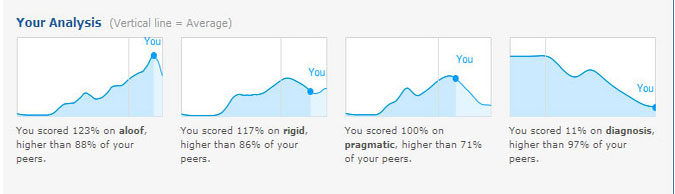
Yep, that's me, 123% aloof and 117% rigid.
Yep, that’s me, 123% aloof and 117% rigid.

I looked at all of the possible outcome descriptions (you can force the test to reveal them at the end even if they don’t pertain to your score) and they’re all just as meaningless. Some are downright wrong. Many of them state that you’re on the BAP if you are over the cutoff on one subscale but not the other two, which is incorrect.

Basically, the “results” of the online test are useless.

If you’re interested in taking the BAP and getting a valid score, you can look at the appendix of the original research paper which has the full set of questions with a scoring key.

The Bottom Line

The online version of the test is too flawed to provide meaningful results. The BAPQ as administered in a clinical setting is used to screen for BAP in parents of autistic children, but the goal of screening is unclear.

My question for any parents of autistic children who might want to answer: do you see aspects of yourself in the BAP questions? Do you think the BAP has any significance for you personally?
I Think I Might Be Autistic. Now What?

Take-a-Test Tuesday has led to some readers realizing that they too might be on the autism spectrum. Their comments nudged me to start writing about a subject I’ve been meaning to tackle: my Asperger’s “origin story” or how I came to realize that I might be autistic and what happened in the wake of that realization.

As usual, I’m mixing personal narrative with a bit of advice based on what I learned from my experience. I hope that other Autistics and those who think they might be on the spectrum will add to what I have to say here by sharing their own experiences in the comments.

—–

So, you think you might be an aspie or autistic or somewhere on the autism spectrum. Now what?

First, take a deep breath. Relax. Nothing’s changed. You’re the same person you were before you took that test, read that article or had a lightbulb go off while talking to someone about autism.

I remember my first inklings that I might be an aspie. I was listening to an NPR story about David Finch, the author of The Journal of Best Practices. His first hint that he had Asperger’s was an online quiz that his wife asked him to take because she recognized so many aspie traits in him.

As they described the quiz questions, for the first time I realized that Asperger’s Syndrome is more than social awkwardness and that I’m more than painfully shy. The symptoms that stood out most for me were the ones I’d never known were “symptoms” of anything other than my personality: attachment to routine, resistance to change, special interests, a need to be alone. Down the list I went, nodding and thinking yes, yes, yes, ohmygoshyes.

I went in search of the Aspie Quiz and what really blew me away were the specific behavioral questions: Have you been accused of staring? Yes! Do you tend to talk too loudly or too softly? Yes! Do you have difficulty filtering out background noise? Yes!

How had I not seen this before?

now-what

I’d heard a similar interview with Finch back in 2009. Interesting, I’d thought at the time, but nothing more. I’d read quite a bit about autism, because I was drawn to the subject. It never occurred to me to ask why. I’d taken the Autism Spectrum Quotient AQ test several times in the past. Every single time I scored above the cutoff for being on the spectrum. Every single time I told myself that it was probably a fluke, or even more improbably, that most people likely scored that high.

For years I’d tiptoed around the subject of autism. Finally, at 42, I was ready to explore the possibility that I was autistic.
Processing your First Contact with Asperger’s or Autism

  • Nothing has changed; everything has changed.
  • Know that no matter how it feels right now, this can be a positive realization.
  • If you’re on the spectrum, learning more about what that means can help you understand yourself better and learn to cope more effectively with the challenges that an Autism Spectrum Disorder (ASD) presents.

Next Part in the Series: Paths to Realization and Is this Me?

What is Neurotypical?

How many books on Asperger’s Syndrome or Autism have you read that begin with Chapter 1: What is Asperger’s Syndrome or Chapter 1: What is Autism? If you or someone you love is on the spectrum, then the answer is probably “a lot.”

The authors’ desire to start at the beginning is commendable but honestly I skip over these introductory chapters. I have the DSM diagnostic criteria memorized and I’m on intimate terms with the signs and symptoms of Asperger’s Syndrome.

Perhaps a more useful opening chapter for aspies would be: What is Neurotypical?

Neurotypical is a term that’s thrown around in the autism community like everyone instinctively knows what it means. If this is a new word for you (like it was for me not so long ago), in the ASD community, neurotypical is often used to refer to people who are not on the autism spectrum. It’s a mash-up of the words “neurologically typical” and is often shortened to NT.

A more correct word for someone who is not autistic is allistic. Technically, you can be non-neurotypical (neuroatypical) even if you aren’t autistic. Having clarified that up front, I’m going to go with the popular usage here.

How Can You Tell if Someone is Neurotypical?

So who are these NTs and how can you tell if someone in your family is neurotypical?

For starters, NTs make up about 99% of the population, so they’re everywhere. It’s very likely that you know neurotypicals and you probably have at least one NT in your family. While there is no widely accepted diagnostic test, NTs are fairly easy to spot once you know what to look for.

Perhaps the most obvious giveaway is an NT’s tendency to make “small talk” or to want to “chat” with you. While small talk appears to be nonfunctional, for NTs it serves a very specific purpose. It’s a good idea to humor them and participate to whatever degree you can tolerate. If you’re patient with them, many NTs will soon feel comfortable enough to move from small talk to more interesting, in-depth conversations.

Another common sign that someone is an NT? Touching. NTs enjoy all sorts of physical contact and often use touch to greet friends, family and even casual acquaintances. While it’s hard to fathom why your real estate agent or hairdresser feels the need to send you off with a hug, try not to be judgmental while fending them off. NTs are simply wired differently.

Sometimes NT behavior can be frustrating. For example, you may notice that NTs have a tendency to say something other than what they mean. If you get a new haircut and you’re not sure how it looks on you, don’t bother asking an NT. Most will tell you it looks great, even if you look like this:

"No, really, I love your new hairstyle!"
“No, really, I love your new hairstyle!”

Why? Because when a neurotypical woman asks her friend “how do you like my new haircut?” she isn’t looking for her friend’s opinion, she’s looking for validation. When her friend says, “I love it” she may mean I love your hair, but what she’s really saying is I love you and value you as a person.

So when your NT friend says “how do you like my new haircut?” and you, being your aspie self, reply, “It’s a little short in the back but I like it”, your NT friend hears I secretly hate you and think you’re ugly.

Confusing, I know.

And good luck getting an opinion out of an NT when you really need one. It may help to preface your question by explicitly stating that you’re seeking an actual, honest-to-God opinion but, even then, the NT’s dogged adherence to socially appropriate behavior may inhibit their ability to say what they’re really thinking. Try to remember that NTs were born this way and their natural sensitivity to what others are thinking and feeling often makes it hard for them to be completely honest.

Of course all NTs are different, much like all aspies are different, so these are just some general guidelines for recognizing the NTs in your life.

Offended Yet?

If you’re neurotypical, how did reading this make you feel? Offended? Stereotyped? Did you enjoy the patronizing tone? How about the sweeping generalizations?

What if it went on to talk about how some NTs are so socially adept that they get promoted into positions they don’t have the knowledge or skills for? What if it listed good careers for NTs (sales, management, counseling) and authoritatively added that you shouldn’t bother considering engineering or computer science because you’ll probably fail if you do?

Perhaps you’d like to read that your neurotype–the way you were born–will cause significant stress to your family or prevent you from having meaningful relationships? How about some unsubstantiated data on the astronomically high divorce rate among people of your neurotype or the alleged rarity of someone like you ever becoming a parent, let alone a good one?

Yes, We Can Read

My search for books about Asperger’s syndrome has left me surprised at how much there is about Asperger’s that isn’t directed at people who have Asperger’s. The majority of the books that I’ve read are addressed to parents, educators, caregivers and counselors. Which is great. There need to be resources for all of these people.

But there also need to be more good comprehensive materials that are written for aspies, not just about us. We can read. We’re eager to learn more about how our brains work. Why is it so hard to find authors who recognize that?

—–

More on neurotyipcals:

Taking the AQ-10

A few weeks ago I took the Autism Spectrum Quotient (AQ) test. In the comments on that post, Nat who you can find on Twitter at @quarridors, mentioned that there is shorter version–the AQ-10. This week for Take-a-Test Tuesday, I took the AQ-10. If you’ve taken both the AQ and the AQ-10, check out my note at the bottom of this post.

The AQ-10 is a condensed (10 question) version of the AQ test. It’s relatively new, and was developed based on a 2011 study involving 1000 people with ASD and 3000 neurotypical controls.

Though the AQ-10 is much shorter than the AQ, according to the 2011 study, it has a similar predictive power. There are some concerns about the AQ-10 study–like the original AQ study, it consisted almost entirely of adults with Asperger’s Syndrome, making it hard to generalize the usefulness of the AQ or AQ-10 for autistic adults who aren’t aspies. There is also a gender disparity in the groups, with about 60% of the control group members being female and about 54% of the ASD group members being male.

The AQ-10 is used as a screening tool for adults in the UK, to identify people who may benefit from receiving a comprehensive autism assessment. The developers of the AQ-10 have emphasized the greater practicality of a 10-question screening test, which can easily be completed as part of typically brief primary care doctor visits.

Like the AQ, the questions on the AQ-10 are drawn equally (2 questions each) from five domains:

  • attention to detail
  • attention switching
  • communication
  • imagination
  • social

It’s interesting to note that the 10 questions with the best predictive value on the short versions of the AQ for adults, adolescents and children were all the same except for one. The developers of the test point to this as evidence that autistic traits are relatively stable across a person’s lifespan. Think about that for a moment.

Pros and Cons of the AQ-10

Pros:

  • Very brief (10 questions)
  • Clinically tested
  • Has similar predictive properties as the 50-item AQ
  • Adult and child versions are available

Cons:

  • Requires manual scoring
  • Limited number and type of questions
  • Lack of subscale scores

Taking the Test

You have to take this one the old-fashioned way, with a pencil and paper. You can find the test in PDF format here but for ease of use (and because there is no automated scoring version available online), I’m going to include the 10 questions in this post as well.

For each of the questions below, choose one of these answers: definitely agree, slightly agree, slightly disagree, definitely disagree:

1. I often notice small sounds when others do not.

2. I usually concentrate more on the whole picture, rather than the small details.

3. I find it easy to do more than one thing at once.

4. If there is an interruption, I can switch back to what I was doing very quickly.

5. I find it easy to ‘read between the lines’ when someone is talking to me.

6. I know how to tell if someone listening to me is getting bored.

7. When I’m reading a story I find it difficult to work out the characters’ intentions.

8. I like to collect information about categories of things (e.g. types of car, types of bird, types of train, types of plant, etc).

9. I find it easy to work out what someone is thinking or feeling just by looking at their face.

10. I find it difficult to work out people’s intentions.

Don’t worry too much about the definitely or slightly designations. Scoring is based on whether you agree or disagree, not on how strongly you feel.

Scoring the Test

Use the following to score your answers (“definitely” or “slightly” get the same score so just focus on whether you agreed or disagreed for scoring purposes):

Question 1: agree=1 point, disagree=0 points
Question 2: agree=0 points, disagree=1 point
Question 3: agree=0, disagree=1
Question 4: agree=0, disagree=1
Question 5:agree=0, disagree=1
Question 6: agree=0, disagree=1
Question 7: agree=1, disagree=0
Question 8: agree=1, disagree=0
Question 9: agree=0, disagree=1
Question 10: agree=1, disagree=0

Phew! Okay, now you should have a number between 0 and 10. The cutoff score is 6. If you score 6 or higher, the doctor in the UK who administered this would then consider recommending you for a full autism evaluation.

One of the things I see over and over in the literature about the AQ is that patients should be referred for an evaluation if they score above the cutoff and are suffering some distress. So if you score above the cutoff and are not distressed by your symptoms, I guess you can go on your merry way.

I scored an 8 (which is very much in line with my 41/50 on the AQ).

The Bottom Line

This is a relatively new, self-report screening instrument.

If you took both the AQ and AQ-10 did you find that your scores were similar?* Did you score significantly higher (or lower) on one than the other? Did anyone score above the cutoff of 6 on the AQ-10 but below the cutoff of 32 on the AQ?

*A quick way to compare your scores is to convert them to a percentage. For example, I got 41/50 on the AQ, which is 82% (41 divided by 50 = .82). I got 8/10 on the AQ-10, which is 80%.

The Importance of the Pasta on the Left

I was in the cereal aisle in Target, waiting for The Scientist to decide on his cereal purchase, when I overheard this exchange between a mother and her preteen son:

Mother: “James, come and let’s pick out some cereal.”

James (appears from around the corner): “But I haven’t finished looking at all the pasta. I looked at the pasta on the right but I didn’t look at the pasta on the left.”

Mother: “We need to pick out your cereal.”

James (sounding panicked, voice rapidly rising into hysteria): “But I need to look at all the pasta! I haven’t looked at the pasta on the left. I need–“

Mother: “Okay, you can finish looking at the pasta if you promise to come right back here when you’re done and pick out your cereal.”

James: “I promise.” (dashes off around the corner then returns a minute later)

Mother: “Are you done?”

James: (looking happy) “Uh-huh.”

If you’re autistic or you have an autistic child, I bet you know why this conversation made me smile.

James’s mother didn’t say, “You don’t need to look at all the pasta.”

She didn’t say, “That’s ridiculous.”

Or, “You can look at the pasta later (or next time).”

Or, “Stop whining or we’re leaving.”

Or, “Grow up and act your age.” (James was around 10 or 11, I think.)

Or, “Get over here and pick out a box of cereal or I’m taking away your video games for the rest of the day.”

The pasta aisle is a thing of beauty, with it's boxes and bags all lined up by color and size.
The pasta aisle is a thing of beauty, with its boxes and bags all lined up by color and size.

Though she may not understand why James needs to look at all of the pasta when he visits Target, she recognized that preventing him from doing it would result in a meltdown in aisle 13.

And look at the results: The situation was rapidly de-escalated. James was happy. He came back and picked out his cereal as promised, without any prompting. His mother had to wait for him, but an extra minute standing in the cereal aisle beats the hell out of trying to calm a kid having a meltdown in the cereal aisle.

Meet Us Where We Are

There is a lot of talk about how autistic kids (and adults) need to learn flexibility. We’re too rigid, have too many nonfunctional routines. There are elaborate systems for teaching flexible thinking (which is important, I get that). But maybe non-autistic people need to be more flexible, too.

For kids like James, Target is stressful. The noise, the lights, the people, the smells–any or all of these can be overwhelming to autistic individuals. (And yes, based on what I saw I’m assuming–perhaps wrongly, but I doubt it–that he’s on the spectrum.)

If looking at the pasta makes a kid feel better, is that a big deal?

For some parents it might be. Let’s face it–a kid who needs to not only look at the pasta, but to be sure he’s looked at all of it? A little weird. But so what? We all have our coping mechanisms and James has found a way to cope with the stress of Target.

And his mother, bless her, she seemed to get this. She doesn’t look concerned about people judging her for letting her son “have his way.” She doesn’t belittle or shame him for what is, in his mind, a very real need. She doesn’t complain that he’s wasting their time or being uncooperative.

Her response left me wondering how long it took them to get to this point. Because not only did James interrupt his study of the pasta aisle to come when she called him, he returned the second time and picked out his cereal without being prompted. For a kid with such an intense need to study the pasta aisle, this is huge. Huge.

In this one small exchange, he’s learning how to negotiate, how to compromise, how to satisfy his needs while being conscious of his responsibilities, how to keep a promise, how to regulate anxiety and/or sensory overload using coping mechanisms.

Yes, autistics can be rigid. Yes, we have some odd routines or habits. Sometimes this has to be addressed. If James needed to spend an hour studying the pasta aisle, then yeah, big problem.

But a few minutes in the pasta aisle, accepting that the pasta on the left is important, even critical, to this particular kid–that doesn’t have to be a problem at all.

When you have an autistic family member or friend, you’re going to run into situations that you find hard to understand. There will be times when we’re not where you think we should be or where you wish we were.

When this happens, try practicing a little flexibility. Meet us where we are. You might be surprised at the results.

The High Cost of Self-Censoring (or why stimming is a good thing)

As an adult aspie, I often feel that I need to self-censor in social situations. Don’t say the wrong thing. Don’t stare at people. (But don’t forget to make eye contact!) Don’t laugh at the wrong time. Don’t speak too loudly or too softly or too often or too infrequently. And above all, don’t stim.

Stimming makes people nervous. As a kid, I stimmed like mad. I’ve been rewatching old home movies and there I am stimming my way through Santa’s Land and Disney World and every birthday party ever. I’m bouncing, rocking, twitching, flapping, hopping. I’m hammering with anything that remotely resembles a hammer and rubbing my fingers over every nearby surface. I’m constantly in motion.

Four decades later, my stimming is more discreet. You’d have to be watching closely to notice that I’m rubbing my thumbs over the spacebar on my keyboard when I stop typing. Or that I’m fidgeting with a bottle cap under the table at a restaurant or playing with my hair while driving or folding and unfolding a piece of paper while I wait in the bank.

Stimming is so much a part of who I am that I when first read about autistic traits, I completely denied that I have stims.

That little kid in the home movies grew into a teenager who learned to stim more subtly to avoid drawing attention to herself. I’ve found socially acceptable stims like doodling or manipulating objects (pen, stress ball, cell phone) with my hands. I’ve tucked away my more obvious stims for use in private.

Well, mostly. The day of my Asperger’s assessment, I started out stimming discreetly during the interview with the psychologist. By the time I hit the three-hour mark in testing, I found myself rocking back and forth as I tried to work out the spatial reasoning puzzles.

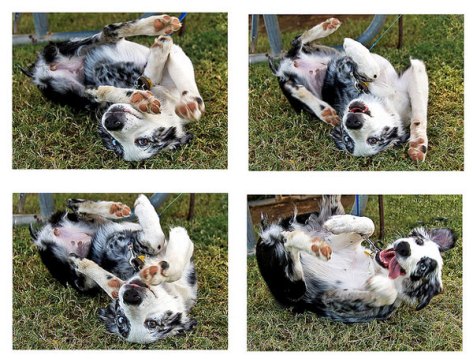
Happy stimming feels a lot like this

There is too much comfort in stimming–it’s too much of a biological imperative–for me to completely extinguish it.

I recently read that medicating a child to reduce stimming is a good way to help the child concentrate on school work. Yes, if the behaviors are self-harming or severely disruptive medication might be the answer (though if it were my child, redirecting toward a less harmful stim would be my first strategy).

But for kids who are rockers or fidgeters? I have a feeling that the medication does more to make the people around them feel better.

If anything, stimming improves my concentration. It’s a release, like sneezing or scratching an itch. Have you ever tried to ignore an itch? What if someone told you it was wrong to scratch yourself to relieve an itch? What would that do for your concentration?

Stereotyped Movement (Stereotypies)

Stimming is the most common term used to describe the repetitive movements characteristic of autism, but a more formal term (and the one used in the DSM diagnostic criteria) is stereotyped movement or stereotypies. In this case, “stereotyped” has a different meaning than the one we’re used to. In a behavioral science capacity, stereotyped movement refers to repetitive, nonfunctional movement.

Like so much of what the experts term nonfunctional about autistic behavior, I’d ask nonfunctional for whom?

A Little Insight from our Primate Cousins

Trying to understand what stereotypic movement is and why it happens led me to reading about stereotypic behavior in captive animals. In an issue of “Laboratory Primate Newsletter” (Volume 23, No 4, October 2004) I found a surprising answer.

The researchers concluded that stereotypic behaviors in captive animals aren’t truly abnormal; they’re a reaction to abnormal environmental conditions. In other words, monkeys should spend their days swinging from trees and running about in the jungle, not sitting in small cages. When the monkeys can’t indulge their natural behavioral tendencies, they resort to stereotypical movements like “pacing back and forth, running in circles, somersaulting, rocking, self-biting, earpulling, hair-pulling, eye-poking, etc.”

Sound familiar?

The article goes on to say:

“Many stereotypies are signs of frustration, with the subject being chronically thwarted from expressing basic activities (Reinhardt).”

Yes, stereotypies are related to frustration at being chronically thwarted from expressing basic activities.

Think about all of the things that feel like basic needs to an aspie. Being immersed in a special interest for long periods of time. Being alone. Sticking to routines. Avoiding excessive noise, strong smells, or crowds. How often do we feel thwarted when trying to pursue the things we find comforting? Chronically seems like a pretty good description to me.

When you look at it from the perspective of the animal researchers, aspies are engaging in stimming (stereotypies) not because we’re abnormal but because we’re constantly at odds with our environment.

While it’s impossible for the majority of us to indulge our aspie tendencies 24/7, it’s important to recognize the cost of self-censoring. When I’m happy, the urge to bounce up and down is nearly irrepressible. I’ve learned that it’s okay to bounce when I’m with my family. In fact, my husband’s reaction to my unbridled, childlike joy is often a huge smile. It makes him happy to see me happy, even if my way of showing it is more appropriate to a four-year-old than a forty-three-year-old.

Self-censoring is exhausting. Letting my aspie side rule feels liberating. Why would I want to extinguish that?

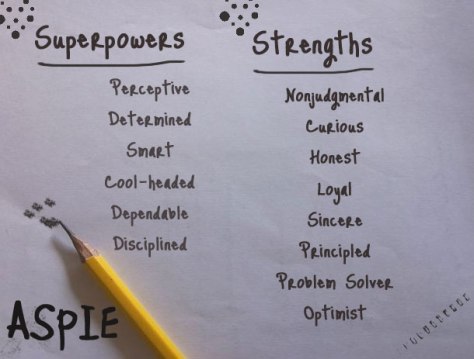
Aspie Strengths and Superpowers

The blog will be on hiatus through the holidays. Thank you for reading, commenting and sharing these past few months. I hope you all have a safe, happy and peaceful holiday and I’ll see you in 2013!

—–

I was going to start this out by saying that being an aspie has certain challenges. I was going to acknowledge how those challenges can be quite severe and then talk about the positive traits of Asperger’s in a measured, careful way.

But you know what? Screw that. Today I’m going to celebrate being an aspie.

I’m going to celebrate myself.

My Aspie Strengths (or How Asperger’s Has Made Me Awesome)

Many of my Asperger’s traits are double-edge swords, gifting me simultaneously with challenges and strengths. Impaired perspective taking? It makes it harder for me to work out people’s intentions but it also makes me nonjudgmental. Trouble with generalizing? That means I have to learn a similar lesson many times over, but gifts me with a dogged optimism and unconventional problem solving skills.

Curiously, some of my aspie strengths are a direct result of my funky wiring but many are coping mechanisms that I’ve developed to survive in a neurotypical world. Asperger’s has made me a survivor–forced me to adapt, by choice and necessity. The result is a unique set of strengths. Here they are, in no particular order:

I’m nonjudgmental. I take people at face value and will give someone the benefit of the doubt until they prove me wrong. A lifetime of being judged on appearance and first impressions will do that to you, I suppose.

I have a strong attachment to the truth. Telling it. Seeking it. Hearing it. If you ask me a question, you’ll get an honest answer. Perhaps more honest than you’d like. If you lie to me, I won’t forget it. I value honesty above many other traits–probably because I’m so bad at detecting dishonesty.

I’m curious. Insatiably so. I love learning, discovering, knowing. If you’re passionate about something and you want to share it with me, I’ll listen with genuine enthusiasm. My interests are wide-ranging and ever-evolving. My need for knowledge feels limitless, exciting and empowering. Give me an answer and I’ll have a handful of questions in reply.

I’m loyal. My attachments to people are few, but when I do form a bond with someone it’s a strong one. I will stand up for the people I care about in the face of a great deal of opposition. When Temple Grandin said that an autistic child will run into a burning building to save a person they love, she wasn’t kidding. That’s me in a nutshell.

I’m sincere. Perhaps naively so. I don’t have the patience or energy to be manipulative. I’m generally good-intentioned. When I do something for another person, I do it wholeheartedly. People often seem puzzled by my sincerity, disbelieving, as if being sincere is in itself some elaborate form of manipulation.

I have well-defined values. The black and white thinking of Asperger’s means that I’ve developed an elaborate and clearly delimited value system. This can be a blessing and a curse. There is a thin line between being principled and being stubbornly dogmatic. At most times, though, my values are my compass and my rudder, helping me navigate the ambiguities of a neurotypical world.

I’m an unconventional problem solver. I’m not afraid to ask wild questions or examine solutions that appear to have little hope of working. My instincts can get way ahead of my ability to verbalize them. Often, I’m told that things won’t work or don’t make sense–right up until I go ahead and do what I have in mind and it works. Or doesn’t. It’s a crapshoot, but that does little to dent my confidence and willingness to try.

I’m an optimist. I live in the here and now. I have few regrets. I view situations starting from zero. Aspies aren’t very good at generalizing from one occurrence to another similar occurrence, which I think leads to an irrational level of optimism. Sure something went wrong in the past, but (my brain always seems to say) this time will be different. Sometimes it is. Either way, I’ve found that taking the optimistic view of life makes me happy.

These are my strengths. What are yours?
These are my strengths and superpowers. What are yours?

My Aspie Superpowers (or How Asperger’s Has Made Me Who I Am)

One of the myths of Asperger’s is that all aspies are savants–that we’re born with some profound skill, like the ability to name the day of the week for any date in history, draw the New York subway system from memory, or do complex mathematical calculations in our heads.

Some aspies are savants, but sadly, I have no savant skills. I’ve always been fascinated by people who do. I think it would be amazing to have a photographic memory or to instinctively understand a system like mathematics.

Like a lot of aspies, I do have a few overly developed traits. They aren’t at the level of a savant skill, but I’ve started to think of them as my aspie superpowers. They’re the things about me that people comment on as being out of the ordinary or above average. They’re a significant part of my self-identity:

I’m perceptive and detail oriented. I notice everything: changes and irregularities, patterns and habits. I can analyze the hell out of things. I see patterns where most people don’t. My affinity for details began as a coping mechanism, I think–a way to identify patterns in social situations that I couldn’t work out instinctively. Now it’s become my default mode for making sense of the world around me.

I have a high IQ. This may not seem related to Asperger’s until you think about what an IQ test is: logic, problem solving, pattern recognition. Especially pattern recognition. The question about what number comes next in the sequence? Pattern recognition. Which shape is missing in the grid? Pattern recognition. Is the sum of the odd numbers between 1 and 12 an even number? Yep, that one is pattern recognition, too. Or it is if your brain works like mine.

I’m calm in a crisis. If something goes wrong, I have an almost superhuman ability to separate myself from the situation and think clearly. Poor executive function combined with impaired perspective taking lets me focus on the facts at hand when others get overwhelmed by panic or “worst case scenario” thinking.

I’m dependable and disciplined. Both of these have roots in my Aspergarian need for routine. Once I get a routine in place, I can do the same thing day after day without tiring of it. I can keep the books, walk the dog, sort the mail–day after day, like clockwork–as long as it’s part of my daily schedule. I’m the kind of person people rely on. I get things done.

I’m determined. Perseveration has a huge upside. If a problem or task catches my attention, I’ll go at it like a doberman with a ragdoll. I’ll work at something long past the time when a more rational person would throw in the towel. A big part of success for me is simply not giving up too soon.

Okay, looking back on that list, it looks rather boring. There’s a reason The Scientist jokingly calls me “Data” at times. But Data saved the Enterprise as often as Picard, right? I like my boring superpowers. They’re useful. They’ve served me well.

Asperger’s or Personality?

The line between my aspie traits and my other more typical personality traits can be a fuzzy one. In the absence of Asperger’s would I still have the strengths that I do? Doubtful. I’d be a different person. Look at my list of strengths. Do you see compassionate, caring, or intuitive on it? How about spontaneous, sympathetic or a team player? I am all of things in varying degrees, but they aren’t my strong points.

My strengths are typically Aspergarian. Without Asperger’s I might be a less extreme form of myself–a blend of my current traits with neurotypical traits. I fear that I’d lose most of my superpowers, though I might gain other superpowers in place of them.

Do NTs have superpowers? Surely they must. I think The Scientist has social superpowers. He’s remarkably charming, persuasive, likeable, confident and intuitive. It’s as hard for me to imagine what he would be like with an aspie brain as it is for me to imagine myself as an NT.

Not that I ever really do. I like being an aspie. Sure it’s a pain in the ass sometimes, but take away Asperger’s and I’m no longer me.

I like me! Have I said that? Are you tired of hearing it yet? Because this is important. I’m autistic and I like myself. There are people who would find that hard or even impossible to believe.

I like being a little different. I like my aspie strengths and superpowers far more than I dislike my aspie weaknesses. Let’s face it, everyone has weaknesses. Everyone faces challenges. The perfect person, the perfect life–that doesn’t exist.

What Are Your Strengths and Superpowers?

The idea of a distinct set of aspie strengths has its roots in Tony Attwood and Carol Gray’s “The Discovery of Aspie Criteria.” They proposed seeing Asperger’s as a set of strengths and talents rather than a syndrome of deficits. If you’ve never seen the list, you can find it in that article–scroll down a few screens until you see the numbered lists. If you haven’t yet identified your aspie strengths and superpowers, it’s a great place to start.

Taking the Reading the Mind in the Eyes test

The “Reading the Mind in the Eyes” is meant to test Theory of Mind (ToM) or the ability to recognize and understand another person’s mental state. It’s supposed to be a more advanced test than “Fear, Anger, Joy“, which tests simple emotion recognition.

The original 1997 version of Reading the Mind in the Eyes consisted of a set of 25 photos showing the area around the eyes and a choice of two possible mental states for each photo.

However, the limited number of items on the test combined with the choice of only two responses resulted in a test that wasn’t very reliable. Parents of autistic children were scoring as far below the controls as the AS/HFA group was. Additionally, the original version of the test included some expressions for basic emotions (happiness, sadness) which were considered too easily recognizable and not a true test of ToM.

The revised version of Reading the Mind in the Eyes contains 36 items with 4 answer choices for each item, increasing the possible range of scores along with the difficulty level. It also contains a balance of male and female photos, a choice between more closely related mental states (i.e. not a choice between opposites like sympathetic/unsympathetic), and is composed entirely of photos representing complex mental states.

In the original study to validate the test, the AS/HFA group scored a mean of 21.9 while the control had a mean of 26.2. However, the AS/HFA group had only 15 participants versus 239 controls. A sample size of 15 is small, especially for study in which participants only have to complete two questionnaires (the AQ and Reading the Mind the Mind in the Eyes. I’m curious why the researchers didn’t make an effort to obtain a larger AS/HFA sample when they had the resources to administer the test to so many controls.

Pros and Cons of the Reading the Mind in the Eyes test

Pros:

  • Tests recognition of complex mental states
  • Balanced presentation of male and female expressions
  • Offers subtly similar answer options to increase difficulty level
  • Self-scoring
  • Provides a list of items that were answered incorrectly (with the correct answers)

Cons:

  • Validation study relied on a small sample size
  • Sets up artificial constraints not present in real life (limited choice of options, time to study “frozen” expressions)
  • Allows for unlimited time to answer each item

Taking the Test

You can take the test here. It’s all on one page. Just look at each set of eyes and then choose which of the four options best describes the state of mind that the pair of eyes conveys. Ideally, you should make your choice as quickly as possible.

It took me a little over 5 minutes to complete the test. I feel like I spent too much time on a few of the photos. For an idea of how unintuitive my process is when I take this kind of test, at one point I found myself unable to decide if a particular expression was content or defiant. These are very different mental states, but I ended up guessing (correctly!) because I couldn’t conclusively pick one over the other.

Once you’ve selected an answer for all 36 items, click the “get score” button and your score will be displayed at the top of the page.

Scoring the Test

Your score is a measure of how many out of the 36 items you answer correctly. You’ll also get a list of which answers you missed and a short summary of where your score fits in the distribution (below average, average or above average).

Here is my scoring information:

Your score: 31

A typical score is in the range 22-30. If you scored over 30, you are very accurate at decoding a person’s facial expressions around their eyes. A score under 22 indicates you find this quite difficult.

The correct answers for the ones you missed are: [I added in my answers in brackets so you can laugh at how wildly off some of them are]

    • 17: doubtful [I chose affectionate – this could be a serious gaffe in a social situation!]
    • 18: decisive [I chose bored]
    • 19: tentative [I chose grateful]
    • 28: interested [I chose affectionate – not that far off]
    • 35: nervous [I chose contemplative]

Like the “Fear, Anger, Joy” test, I scored slightly above average. I’m starting to question how much these tests say about a person’s ability to read facial expressions in “live” social contexts.

When I’m taking a test like this, there are two artificial constraints:

  1.  I’m forcing myself to intensely focus on and study each facial expression.
  2.  I’m given limited options to choose from.

Based on the availability of 4 choices, random guessing alone would result in, on average, 13 correct answers. If you look at the options for each expression, at least one and often two are obviously incorrect (to me, and that may just be me). One of my primary test taking strategies is process of elimination and my approach to this test was no different. If I can eliminate one or two options, my odds of guessing correctly go up significantly.

The artificial nature of the test seems to reduce its value in identifying problems with ToM. When I’m interacting with another person, I’m usually too preoccupied with trying to follow the conversation to spend much time “studying” the other person’s constantly changing expressions.

Often when I’m concentrating on a conversation, I’ll look away from the other person’s face because I find it easier to process information that way. You can’t gather a lot of facial expression data when you’re staring out the window. And, most importantly, there are no prompts. The other person’s expression could be saying literally anything and I have no helpful cue words to narrow that down for me.

Can you guess what these pair of eyes are saying without any cue words to help you? Give it a shot in the comments if you like.
Can you guess what this pair of eyes is saying without any cue words to help you? Give it a shot in the comments if you like.

Then there is the fact that recognizing an expression is one thing; attributing causation is another thing entirely. Facial expressions are supposed to provide the clues that allow us to understand what another person is experiencing (the content of their mental state). Recognizing an expression of anticipation is the first step; deducing what the other person is anticipating should logically follow. Together these make up the concept of Theory of Mind.

To say that the Reading the Mind in the Eyes test is a measure of Theory of Mind is only partially true, especially for those of us on the spectrum. The second step of the process–understanding the content of the other person’s mental state–is where I often go wrong.

The Bottom Line

This is an interesting test of static facial expression reading. It’s value as a test of Theory of Mind is less certain.

Sadness

Sadness feels like the emotion that is most strongly connected to humanity–the one that binds us to each other in some important and primitive way.

I can be happy by myself. I’m as likely to be angry with myself as with someone else. But sadness–I usually need another person to tip me over into feeling sad.

Like my anger constellation, my sadness constellation required a thesaurus. Once I got past grief, depression and resignation, I needed help identifying other types of sad feelings. But unlike my exploration of anger, the thesaurus wasn’t much help this time. I added a few more words to the constellation, but I’m not sure how strongly I experience any of them.

My sadness constellation, sketched out on a Starbucks napkin

Sadness feels like a diffuse emotion, more of a background state of being than a tangible feeling. I’m rarely “actively” sad. I don’t burst into tears when I hear sad news. The last time I cried at a movie, I was twelve. The only book that ever made me tear up was  A Prayer for Owen Meany. More than once I’ve sat stoically immobile beside someone I love while they broke down.

My sadness is all undercurrent, twisted up inside me, unable to escape to the surface. This, of course, makes me look cold and unfeeling. The stereotypical cold-hearted aspie.

The first time I confronted my muted sadness was in high school. Junior year. A girl in my class, Karen, was killed in a car accident. The entire junior class attended her funeral, and everyone sobbed from beginning to end. Except me.

I remember standing there, my best friend crying against my shoulder, and feeling . . . confused. I barely knew Karen. She was one of the “fast” girls, part of a small clique that didn’t mix in with the rest of the class much. Many of the girls crying that day in church wouldn’t have hesitated to whisper something mean about Karen or her friends when she was alive. Yet here they were, brokenhearted. This made no sense to me.

Of course I felt sad that she’d died. It was a horrible tragedy. But obviously I didn’t feel as sad as everyone else. If I had, wouldn’t I be crying, too? Soon this thought consumed me. In desperation, I tried to make myself cry by thinking of sad things, by focusing on how sad this day was. I squeezed my eyes tightly closed until they started to water. A few teardrops fell but mostly what I felt was a sick, sinking panic.

While everyone was mourning the loss of our classmate, I alone was wondering: What’s wrong with me? And afterwards, while everyone was getting drunk to soothe their pain, I was hoping that if I got drunk enough, I’d somehow gain access to this mysterious thing called grief.

While I’ve experienced loss since then, my experience of grief is uneven and unpredictable. Sometimes my reaction to death is a sadness so strong and overpowering that it becomes physically painful. Other times I feel like my grief is strangled inside me with only the smallest of escape valves to trickle through. In this sense, grief frightens me. I feel like I haven’t practiced enough and when the big day comes, I’ll be unprepared, like a boxer entering a title match with only a few amateur bouts under her belt.

The rest of my experience with sadness is no less confusing. Most often sadness equals resignation, that sinking feeling that no matter what I do, the underlying characteristics of a relationship or a situation will never change. I used to be more of a fighter, wanting to fix everything and everyone, but increasingly I’m resigned to what is.

This is good and bad. Good because I’m relinquishing my intense need for control; bad because resigning myself to a situation can feel like giving up, and giving up can lead to hopelessness.  I put a question mark next to hopelessness because it’s rare and transient. I’m an optimist at heart and if studying economics taught me anything it’s that in the long run, everything can change.

Sometimes I get the blahs. Life looks dull and unappealing. My natural enthusiasm evaporates and I’m left with a gray cast over everything. I’m not sure if the blahs have a specific trigger or if they’re hormonal/cyclical. I’ve seen other aspies talk about being unexpectedly overcome by a general feeling of sadness and not being able to identify the source, which is exactly what I associate with the blahs.

Fortunately, I have an emotional reset button. If I go to sleep feeling down, I’ll usually wake up the next day feeling fine. If I don’t reset overnight, the blahs can stretch into ennui. I’ll get bored and restless, lose my focus, bounce around between tasks accomplishing little or nothing. My routines break down, which only increases my restlessness and lack of focus.

At this point, I need to make a conscious effort to get myself back on track or I risk slipping into depression. A lot of aspies struggle with depression, either as a periodic state or as a clinically comorbid disorder.

My experience with depression has been the less severe, episodic type: a period of feeling down and discouraged, usually in response to something someone has done or said. But I’m mellowing with age, each passing year lessening my need to beat up on myself in response to other people’s slights and judgments. These days I’m more likely to chuck unpleasant interactions into the resignation bin and move on.

That leaves only distress. Is distress really a form of sadness? Some of the synonyms I found for it certainly are: agony, misery, suffering, anguish, torment. I’ve always associated distress more with anxiety or fear, but thinking about it now, I do sometimes feel distress as a form of sadness. I have a fear of abandonment and that fear can trigger a deep-seated, overwhelming distress.

Asperger’s is such a paradoxical condition. I love being alone but I fear abandonment. I don’t often experience unmitigated grief but when I do, it’s overwhelming. I need a thesaurus to help me identify the shape of my feelings, but once I put names to them, they come alive for me in very specific ways.

If you look at my constellation, you’ll see that I added regret and melancholy but after some reflection I put an X next to them. I don’t spend a lot of time looking backward, especially not in a sad way. I’m more of a “learn from it and move on” kind of person. The present moment is more alive for me than any ghost of a memory.

Since learning more about Asperger’s I’ve come to wonder if my muted sadness is a self-protection mechanism. When I wrote about happiness and anger, I talked about the unfiltered versions of these emotions that I experience–the emotions that feel particularly autistic in nature.

I’m far less equipped to handle unfiltered sadness. When it comes, it’s crushing. I think my subconscious instinct is to mute the intensity. There is, after all, only so much sadness a person can handle. So I experience sadness in my own way, inwardly, quietly.

The Purpose of Sadness

I read recently that the “evolutionary purpose” of sadness might be to trigger reflection after a major life event. When we experience loss or a setback, it makes sense for us to withdraw and reevaluate our lives. The result is often a life-changing insight or decision.

If this is the case, my sadness serves me well. I turn inward, often and intensely, searching for answers, insight, a truer path. Even at that funeral in high school, in the absence of grief, I was looking inward. Sad, perhaps, in a very similar way to the rest of the girls, though I didn’t understand it then.

As an adult, I know that the teenaged girls in that church were mourning more than the loss of a classmate. They were mourning the loss of their own innocence. They were confronting the cruelty of life. They were facing the dangers that adulthood holds, the possibility that it could have been any one of us rocketing down the highway one moment, dead at the bottom of a cliff the next.

They were sad for Karen, sad for themselves, frightened, overwhelmed. When I look at it in that context, I see that my feelings weren’t that different from theirs. I struggled with the expression of my sadness–I still do–but it’s been there all along.

Anatomy of a Meltdown

Last weekend, I had a meltdown and the next morning I tried to capture some scattered impressions of it to share. I’ve purposely left this raw and unedited, the way it unspooled in my head, to give you a feel for how chaotic a meltdown can be. While meltdowns are different for everyone, this is how I experience them.

——————————————-

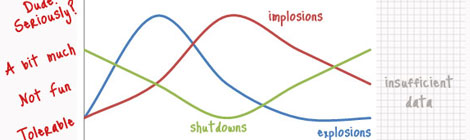
A meltdown can go one of two ways: explosion | implosion.

Explosion

Everything flies outward. Words. Fists. Objects.

Implosion

Have you ever seen a building implode? The charges go off somewhere deep inside and for a moment you swear nothing is going to happen and then seconds later–rubble and dust and a big gaping hole in the ground.

——————————————-

It feels like a rubber band pulled to the snapping point.

——————————————-

What I don’t want to hear:

It’s okay.
(It’s not.)
You need to pull yourself together.
(I will, when I’m ready.)
Everything will be fine.
(I know.)

——————————————-

I’m not looking at you because I don’t want to see you seeing me this way.

——————————————-

It feels like the end of the world. It feels like nothing will ever be right again.

——————————————-

What I need:

  1. Space
  2. Time
  3. Absence of judgment

——————————————-

The headbanging impulse is intermittent but strong. I stave it off as best I can because:
a) my brain is not an infinitely renewable resource
b) headbanging scares other people

——————————————-

Meltdowns are necessary. Cleansing. An emotional purge. A neurological reboot.

——————————————-

Please don’t ask me if I want to talk about it, because:
a) there’s nothing to talk about
b) I don’t have the resources necessary for talking

——————————————-

meltdowns

Evolution of meltdowns over a lifetime:

For my first 12 years, I internalize well. So well that I end up in doctor’s offices and emergency rooms with mysterious headaches, high fevers, stiff necks and stomach bugs. At various times I’m told that I don’t have meningitis, migraines, appendicitis. What I do have . . . that’s never conclusively decided. Things come and go, seemingly without rhyme or reason.

Puberty hits. Hormone surges make internalizing impossible. I slam doors, sob uncontrollably at the slightest provocation, storm out of the house, crank up my stereo. My anger becomes explosive. I pinball between implosions and explosions.

Early twenties, into my thirties, the explosions become rare but the implosions grow worse. I can’t get through an emotionally charged conversation with my husband–let alone a fight–without imploding. The headbanging impulse appears. Muteness takes center stage.

My forties–I can count the explosions on one hand. The implosions are down to a couple a year at most. As the meltdowns have lessened, the shutdowns have increased. This is lateral movement, not progress.

——————————————-

It feels like my whole body is thrumming, humming, singing, quivering. A rail just before the train arrives. A plucked string. A live wire throwing off electricity, charging the night air.

——————————————-

I’m 90% successful at staving off headbanging. The thing is: when that impulse arises, headbanging feels good. It’s . . . fulfilling?

——————————————-

Will comforting me help?
No.
Do I want the meltdown to be over?
Yes, but not prematurely.
Would I like a hug?
No.
Am I in danger?
No. I’m conscious of the boundary between stimming and serious self-harm.
Do I want company?
If you’re okay with sitting silently beside me.
Can you do anything to make me feel better?
Probably not. But you can avoid doing the things that will make it worse.

——————————————-

Muteness: Complex speech feels impossible. There is an intense pressure in my head, suppressing the initiation of speech, suppressing the formation of language.

——————————————-

My meltdowns aren’t so much about triggers as thresholds. There is a tipping point. A mental red zone. Once I cross into that zone, there’s no going back.

——————————————-

It feels like dropping a watermelon on the pavement on a hot summer day. The bobble, the slip, the momentary suspension of time just before the hard rind ruptures and spills its fruit, sad and messy, suddenly unpalatable. And no one knows whether to clean it up or just walk around it.

——————————————-

A shutdown is a meltdown that never reached threshold level. Either my threshold is rising or I’m becoming less sensitive to the precursors as I age.

——————————————-

Meltdowns are embarrassing. A total loss of control. Humiliating. They make me feel like a child. They are raw, unfiltered exposure.

——————————————-

Panic. Helplessness. Fear.

——————————————-

Imagine running as far as you can, as fast as you can. When you stop, that feeling–the utter relief, the exhaustion, the desperate need for air, the way you gulp it in, your whole body focused on expanding and contracting your lungs–that’s what crying feels like during a meltdown.

——————————————-

Please don’t touch me. Don’t try to pick me up, move me, or get me to change position. Whatever position I’ve ended up in is one that’s making me feel safe. If it makes you uncomfortable to see me curled up in a ball on the floor, you should move–remove yourself from the situation.

——————————————-

There is emotion at the starting line, but a meltdown is a physical phenomenon: The racing heart. The shivering. The uncontrollable sobs. The urge to curl up and disappear. The headbanging. The need to hide. The craving for deep pressure. The feeling of paralysis in my tongue and throat. The cold sweat.

——————————————-

The physical cascade needs to run its course. Interrupt and it’ll just start all over again a few minutes later. Patience, patience.

——————————————-

What I need when I’m winding down:

  • deep pressure
  • quiet
  • understanding
  • to pretend it never happened

——————————————-

The recovery period is unstable.

Exhaustion comes first. Mixed with anger, at myself mostly, for losing control.

My filters don’t come back online right away. Unless you can handle an unfiltered aspie, proceed with caution.

Finally, there is euphoria. A wide open feeling of lightness, of soaring, of calm.

——————————————-

one woman's thoughts about life on the spectrum