The Athletic Aspie. No, really.

Aspies are notoriously unathletic. We tend to be clumsy and uncoordinated. Chalk it up to a motor planning deficit, poor executive function, proprioception difficulties, dyspraxia, or all of the above. Whatever the cause, the result is that we’re more likely to be branded a geek than a jock.

Unfortunately, I never got the memo on this. All my life I’ve loved sports and being physically active. Loving sports, in my case, isn’t the same as being good at sports, but I’ve never let that stop me.

Though my parents didn’t know I had Asperger’s they did know that I was clumsy. One of their nicknames for me was “Grace”–as in, “careful there, Grace” and “that’s our daughter, Grace.” I think this is funnier when you’re the one saying it than when you’re the one tripping over an inanimate object.

Perhaps in an effort to help me overcome my lack of coordination, they signed me up for a lot of individual sports: dance, gymnastics, bowling, golf, diving, swimming, karate.

Most of these were activities that I could do with other kids but didn’t require the type of interaction that team sports do. I was on a bowling “team.” All that meant was that I took turns with four other kids. The bowling itself was an individual pursuit. Other kids took a turn. I took a turn. I got to add up the scores. I wandered off to watch one of the arcade games. Someone called me back when it was my turn. It was great.

Golf and dance and karate were the same. I did these things alongside other kids but not really with them. There was an appearance of social interaction. The actual amount of interacting I did was minimal and that was fine.

I’ve always loved individual sports for exactly this reason. I learned to swim soon after I learned to walk. My family had a swimming pool in the backyard so I was in the water months after being born and enrolled in swim lessons as soon as the YMCA would take me. Swimming is still one of my favorite ways to relax. I love being in the water–the sensation of weightlessness, of gliding, of floating, of being surrounded and suspended–and I love the rhythmic movement and sensory deprivation of a long swim.
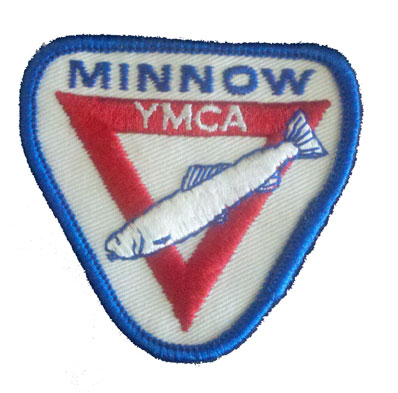
My YMCA Minnow patch – one of the few things I’ve saved from childhood.

As an adult I took up running. Like swimming, I enjoy the rhythm of running. I also like the way it gets me out into the quieter places–trails through the woods, quiet paths along the river, a beaten single track frequented more by deer than humans. I loved long bike rides as a kid for the same reasons.

The Beauty of Individual Sports

I tried team sports. In middle school, I was on the school softball and basketball teams. It was fun but I wasn’t very good at it and spent most of my time sitting on the bench during games. I also got razzed a lot by coaches for not making enough effort. My basketball coach was always yelling at me to be “more aggressive” but I had no idea what she meant.

There was a lot about basketball that I didn’t quite get. Team sports have many variables–the rules, the other team members, the fast pace, the ball (inevitably there’s a ball involved).  For the typical aspie, this is a lot to manage. By the time I got to high school, I knew that team sports weren’t for me.

But individual sports! This where aspies can shine. When I’m out on the trails or in the pool, I feel strong and athletic. I feel like I’m coordinated and connected to my body. I feel like I’m good at a sport! Forgive my exclamation points, but this is exciting for someone who grew up feeling clumsy.

So, let me sell you on the wonders of individual sports for aspies of all ages:

1. You can progress at your own pace. Individual sports allow you to measure your progress against yourself. While you might compete against others, most individual sports also encourage “personal bests.” Running a new best time for a mile or swimming a personal best for a 400 is as fulfilling as beating an opponent. Maybe more so, because it’s an indication that your practice is paying off and you’re better at your sport than you were a month ago or a year ago.

2. You can be part of a team without the pressures of a team sport. Individual sports can be less stressful than team sports when it comes to having to perform well every time. If you have a bad day as a team player, your actions can impact the whole team. If you have a bad day as a cross country runner, you might not place well, but one of your fellow runners could still win the race. There are team consequences, but they tend to be less severe.

3. You can practice by yourself. This is a huge advantage for aspies. Because of our motor coordination issues, we might need a lot more practice than the average person to learn or master a skill. When that skill is something that doesn’t require a team or a partner to practice, we can spend hours working on it alone, at our own pace.

4. You play side-by-side with others. Team sports put a big emphasis on bonding with other team members, which can be stressful for aspies. Individual sports allow you to play alongside others, interacting as much or as little as you feel comfortable.

5. Individual sports tend to be rhythmic, repetitive and predictable. And what do aspies like more than rhythmic, repetitive, predictable movement? Running, cycling and swimming are like large-scale, socially acceptable stims. And you can do them for as long as you like. The more, the better!

6. Individual sports can burn off a lot of excess energy. Many individual sports are endurance based, making them an ideal way to tire out a high-energy aspie. Even moderately vigorous physical activity will burn off excess energy and trigger the release of endorphins, which not only improve your mood but can reduce anxiety and help you sleep better.

7. Individual sports improve coordination. All sports improve coordination, but individual sports tend to be more “whole body” sports, requiring you to integrate all of the parts of your body to achieve the best possible result. Think of the type of movement required for swimming breaststroke versus the type of movement required for playing shortstop.

Why Exercise is an Essential Part of Managing My Asperger’s

I need to get in at least an hour of running, swimming or walking every day. I need to exercise every morning. When I say need, I’m not kidding. If I didn’t exercise religiously, I would likely be on medication for both anxiety and depression.

Hard physical activity burns up the unwanted chemicals in my body and generates a nice steady flow of good chemicals. Exercise takes the edge off my aspie tendencies and leaves me feeling pleasantly mellow.  If my physical activity level falls for a few days in a row, I start feeling miserable. I get short-tempered, cranky and depressed. I lose my emotional balance. I don’t sleep as well. I find it harder to focus.

Being physically active also keeps me connected to my body. I have a tendency to retreat into myself and become disconnected from everything that isn’t inside my head. I’m also still–in spite of decades of sports practice–more clumsy and uncoordinated than the average adult. Being physically active helps me combat this and makes me more physically resilient when I do take an expected tumble.

A Little Different Spin on Physical Activity

One of my favorite bloggers, Annabelle Listic, has written a wonderful post–Kinect with Me!–about how she is using the physical activity of gaming to address some of her concerns (which are different from mine). I’ve never played a video game that requires physical interaction but her post got me thinking that this type of gaming might have many of the same benefits as participating in an individual sport.


Lessons from an Aspergers-NT Marriage (Part 4)

This is the last post in series about the lessons my husband (NT) and I (aspie) have learned during the 25 years we’ve been married.

Learn how to recognize your partner’s expressions of love

Aspies and NTs speak completely different languages when it comes to expressions of love. You can either learn to translate your partner’s “love language” or you can spend the rest of your marriage wondering if this person you’re sleeping next to every night really, actually loves you.

How does this translation work? Like this:

The Scientist: “You don’t have to make my lunch every morning. I can pick something up in the cafeteria.”

Me: “I don’t mind. It only takes a few minutes and I know you’d rather have something healthy to eat. This way you don’t have to waste time waiting in line.”

The Scientist: “So you mean you make my lunch because you care about me, right?”

Exactly.

Learning how to translate the ways your partner thinks about love and intimacy can be challenging in an aspie-NT relationship.                                                                 Image via creative commons license from the Flickr photostream of DailyPic.

Accept that there are things you’ll never understand about your partner

No matter how long you live together or how much you love each other, there will be moments when you feel like your partner is the most incomprehensible person on Earth. The aspie and NT brains have key differences. The sooner you accept this, the less frustrated you’ll be when your partner does something that leaves you scratching your head.

There have been many times when The Scientist has given up on a conversation with the words, “I just don’t understand you.” It’s not that he isn’t trying. He’ll ask me lots of questions to try to zero  in on an explanation for something I’ve done or said. He’ll wait semi-patiently while I sit mutely and stare off into the distance, unable to put words to what I’m feeling. He’ll repeat things back to me to see if he’s hearing me correctly. But no matter how many different ways I explain it, it still doesn’t make sense to him because we’re both starting from fundamentally different places.

This goes both ways. The day The Scientist told me that he feels something–a physical sensation of warmth was how he described it–when he says, “I love you” I was stunned. I tell him that I love him every day but I’ve never associated a physical feeling with those words.

I can logically understand what this physical feeling might be like, but I’ll probably never know exactly what he feels. By the same token, I can tell him that when I sit in a crowded restaurant, my brain is tracking the conversations at all of the tables within earshot, but I don’t think he can ever replicate that experience in his own head.

We can make educated guesses at what’s going on inside the head of our partner, but there will always be some experiences that we can’t truly understand.

Have realistic expectations but don’t stop trying to grow and improve your relationship.

When faced with the day-to-day challenges of an aspie-NT marriage, it would be easy for both partners to simply give up in frustration. I can think of plenty of times when walking away would have been easier and less painful than trying to work things out.

Balancing realistic expectations–by both partners–with a concerted effort to improve can be a relationship-saver. Realistic expectations go both ways. The NT partner shouldn’t expect the aspie partner to morph into a typical person overnight. (The Scientist says he wouldn’t want this even it were possible.)

By the same token, the aspie partner shouldn’t expect the NT partner to simply put up with an endless barrage of unchecked aspie behavior. Knowing what can be changed and what can be tolerated is essential.

The second part of this equation is one that might draw some heat from aspies. I’m a firm believer in trying to improve my ability to function in an NT world. Before anyone jumps down my throat about the potential evils of assimilating, let me explain.

The day I explained to my husband about my Asperger’s, one of the first things he said was, “I love you exactly the way you are.” I treasure that and I know it’s not something he said just to make me feel better. He means it. But I also know that I’m hard to live with. I find myself hard to live with at times. So when I say I want to improve my level of functioning, it’s because I want to struggle less on a daily basis and because I want the people around me–the people I love–to struggle less. It has nothing to do with conforming to the expectations of an NT world and everything to do with making life less stressful and more enjoyable for myself and my family.

Autism is My Special Interest

Before I started reading about Asperger’s Syndrome, I had no idea what a special interest was, even though I’ve had them all of my life. A special interest, for those you who aren’t familiar with the term, is an “encompassing preoccupation with one or more stereotyped and restricted patterns of interest that is abnormal either in intensity or focus.”

In other words, an interest in a topic that is either very narrowly defined or very intense. If you’ve never spent time around someone with Asperger’s you might underestimate what those two phrases mean.

I wrote a post about special interests in general earlier this week. Not surprisingly, one of my current special interests is autism. Here’s a glimpse of what a special interest looks like in action for me:

  • I spend 3-4 hours a day writing, reading, researching and thinking about Asperger’s Syndrome and autism. I’d spend more, but I have to work, eat, walk the dog, sleep, etc.
  • My idea of a fun way to spend an evening is watching a DVD on occupational therapy for sensory dysfunction.
  • I scribble notes for blog posts on scraps of paper at all hours of the day because I’m constantly relating things that I see, read, hear and experience back to ASD.
  • There are 532 autism- and Asperger’s-related scientific articles saved in my Dropbox. There would be more but I only managed to get as far back as 2009 before I lost access to the PubMed and PsychoInfo databases when I graduated.

  • Words like perseverative and motor planning deficit are part of my daily vocabulary.
  • My browser has a bookmark list called “aspie links.” It has too many links to reasonably find anything so I’ve also created another bookmark list called “important aspie links.”
  • Among the important bookmarks is one for the video of the latest meeting of the Interagency Autism Coordinating Committee, in case I need to watch the chapter on the DSM-V updates again.
  • My county library has 51 books and DVDs on Asperger’s and I’m reading/watching them in the order the library catalog lists them. I’m on number 17. When I finish that list, I’ll start on the list of 317 autism-related books/DVDs. In order.
  • If you get me started talking about anything autism related, I guarantee you’ll lose interest long before I do. Unless you’re a fellow aspie with a special interest in autism . . .

What’s so Special About a Special Interest?

First, I need to say that I hate the phrase “special interest.” It sounds demeaning or patronizing. All I can think of is a doddering old great aunt looking over my shoulder at my stamp collection and saying, “well, isn’t that special.”

I’d much rather use “obsession,” or if that’s too extreme, then “specialized interest,” which is more precisely descriptive. But the term most often used in the ASD community is special interest so I’ll use that here, cringing every time I type it.

Okay, with that bit of editorializing out of the way, we can talk about a topic dear to most aspies’ hearts: the special interest. According to the DSM-IV diagnostic criteria for Asperger’s Syndrome, having an “encompassing preoccupation with one or more stereotyped and restricted patterns of interest that is abnormal either in intensity or focus” is a core symptom of AS.

You’ll notice there are two parts to that criteria: intensity or focus. A special interest can be an intense interest in a broad subject (architecture) or a narrowly focused interest (mid-12th century Cistercian monasteries). Generally, narrowly focused interests are also intense, but a special interest doesn’t have to be stereotypically narrow to qualify.

What Does a Special Interest Look Like?

A partial list of my special interests, starting in childhood:

  • Barbies
  • Construction toys (legos, lincoln logs, tinker toys)
  • Text (reading, writing, words, found text, Roget’s thesaurus)
  • Stamps
  • Coins
  • Guinness Book of World Records
  • Baseball cards
  • Sewing (making my own clothes)
  • The stock market
  • M*A*S*H (TV show)
  • The Doors
  • Star Trek:TNG
  • Martial Arts
  • Human detritus (abandoned places, found objects, discarded things, cemeteries)
  • Zen Buddhism
  • Dog training
  • Astronomy, especially Messier objects
  • The Choson Dynasty
  • Shamanism
  • National parks
  • Running
  • Autism (!)

You can look at the list and think, “but everyone has hobbies, what’s so special about yours?” Like much of what differentiates an Asperger’s trait from a general personality quirk, the answer is the degree to which the trait is present.

For example, when I took up running, I didn’t just go out and jog a few times a week. I read books about training for marathons. I found workout plans online and joined a training site to get personalized drills. I learned about Fartlek and track workouts and running technique. I signed up for road races. Ten years later, I spend more on running clothes and shoes than on everyday clothes. I use a heart rate monitor and a distance tracker to record my workouts. If I go on vacation, I pack all of running stuff. I don’t just like to run occasionally; running is an integral part of my life. It fills a very specific need.

A visual representation of some of my special interests over the years

Shelter from the Storm

That’s a key differentiator between a run-of the-mill hobby and an Aspergerian special interest. Spending time engaged in a special interest fulfills a specific need for aspies. It’s more than just a pleasant way to pass the time. For me, indulging in a special interest is how I recharge myself. It’s comforting. It allows me to completely immerse myself in something that intensely interests me while tuning out the rest of the world. If you have a favorite movie that you rewatch or a book you like to return to again and again, it’s a bit like that.

Special Interests Gone Wild

The danger in special interests is that they can become consuming. They can take over every conversation, every free minute of the day, every thought, if you let them. They can be a refuge or a hiding place.

There are days when I’m so engrossed in writing and/or work (I’ve made one of my special interests into a career) that I’ll happily spend eight or ten or twelve hours at the computer. I put dinner on the stove and then forget about it until I smell it burning. The sun sets and hours later I realize the house is pitch dark. If the dog didn’t nudge my elbow when it was time for her to go out or be fed, I would forget that she existed.

Clearly this can be a problem.

Another problem can arise if the object of a special interest is socially unacceptable. When my husband read my list of special interests, he jokingly added himself to it. He was being funny, but sometimes aspies do take on another person as a special interest. If that person is a celebrity, the aspie can safely spend hours learning about and admiring that person from afar. But if the person is someone in the aspie’s life, the special interest may be expressed as unwanted attention, harassment or stalking. (You can read an excellent first person account of this issue here:  Love or Obsession: When a Person Becomes an Aspie’s Special Interest.)

So while most special interests are “harmless,” if an interest involves behavior that is illegal, taboo or a threat to your or someone else’s health or wellbeing, it may be necessary to seek help in redirecting your attention to a safer alternative.

How Does an Aspie Find a Special Interest?

Special interests tend to find us, rather than the other way around. I have no idea what has drawn me to many of my special interests over the years. Most are things that I have an intense but inexplicable fascination with.

Take abandoned places. I can’t explain what the lure is, but I can spend hours roaming an old townsite or quarry. I’m especially intrigued by abandoned psych wards. I can easily get lost exploring websites like this one: 10 Abandoned Psych Wards Photographers Love Sneaking Into

Like writing, reading, and martial arts, my interest in abandoned places and things has been with me since childhood. But other interests have come and gone over the years. A special interest often arises suddenly, becomes intense for a period (months or years) then disappears just as quickly. My collecting-related interests from childhood were like that. I would spend hours organizing, sorting and rearranging my coins, stamps and baseball cards. I’d talk my parents into driving me to collector’s shows, my tattered value guide tucked under my arm, bouncing with excitement at the prospect of filling a hole in one of my collections.

Then, when my interest in one of my collections suddenly dried up, I’d pack my binders and reference books and collecting paraphernalia away in the closet where they’d sit collecting dust while I spent hours comparing annual editions of the Guinness Book of World Records to see which records had changed or clipping articles about M*A*S*H from magazines so I could add them to my scrapbook.

How Much is Too Much?

Special interests are important to most aspies’ happiness and perhaps to our mental health. If I go through a period where I can’t engage in my special interests, I get agitated and spend a lot of time thinking about what I’d like to be doing. For me, and for a lot of aspies, a special interest is our preferred way of de-stressing, recharging and just plain enjoying ourselves.

But like any good thing, it’s possible to overdo it and veer into unhealthy territory. I think it’s safe to say that a special interest has become too consuming when it keeps you from taking care of daily responsibilities (school, work, hygiene), negatively impacts your health (lack of sleep, poor eating habits), or has a significant negative impact on loved ones (limited social contact, financial burden).

However, there is one case where you get to pursue your special interest all day, five days a week, and society gives you an approving thumbs up: when you turn a special interest into a career. Suddenly, you’re no longer a geek who knows too much about C++ programming, production switchers or eighteenth century fashion. You’re a computer programmer, an audio equipment repair technician or a museum curator. Big difference, right?

I’ve been lucky enough to do this twice, making it perfectly acceptable to dedicate most of my waking hours to a favorite subject. I’ve read and heard about a lot of aspies who’ve done the same with their lifelong special interests. It’s certainly not possible for everyone with Asperger’s to turn a special interest into a job or career, but when it does work out that way, you get to be one of the lucky people who earns a living doing what you love.

—–

For another perspective on having a special interest feels, check out Focusing on Special Interests by Jeannie Davide-Rivera who blogs about Asperger’s at Aspie Writer. I especially enjoyed learning about her first special interest, because we shared some favorite baseball players in common as children.

Lessons from an Aspergers-NT Marriage (Part 3)

This is the 3rd in a 4 part series about the lessons my husband (NT) and I (aspie) have learned during the 25 years we’ve been married.

Recognize that aspies need plenty of alone time

Being alone is how people with Asperger’s regroup. When I retreat to my home office and close the door, it doesn’t mean I don’t enjoy the company of my family. It has nothing to do with how much I love my husband. It doesn’t mean that I’m disinterested, selfish, cold or insensitive. It means I’ve hit my limit for social interaction and need to recharge.

Somehow, The Scientist figured this out years before we knew anything about Asperger’s and has learned to recognize when I’m nearing my limit, sometimes before I do. If we have guests staying with us for a few days, he makes a point to build time alone for me into the schedule. If he sees that I’m starting to tire or withdraw during a long social event, he’ll suggest that we do something away from the crowd for a short time to help me refocus. He’s also come to accept that when I say I need to leave a social situation, I’ve truly stuck it out as long as I can, and staying longer is going to cost me more than it’s worth.

I probably sound like a social tyrant. Maybe I am. I’m certainly not an average wife who thrives on entertaining and socializing. But I’ve learned that being realistic about my limits–and pushing at them where I can–is less destructive to our relationship than overreaching and ending up in tears.

Aspies need plenty of time alone. It doesn’t mean that we’re disinterested, selfish, cold or insensitive. (Creative Commons 2.0 (by-nc-sa))

 Compromise

Good advice for any marriage, but especially important when one partner has Asperger’s Syndrome. You may find that some of the compromises you make are unconventional. For example, The Scientist and I have realized that we need to compromise about which social occasions I attend. He gets invited to a lot of work-related dinners, cocktail hours, award ceremonies, etc. We’ve concluded–after much arguing, discussing and agonizing–that it’s unrealistic to expect that I’ll attend every event (his preference) or none of them (my preference).

Our compromise is that I’ll attend the important events and he’ll go to the less important events alone.  This means that I’m going to be uncomfortable some of the time (talking to strangers–oh no!) and he’s going to be uncomfortable at times (making excuses for my absence). Like most compromises, no one is completely happy with this arrangement, but it’s the least bad option.

Compromising can be a hard skill for aspies to master. I’ve found that it helps to take a cost-benefit approach. What is doing this for my partner going to cost me? What would not doing it cost him? What are the potential benefits–for him, for me, for our relationship?

For social occasions, the biggest costs are usually the anxiety in the days leading up to the event and the physical exhaustion I’ll feel afterwards. The benefits tend to be a happy husband and some enjoyable moments of social interaction. By listing the costs and benefits as concretely as possible, it’s easier for me to find places where I can compromise rather than reflexively rejecting every social invitation as being too much work.

Identify triggers and try to work around them

Triggers may seem odd or even incomprehensible to the NT partner. Case in point: I don’t like having the bathroom fan on while I shower. The drone of the fan and the feel of moving air on my wet skin are unpleasant sensations. Complicating matters, the shower light and bathroom fan are on the same switch so to avoid the fan I have to shower in semi-darkness. The Scientist thinks this is silly. He rolls his eyes when I flip the switch off. He says I’ll get used to it. He points out that the fan is on the other side of the bathroom. He understands a lot of my quirks but not this one.

All aspies have triggers–experiences that elicit a stress response. Some people have many and others just a few. Triggers can be environmental/sensory (sounds, smells), social (crowds, public speaking), or situational (new places, unexpected changes). Some triggers, like the bathroom fan, are mild. They cause discomfort or low level anxiety, but we can live with them if we have to. Others are more severe, leading to angry outbursts, crying jags or mute withdrawal.

If the aspie partner has clearly identified and communicated her triggers, the NT partner needs to do his best to respect them and make accommodations if necessary. Sometimes an accommodation is as simple as not explaining yet again why something would be fine if only the aspie would give it a try. Other accommodations can be more stressful on a relationship. If the aspie partner can only get a good night’s sleep by sleeping alone or she finds grocery stores intolerable, both partners need to be open and honest about what kind of accommodations are feasible.

Communicate

You’ll find this advice at the top of most “secrets to a happy marriage” lists. The thing about being married to an aspie is that we have serious communication deficits. The NT partner may think he is communicating but most of what he’s saying doesn’t seem to be getting through. NTs communicate in subtle ways that aspies find difficult to interpret.

Here’s a typical example: One day I was making lunch and the following exchange took place:

Me: “I found this great new recipe for chorizo and grits. Do you want to try some?”
The Scientist: “That’s okay. I’m not very hungry.”

I was a little hurt that he didn’t want to try the new recipe I was obviously so excited about but I went ahead and made enough for myself. Thinking he might like to taste it, I offered him a bite.

The Scientist: “Wow, that’s great. Is that all you made?”
Me: “Yeah. You said you didn’t want any.”
The Scientist: “But I hoped you’d make me some anyhow.”
Me: “I asked you if you wanted some and you said you weren’t hungry.”
The Scientist:  “I didn’t want to make extra work and I wasn’t sure if you had enough for both of us.”

I was stunned. It would have been no extra work to double the portion and I had plenty of ingredients. Why hadn’t he just said “yes” when I asked if he wanted some? Apparently I was supposed to know that his “no” meant “yes.” Apparently this is what “good wives” do. We both felt bad afterwards–he felt like I was being selfish by cooking only for myself and I felt like I’d been tested and failed.

Keep in mind that we’ve been married for twenty-five years and know each very well. Yet, this still happens now and then.

Aspies need explicit communication. Forget about dropping hints. Forget about body language and inferences. We need to be told exactly what our NT partner wants, needs, or expects. And we may need to be told more than once, in slightly different ways, until we get it.

In part 4:  love and acceptance, aspie style

The Making of a Little Professor

Aspies have a reputation as encyclopedias of useless information. We’re the geeks, the braniacs, the little professors. I’ve done more than my share to keep this stereotype alive. I’m a treasure trove of seemingly useless facts and I have superhuman memory for random bits of information.

I know that tigers are solitary animals while lions prefer to live in groups. The last half dollar to be made of mostly silver was the 1964 Kennedy half dollar. The normal human body temperature is not actually 98.6 degrees. The minivan was invented to take advantage of a loophole in CAFE standards.

Why do I accumulate and catalog so much random information?

I think aspies are innately curious by nature. I know that I am. But I think a bigger factor, at least for me, is the tendency to see the world in patterns.

I can’t help noticing patterns and, when a pattern is broken, I need to know why. For example, have you ever noticed that the tops of school buses are painted white? I have.

A few months ago I moved from a rural place where I rarely saw a school bus to a busy metropolitan area. Suddenly there were school buses everywhere and, unlike the school buses of my youth which were uniformly yellow, the school buses here are painted white on top.

A white-topped bus, in case you haven’t seen one around your neighborhood.

Most people will see this and go “huh” and carry on with their day.

But I see the white top on a bus and need to know why it’s there. It’s not arbitrary, right? Someone, somewhere, at some point decided that painting the tops of school buses white is better than painting them yellow. A policy was created, money was budgeted.

At least that’s what I find myself hoping when my daughter finally decides to Google “white tops of school buses” so I’ll finally shut up about it.

That’s how I came to know that painting the tops of school buses white makes the buses cooler (by reflecting sunlight) and safer (by making them easier to see). Also the flashing white light on top makes school buses visible from a greater distance in fog or rain.

In case you were wondering.

The thing about this kind of useless knowledge is that it doesn’t feel useless to me. I like thinking about the simple elegant solution that a change in paint color presents and I like knowing why a familiar pattern has been broken.

Now if only I knew why bacon in a box doesn’t have to be refrigerated . . .

Cooked meat that comes in a box and doesn’t have to be refrigerated. What makes this possible?

Autistics Speaking Day 2012: This Is My Normal

This is my contribution to Autistics Speaking Day 2012. Because this is a day centered around autistics speaking for and about themselves, I’d like to also link to a short post  I wrote a month ago that contains links to many other blogs and websites by autistic people: See. Understand. Experience. Autism. You can also find many more contributions at the Autistics Speaking Day website.

~~~~~

I’ve been autistic all my life, but I’ve only been aware of my autism for nine months.

That’s nearly four decades of knowing I was different, nine months of knowing why.

*

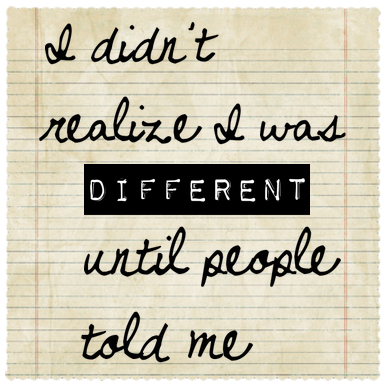
As a kid, I didn’t realize I was different until people told me.

Sometimes other kids told me in words: nerd, tomboy, babytalk, weirdo.

Sometimes they told me in actions: laughter, rejection, intimidation, bullying.

Sometimes their parents told me for them: We know you’re just using Leah because you don’t have any other friends. She’s not allowed to have you over until you learn how to be a true friend.

Sometimes my own parents told me: quit bellyaching, you need to make more friends, all that crying isn’t normal, it’s time to grow up and be like other girls.

*

I got the message: you’re broken; fix yourself.

I had a lot of determination but few resources.

Eventually, I gave up trying to fit in and embraced my weirdness. I found friends who were equally weird.

Being defiantly different became my thing; sometimes it still is.

*

But much of the time now, I forget that I’m different. When I’m alone, I forget. When I’m with the people who love and accept me unconditionally, I forget.

Until someone else reminds me–with a puzzled expression or a sarcastic remark–I forget that my brain functions differently from the other 99% of the human race.

*

I’m not just different on the outside–shy, quiet, awkward, odd.

I’m different on the inside. My wiring is nonstandard.

I’m not broken. I don’t need to be fixed.

What I do need is a little support here and there. Patience, humor, understanding.

Not pity or sympathy.

Not to be made normal.

*

People say things like:

You’d feel better if you got out of the house more.

You’d feel better if you stimmed less.

You’d feel better if you paid more attention to your looks.

To the people who think this is helpful advice I want to say:

No. Those are the things that would make you feel better, make you feel less uncomfortable around me. Doing those things would make me more tolerable to you.

Because until you said that, I felt fine.

*

This is my normal. It’s not like most people’s normal, but it’s the only one I’ve ever known and I’m content with it.

I like myself.

I forget that I’m different until you remind me.

Lessons from an Aspergers-NT Marriage (Part 2)

This is the 2nd part of a 4 part series about the lessons my husband (NT) and I (aspie) have learned during the 25 years we’ve been married.

——

Accept that aspies have good days and bad days.

I try hard to keep some of my more annoying aspie traits under control, but there are times when symptoms that I thought I had a handle on suddenly resurface or worsen. This tends to happen when I’m stressed or anxious.

A few weeks ago, an unplanned four-hour wait at the DMV triggered a bout of perseverative thinking. Even though I was aware of it, it was difficult to stop going over and over the situation in my head and, worse, out loud. It wasn’t like I wanted to keep recalculating our potential wait time based on the rate of customers being served times the number of people ahead of us factoring in the bizarre DMV numbering system that involved six different letter prefixes plus the periodic return to the queue of skipped numbers. It wasn’t that I was enjoying obsessing over each clerk who disappeared on break, thereby lengthening our wait time, or repeatedly pointing out how arbitrary the list of required identity documents was. I just couldn’t stop myself from doing it, even though I was aware of what was happening and aware of how my perseveration was making a stressful situation worse for both of us.

Anxiety or sensory overload can aggravate a wide variety of Asperger’s symptoms. When I’m stressed I find that I’m more clumsy, less open to being touched, more rigid in my thinking, less willing to deviate from routine, more vulnerable to perseverate thinking, more prone to tunnel vision, and more likely to struggle with auditory processing. Symptoms that don’t normally interfere with my functioning can become a big obstacle. I know it’s frustrating for my husband to find himself in a stressful situation and then have to deal with an outbreak of my aspie traits on top of everything else. These are the moments that really test our marriage and I’m still working on finding ways to make them less awful for both of us.

Try to balance the aspie partner’s touch sensitivities with the NT partner’s need for physical affection

Touching, one of the most important and fundamental aspects of an intimate relationship, can be uncomfortable for people with Asperger’s. Although I’ve made a lot of progress in this area, there are still times when I shrink away from being touched.

Certain types of touching in particular–light touches and those that come at unexpected times–are more likely to be uncomfortable. When I’m intensely engaged in an activity, being touched often registers as an unwanted distraction rather than spontaneous affection. I’m also more likely to pull away from touch when I’m stressed or anxious.

Then there are the times when my brain is so busy trying to figure out where a certain type of touch is headed that it’s hard to simply relax and enjoy the moment. Because aspies don’t get many of the nonverbal cues involved in intimate relationships, we rely heavily on the intellectual side of our brains to process how an intimate moment is going to proceed. Yeah, that’s about as romantic as it sounds.

All of this can be very hard on an NT partner who naturally craves physical affection. Although it’s hard to change how I feel about being touched at the “wrong” time, I try to compensate by initiating physical contact that I’m comfortable with at a time that’s good for me.

Author Liane Holliday Willey once took a lot of heat for including holding her husband’s hand five times a day on her “to-do” list. Putting handholding on a to-do list may sound cold and mechanical but that doesn’t mean that the action itself has to be mechanical. Since I’ve begun consciously looking for opportunities to initiate small touches during the day, I find that being physically affectionate has become more of a natural instinct for me and that feels good.

Accept that the NT partner may need to compensate for the aspie partner’s social skills deficits at times.

No matter how hard I work at improving my social skills, I still regularly miss nonverbal cues, resulting in everything from confused looks and awkward pauses to downright hostility from other people.

Here’s a recent example from when The Scientist and I met with a saleswoman about a new apartment:

Saleswoman to The Scientist  (who she’d met previously): “It’s good to see you again.”
The Scientist : “It’s good to see you, too.”
Saleswoman to me: “I’m Linda. It’s nice to meet you. Have a seat.”
Me (shaking her offered hand then sitting down): “Thanks, it’s nice to meet you too.”
{awkward pause}
The Scientist : “Oh, Linda, I don’t think you met my wife.”

I had no idea what was causing the awkward pause until The Scientist jumped in and offered my name to the saleswoman. What threw me was this: The Scientist had already met Linda and didn’t introduce himself. I must have been subconsciously modeling his behavior so I didn’t introduce myself either.

This sounds like a minor hiccup in the conversation but it happens frequently and it unsettles people. As an aspie–and an adult–it can be hard to accept that you need this type of help from your partner. Again, get over it. We all have skills that come naturally and social skills aren’t on the list of natural talents for aspies.

This is an area where practice can help. If the NT partner is willing, you can try roleplaying or talking through how unfamiliar events might play out. However, both partners need to understand that while aspies can work at improving social skills, it’s unlikely that they’ll achieve the sort of social proficiency that comes naturally to NTs.

Having to frequently repair social errors is hard on the NT partner and will probably continue to be an issue throughout your partnership. Acceptance can go a long way in situations where change is slow and inconsistent.

—–

In part 3: Compromise, communication aspie-style and understanding triggers

Writing is Communication Too

If you get a group of writers together, on the internet or in a workshop, someone will eventually ask the ultimate navel-gazing question: why do we write?

My stock answer–the one that’s easiest to explain and makes me look least weird–is that I write because I enjoy it. There’s nothing like the rush of chasing an idea, my fingers flying across the keyboard, barely able to keep pace with my thoughts. There’s no other activity I can get so completely lost in.

That answer saves me from having to reveal this: I write to set the words in my head free.

My brain latches onto interesting ideas in a way that makes it hard to stop thinking about them. Once something grabs my attention, my mind will turn it around and around, shaping and growing it like a vase on a potter’s wheel. Writing the idea down stops the rapid spinning of the wheel and leaves me with the equivalent of a finished vase I can share with other people instead of a hard lump of clay sitting in my brain.

Shaping an idea in my head feels like this:

Ultimately, I write because I need to. I communicate better through written words than spoken words. When I write, I can take as much time as I like to shape my thoughts into a coherent whole. I can get feedback from others to check for clarity. I can let an idea breathe and grow over days or weeks.

The process is something like this: Write. Revise. Reconsider. Delete. Edit. Clarify. Rethink. Shape. Walk away. Come back. Write more. Think more. Print it. Read it. Share it. Revise, revise, revise. Done. Mmm, maybe just change that word. Or this one. Okay, really done. Yeah? Yeah.

Doing this in a spoken conversation is impossible. There’s no delete button for spoken words. Revising, in the form of explanations and clarifications, is rarely successful. Once you say something, it’s out there in a way that is, ironically, indelible.

Communication Deficit or Communication Difference

So do I have a communication deficit? (one of the core diagnostic criteria for Asperger’s)

That may depend on how we define communication. You could argue that writing is a one-way process. I carefully shape my idea and put it out there, feeling quite content with how it looks and feels, and then I go on my merry way, chasing another bright shiny idea.

It’s all very neat and tidy. It’s also very autistic. What could be more characteristic of an aspie than a one-way information dump followed by a determined retreat back inside my head to ponder the mysteries of the universe, or at least the mystery of why someone keeps leaving sandwiches on the sidewalk of one particular street where I walk my dog?

But, short of a mind meld, writing is my best shot at sharing what I want to say. I could talk all day and not get across half of what I can communicate in writing. Since I’ve started blogging, I’ve shared things with my family–in writing–that we’ve never talked about. Big important things and little niggling things, all of them left unspoken, sometimes for many years.

The result has been anything but one-way. Sharing my thoughts in writing creates an opening for others to start conversations, to ask questions, to offer insights and to share their own thoughts. This is communication–deep, fulfilling, nontraditional communication–in a way that I’ve rarely experienced.

It feels so good to share something with my husband and see a light of understanding in his eyes. It’s done wonders for our relationship to revisit past hurts and misunderstandings in a fresh light. There’s a new level of understanding opening up and I think it’s because I’m finally able to communicate, really communicate, how I experience and process the world around me.

I’ve also discovered that writing is a way to communicate with myself. The process of exploring Asperger’s is helping me integrate disparate parts of myself into a whole. It’s creating a map of my inner landscape in a way that is profoundly healing and empowering.

Perhaps this is what I meant when I said I write because I need to. Writing connects me to those around me, and it connects me to myself.

Once a Writer, Always a Writer

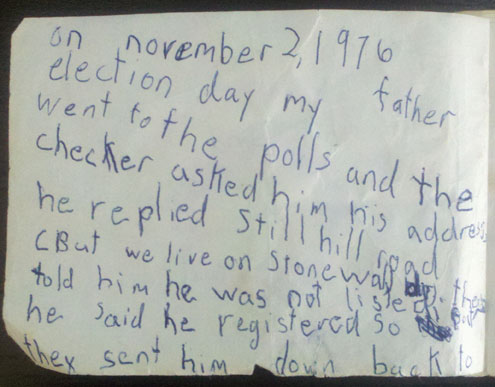
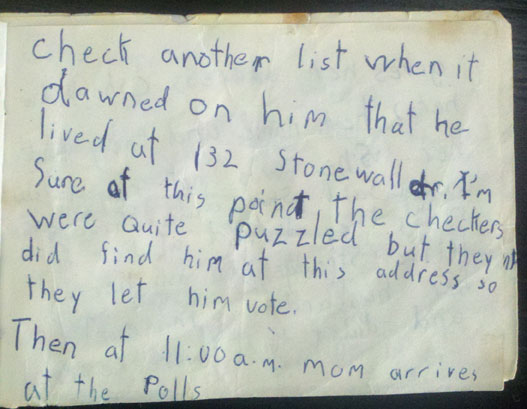
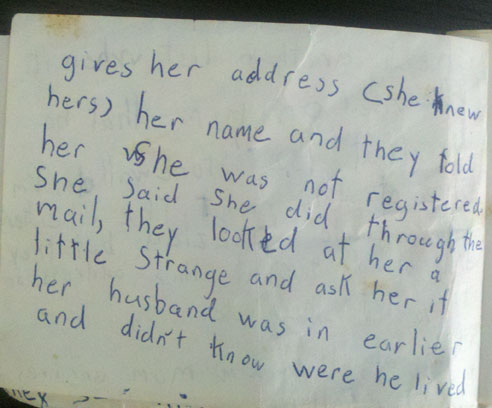
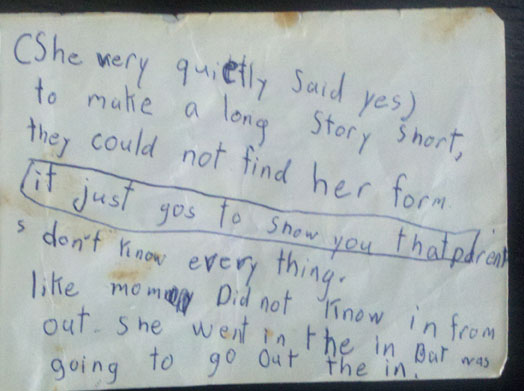
This is one the first things I ever wrote, when I was seven. I remember hearing my mother telling parts of this election day story to someone and deciding that I wanted to make it into a book. I still have it, in all its stained, stapled glory, and thought it would be fun to share.

If you look closely enough at these pages, you’ll see my aspie traits shining through. Note the atrocious handwriting.
Aspie trait #2: oddly advanced vocabulary and syntax for a 7-year-old (quite puzzled, indeed)
I have a feeling a lot of this writing is actually echolalia (the repetition of another person’s words, which is common to kids with ASD) and I was mimicking my mother’s telling of the story to another adult.
More aspie traits: a pedantic approach to social situations and a rigid adherence to the rules (going out the “in” door! *gasp*). I was also a pretty funny little kid, no?

The Angry Aspie Explains It All

The emotion I see most routinely associated with autism is anger. Again and again–on Facebook, discussion forums, blogs–I see pleas from parents for suggestions about handling anger outbursts in their autistic children. Adult ASD forums are an outlet for more direct expressions of anger–at friends, acquaintances, family, classmates, colleagues, strangers and the world in general.

We autistics are apparently an angry bunch. And it’s no wonder. As children, the world comes at us with an intensity that is confusing, frustrating and, yes, aggravating. Add to that years of miscommunication, bullying, rejection and being misunderstood and it’s not surprising to see the  “angry autistic” has become a deeply entrenched stereotype.

Yet when I sat down to make my anger constellation, I only got as far as rage and frustration before I was stumped. While anger has been a familiar companion over the years, it’s one that I’ve relegated to the shadows.

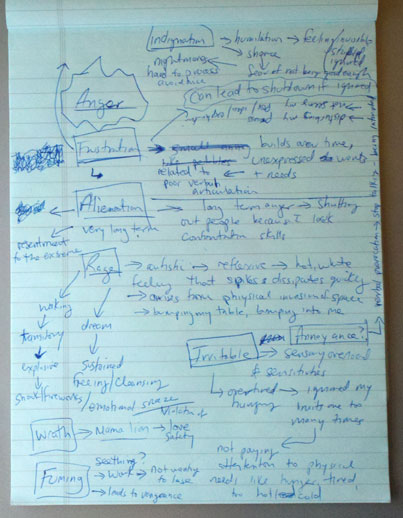
I created my happiness constellation unprompted, a nice little sketch on a small, clean notebook page. My anger constellation required a thesaurus and a good hour of hard thought to produce this:

The brainstorming notes for anger constellation

I’m including that page of notes here not because I expect anyone to read it but because it’s a good visual representation of how I experience anger–a chaotic, fractured and sometimes incoherent mess. I’ve spent days avoiding writing this next part, the part where I have to untangle the mess.

Anger makes me uncomfortable. I avoid it. I suppress it. The last thing I want to do is talk about it. Expressing anger feels wrong. Bad.

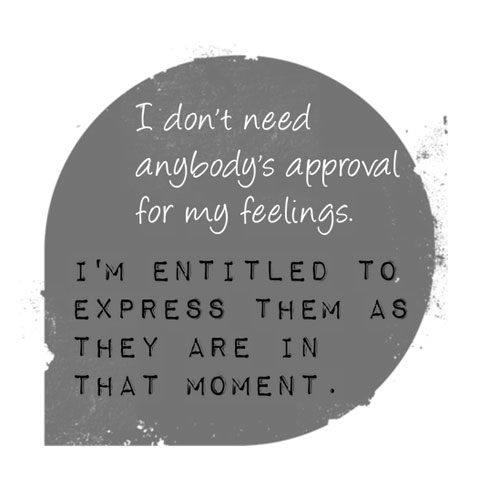
So first, a reminder:

And a word about the words I’ve chosen. They feel arbitrary. I’ve done the best I can to put names to the different ways anger manifests for me but even after much thought I’m still not sure they’re the most appropriate choices.

Frustration first, since it’s the first word that came to mind and one of the easiest to describe. Frustration is unmet expectations. It’s waking up to an ice storm on a day I’d planned to run. It’s spending far too long struggling to open a package of cookies and then tearing the package down the middle. It’s not remembering how to switch from the DVD player to cable and getting 500 channels of static. Frustration makes me grit my teeth and growl when what I should be doing is identifying my needs and articulating or acting on them. Serial frustration sometimes leads to a shutdown or a meltdown.

Annoyance. I’ve written and deleted more descriptions of this one than I can count. Which in itself is annoying. Annoyance is a disruption of my process or state of mind. I can’t find the right word to finish a sentence and lose the flow of what I’m writing. The people in the hotel room next to mine are watching TV when I’m trying to fall asleep.

Annoyance is the fly buzzing around my head; frustration is taking twenty whacks at it and missing every time.

Thanks to Asperger’s, I have more than a passing familiarity with irritability, which has roots in sensory overload. I’m overtired. I’m hungry. I’m hot. My shirt is scratchy. I’ve ignored my sensory limits one too many times and it’s turning me into a cranky toddler. Danger, danger, shutdown is imminent.

And thanks to being a mom, I’ve discovered wrath, which is what I’m calling that mama lion feeling that comes charging out its hiding place when someone messes with my kid. Bad idea. Enough said.

For some inexplicable reason, right after wrath, I added fuming to my notes. There’s little relation between the two–wrath is primitive and instinctive. This other thing–the one that makes me seethe with anger and vow to right some perceived bureaucratic wrong like I’ve just been granted membership in the Justice League–is purely intellectual. It doesn’t happen a whole lot, but when it does, I’m a force to be reckoned with. Pass me my cape and stand back.

The Big Three

All of that so far? I’m fine with it. It’s the kind of anger that comes and goes. What follows, the big three of indignation, alienation and rage, those are more firmly entrenched.

Let’s start with the one that’s been with me the longest: indignation. Indignation arises from humiliation, shame, fear of not being good enough, from feeling invisible, stupid or ignored. It’s the way my vision blurs when someone treats me like I’m an idiot for asking the same question too many times. It’s the hot blush I can’t control when I say something that falls on deaf ears. It’s the blood pounding in my ears when someone lectures me like I’m a child.

Indignation is wanting to scream I get it, I know, I understand, I’m here, I have something to say, slow down, I can do this, stop trying to fix-help-correct-educate me. It’s been with me for as long as I can remember. It festers in the broad gap between intellectual ability and social skill.

Alienation arrived later, sometime in early adulthood, but it sits stubbornly beside indignation with no plans to leave any time soon. It may be odd to describe alienation as an expression of anger, but as my husband put it, “you’ll shut someone out for 5 years instead of yelling at them for 5 minutes.” That’s an exaggeration, but not by much.

My capacity for resentment is deep and wide.  I lack confrontation skills. Never learned them as a child, didn’t see much use for them as I moved into adulthood. It’s easier to stay mad. In my twenties and thirties, my anger fueled my actions and propelled me through a lot of pain. It’s probably responsible for a good deal of my success. But clinging to that anger also cut me off from people in deep, possibly irreparable ways. Because that was easier, too. Still is. I’m working on it.

Because I avoid dealing with the feelings that swirl around indignation and alienation, they revisit me at night in the form of dreams–nightmares really–filled with rage. When I first started having these dreams about ten years ago, the intensity of them was startling. I would wake up thinking, who is that crazy woman? For a while, I thought there was something seriously wrong with me. I was turning into a freakish mutant–mild-mannered woman by day, raging she-Hulk at night.

Recently I’ve discovered a pattern to the anger and violence of my nightmares. Understanding why they happen doesn’t make them any less disturbing, but it’s helped me formulate a strategy for reducing their frequency. Which is (and will be) a post in itself.

The Anger that Goes Straight to My Hands

Finally, another of those feelings that doesn’t have a name. In the same way that I experience pure undistilled happiness, I also experience a very pure form of anger. It starts in my brain and terminates in my hands. It’s reflexive. White hot. Short-lived. Irrational. More chemical or electrical than emotional.

It’s like this: my husband bumps into me in the kitchen and I impulsively, irrationally get the urge to punch him. And here’s the weird thing: I’m not mad at him. I’m not mad at all. I’m experiencing the emotional equivalent of touching my hand to a hot stove. Trigger→physical impulse to react. There’s no cognitive processing involved. I’m not thinking. I’m reacting.

This feeling is almost always triggered by a physical experience and only happens when I’m hovering near my limit for sensory stimulation. I’ve learned to control the physical impulse. The trigger hits, I feel a spike of intense negative energy surge from head down my spine, and I still my hands until it passes.

That last part is key. If I didn’t hold on tight and ride out the physical impulse, I would lash out with hands at whatever was nearby, punching, throwing or breaking something to dissipate the energy in my hands.

When I read stories about children lashing out violently, I wonder if this is what they’re feeling. Maybe it’s not anger in a traditional sense but the need to release a sudden incomprehensible surge of energy.

A Universal Reaction

Most often my reaction to any form of anger is that I want it to stop. I didn’t learn how to express anger constructively as a kid, only that it was undesirable.

While I was doing some research about anger and autism I can across an interesting study (Rieffe et al (2007) ): in a group of ten-year-olds who were surveyed, all of the neurotypical kids reported experiencing anger, but only 77% of the autistic kids said that they ever experienced anger. (All of the kids in both groups reported feeling happiness so we can rule out the myth that autistic kids simply don’t feel emotions as an explanation.)

I wonder if some of the autistic kids in that study were like me at that age–afraid to admit to an emotion that they’d been taught was bad. Because at ten years old, if an adult asked me if I ever got angry, I probably would have said no. I didn’t want to be seen as a bad kid and I thought only bad kids got mad at stuff.

My literal aspie brain didn’t perceive the difference between “expressing anger in destructive ways is bad” and “expressing anger is bad.” What I really needed was for someone to specifically say, “when you’re mad, here are some things you can do about it.”

Anger as a Protective Mechanism

Anger is an expression of a violation of my person. If I deprive myself of the right to express that, then I’m depriving myself of the right to have boundaries and to keep myself safe.

As I read back over that last sentence, I was struck with one of those big “aha” moments that sometimes happen while I’m writing. As I’ve grown older, I’ve gotten better at defining boundaries and structuring my life in a way that supports those boundaries.

So much of my anger as a teen and young adult was related to feeling vulnerable and inadequate. As those feelings have dissipated I’ve released a lot of the deeply entrenched anger that built up during those years. I’m arriving at a place of acceptance. I’m slowly dusting off the layers of my adult self, like an archaeologist at an ancient dig site, careful not to damage what I’m uncovering.

As each new layer reveals some fascinating little detail, I scramble to integrate it into my understanding of myself and marvel at the fact that this much self discovery is possible at my age.

one woman's thoughts about life on the spectrum