This is the 4th part in an ongoing series about being diagnosed as autistic at the age of 42.
Mourning the Loss
Eventually reality set in. I’m autistic.
Not the happy “Yay! I’m different! I’m unique! I’m special!” autistic.
More like “Holy crap . . . I’m defective . . disabled . . . challenged . . . never going to get any better” autistic.
This was when the mourning began. Once the bright shiny new this-explains-everything stage wore off, I started thinking about the other side of being autistic. I wasn’t going to “outgrow” my social awkwardness. I wasn’t going to wake up one day and suddenly have a balanced emotional life. The challenges I faced weren’t imagined and they weren’t going to magically disappear. They were with me for life.
This is me. This is always going to be me. Forever.
Talk about hard realizations.
The questions that arose were mostly variations of “how would my life have been different if I wasn’t autistic?” As I tried to envision taking away this or that autistic part of me, it became obvious that Asperger’s was responsible for a lot more than what makes me weird. It’s responsible for many of my strengths, too. Take it away and I’m no longer me.
That person I was mourning? She doesn’t exist.
Mourning the Loss
Don’t be afraid to acknowledge your anger, disappointment, sadness or other negative feelings.
Recognize your strengths along with your weaknesses.
You’ve always been autistic and always will be. However, that doesn’t mean you can’t work on learning social skills, developing coping mechanisms or changing your lifestyle/environment in ways that support you.
Healing the Child (or Younger Self)
Growing up undiagnosed is hard. There is a lot of pain that comes from knowing that you’re different but not knowing why. Asperger’s gave me an explanation, but more importantly it gave me a starting point for healing that scared, confused kid inside me.
As I worked back through the more difficult aspects of my childhood, I felt like I was somehow mothering my younger self–revisiting each moment, looking at it in a new light and telling that younger version of me that it wasn’t my fault, that I’d done the best I could, that to expect more from me in the absence of support would have been unreasonable.
I wasn’t “obviously” autistic as a child–girls manifest ASD traits differently than boys in many cases and Asperger’s didn’t exist as a diagnosis in the 1970s.
I was, however, a handful. I was overly smart, easily bored, very curious and constantly in motion. Consequently, I got a lot of guidance from adults on how to behave properly. This reined in my more problematic behaviors, but it also made me feel like I was forever in danger of doing something “wrong,” especially when I “wasn’t trying hard enough.”
Being able to look back at my childhood and see that my behaviors were a result of my brain chemistry and not a result of “not being good enough” allowed me to begin to heal some of those lingering insecurities.
Learning more about Asperger’s helped me understand that I was bullied not because I was weird, but because I was socially inept. Reading about selective mutism gave me an explanation for my largely silent elementary school years–the ones where I never spoke in class unless forced to. Finding information about how ASDs manifest in girls shed light on why I had so much trouble maintaining friendships.
Each new bit of information absolved me of some perceived failure as a child and helped me begin healing some very old wounds.
Healing
Learning more about Asperger’s/autism in children can help you understand challenges you faced in childhood.
As an adult, you can choose to forgive the people in your life who hurt you as a child.
It may help to imagine your adult self sharing your new information with your child self as a way to offer comfort or explanations for unhealed childhood wounds.
If you find yourself having distressing reactions that are difficult to cope with, consult with a mental health professional or a trusted friend/mentor for help.
Something is happening deep inside me, something unexpected and strange and fantastic. I’m not sure if I can describe in any sort of way that will make sense, but here goes.
*
Last night I had a dream. I was in a railway station, crossing the platform to the exit, when I came upon a woman and her pet goose. As I accidentally stepped between the woman and the goose, the goose nipped at my pants. Surprised, I yelped and flapped my hands.
*
Here’s the strange part: I haven’t flapped my hands since I was very young. From watching old home movies, I know that I flapped as a toddler and preschooler. I’m not sure when I lost my flap but my best guess is very early in elementary school.
Here’s the unexpected part: I’ve never consciously stimmed in a dream. I didn’t realize the lack of stimming in my dreams until I woke up this morning and was overpowered by the memory of my dream flapping.
Which brings me to the fantastic part: In the dream, in that moment when I flapped, I was flooded with the sensation of being connected to my original self.
*
Huh?
I know.
I don’t think there are words to describe that last part properly. It felt like a wormhole to the past opened up and for the briefest moment I was able to experience my self as a very young child. Not imagine or remember, but actually experience it.
It was unlike anything I have ever felt, imagined, or experienced as an adult. I can’t even say that I clearly remembering feeling that way as a child.
Perhaps it has nothing to do with childhood. Perhaps the concept of original self transcends age and hinges instead on access.
I don’t know and I don’t really care. I have to give it a name so I can tell you about it, but in my mind, it doesn’t need a name. It is a state of being, as clear as any I’ve ever experienced.
It felt like untainted joy and freedom. It felt infinite. It felt like I was connected to the absolute most original version of my existence.
I can’t explain how I know that, but I do.
And it was so strongly tied to that flap–that startled, instinctive response provoked by the angry little dream goose.
*
But it was a dream, right? Dreams trick us into thinking all sorts of strange things.
Perhaps.
But dreams also tap into our subconscious in ways that we can’t access when our waking defenses are active.
*
All morning I’ve been thinking about why this happened. Why now?
What I’d like to think is this: I’m slowly rediscovering my original self.
Part of that rediscovery is tuning in to my urge to stim and setting it free. Too many years of reflexively quieting my body, of squeezing my stims down to their least noticeable versions, has disconnected me from myself in an essential way.
Slowly, slowly, the stims of my childhood are coming back. Last night as I was waiting for the pasta to cook, I found myself twirling in the kitchen and instead of stopping, I let myself enjoy it. I kicked out my foot and make a full spin to the right, then kicked out my other foot and twirled to the left. I did it again and again and soon I found myself laughing out loud.
Twirling around in the kitchen feels good. It feels right.
*
As I unlearn my habit of minimizing my stims, I feel like I’m reintegrating parts of myself that have been disconnected for a very long time.
And I find myself wondering if acceptance comes not from learning to accept but from unlearning a lifetime of rejecting.
Let’s get the hard part out there first: I lack empathy.
By lack, I don’t mean a complete absence of empathy; I have an empathy deficiency. If most adults are “doing empathy” at the calculus level, I’m still in Algebra II and solving for X in ways that would make your head spin.
Before I discovered the online autism community, I assumed that my impaired empathy was typical for someone with Asperger’s. Much of the published literature includes impaired empathy as a common AS trait. “Lack of social or emotional reciprocity” is one of the diagnostic criteria. My own experience didn’t disprove that.
Then I discovered the online ASD community and suddenly felt like I needed to hide my struggles with empathy. Everywhere I looked people were refuting the notion that autistics lack empathy.
Again and again I’ve encountered discussions about empathy online and quietly slunk away, feeling like there was something wrong with me–like I was a “defective” autistic.
I Googled empathy–probably one too many times. I read the long list of definitions at Wikipedia . I read Simon Baron-Cohen’s writing on the subject and felt the same anger others have expressed at his biases. I read looooong threads on Wrong Planet and Facebook. I revisited the diagnostic criteria. I combed through the #actuallyautistic tag on Tumblr.
The more I read, the more confused I became. I started to wonder if I was talking about the same thing others were talking about when I use the word empathy.
So let’s talk about that. What is empathy, exactly? What are we talking about when we talk about empathy?
Sympathy vs. Empathy
Empathy, in the most basic sense, is the ability to understand and share an emotional state with another person.
As an adult with a good amount of life experience, I can often understand the emotional state of another person. I know that if someone’s dog has died, they’ll feel sad. Most people probably come to this conclusion in a more instinctive way than I do, but I get there all the same.
Depending on the situation, I may share an emotional state with another person to some degree. I know how I felt when my dog died. Logically I know that the other person feels very sad. If I knew the person’s dog, I’ll feel a sense of loss myself, and that will contribute to my sharing their emotional state. However, I rarely experience a strong emotional reaction to another person’s circumstances.
That’s not to say that I don’t experience concern toward other people. Simple concern for others, though, isn’t so much empathy as sympathy. Sympathy is a concern for the wellbeing of another person. It can exist in the absence of the empathic act of sharing an emotional state with that person. It often arises from empathy, but it doesn’t have to.
When my daughter says she’s had a bad day at work, even though I find it hard to share her emotional state, I sympathize with her frustration or sadness. I don’t know what it feels like to get a phone call from a suddenly homeless student. I can’t truly share what my daughter is feeling as she tells me about the experience. But I do worry about her ability to cope with the situation. I understand how important her work with is to her. I hear the distress in her voice and want to do what I can to offer comfort.
In this type of situation, I have a great deal of sympathy, regardless of how strongly rooted in empathy my concern is. My sympathy doesn’t always come across like a neurotypical person’s sympathy would–okay, it rarely does–but it exists just the same.
The Challenges of Perspective Taking
The examples I used above are fairly explicit in terms of the emotional content of the situation. Both a dead dog or a student who’s been kicked out of her home have obvious contextual clues to the emotions that are present. Even my rudimentary empathic radar is going to pick them up.
Where I struggle most is in subtle situations. I often say things that other people consider insensitive and then I completely miss their wounded reaction to my comment. Why? Because I didn’t know that my comment was insensitive in the first place and I have trouble reading nonverbal communication.
Think about it. If you didn’t know someone’s dog had died, would you find it easy to understand and share their emotional state? Probably not. You’d pick up that something was wrong, but you wouldn’t be able to truly comprehend how they felt until they explained the source of their distress.
For me, all the little things that people communicate nonverbally or hint at or imply are like a whole bunch of secretly dead dogs. Until some says, “your comment hurt my feelings because ________” all I have is a vague feeling that something is off. Maybe not even that.
This is why I “failed” the Sally-Anne test. Twice. I failed it when I first discovered it early in my reading about Asperger’s and then I failed it again a few weeks ago, because it was presented in a slightly different format. Yep, twice.
You can argue that the Sally-Anne test has little to do with empathy. It’s true, the Sally-Anne test doesn’t predict the emotional dimension of empathy. Taking the test doesn’t require you to share an emotional state with Sally. It does, however, require you to set aside your own knowledge of the situation and take Sally’s perspective.
This is where a more precise definition of empathy comes in handy. Empathy actually has two components: cognitive (perspective taking) and affective (emotional response to another’s emotional state). The Sally-Anne test is a test of cognitive empathy, which is impaired in people with Asperger’s. However, when it comes to affective empathy, according to a 2007 study* aspies are on par with neurotypicals.
So. Affective empathy? We have it. Cognitive empathy? Not so much.
This is why I can fail a simple test twice, even when I already know the “answer.” I automatically default to my own perspective. I can take another person’s perspective, but it often requires a conscious decision on my part to do so. This seems to be something that’s silently implied in the general, vague, oft-used notion of empathy: that one can spontaneously and instinctively understand and share an emotional state with another.
When I say I have an empathy deficiency, I mean that I struggle with taking the view of another person spontaneously and instinctively. I lack cognitive empathy.
Too Much Empathy?
Over and over again I see references to autistic people having too much empathy. While I think the people using this phrase mean well, I’m not sure it’s accurate. Is an autistic person who feels overwhelmed by an emotional situation truly sharing and understanding the emotional state of another person too much or are they overwhelmed by an inability to regulate their own reaction to a highly-charged situation?
Generally, when I feel emotionally overwhelmed by another person’s emotions, it’s related to my alexithymia (emotional dysfunction). In short, I have trouble regulating my own emotions and I have trouble discriminating between emotions that are “aimed at” me and emotions that are “aimed at” someone else. If I encounter two people having a shouting argument, my emotional reaction is the same as if I were the target of their shouting, as if they were both angry at me.
I don’t think this is empathy. I’m not sharing their emotional state (anger) so much as feeling like the target of it. If I were sharing the emotional state of the people in the shouting match, wouldn’t I feel like shouting at someone, too? Instead, I feel frightened and intimidated. I feel an intense need to escape from a situation to which I’m nothing more than a bystander.
In fact, in this kind of situation, the only person I’m thinking about is myself and how uncomfortable I am. There I go again, taking my own perspective. My distress at the situation might outwardly appear to be empathic but my internal reaction is a great big “MAKE IT STOP, NOW.”
This type of reaction is mentioned in the 2007 study I referenced earlier. The researchers found that the aspies scored significantly higher on a scale of personal distress than the neurotypical group, indicating “a greater tendency to have self-oriented feelings of anxiety and discomfort in response to tense interpersonal settings.” Note the use of self-oriented feelings in that sentence. Empathy by definition describes a state shared with others; an overabundance of self-directed anxiety or discomfort is not the same as “too much empathy.”
The Right Way to be Autistic
Circling back to what got me started on this post: the subtle implication in the discussion about empathy that there is a right way to be autistic and that right way includes having empathy or too much empathy. And perhaps as a corollary to that: autistics who have too much empathy are doing their part to subvert the stereotype of the unfeeling autistic.
That was probably an unpopular paragraph. If you found it offensive or upsetting, take a moment to stop and think about why.
Is there any difference between the subtle pressure to (appear to) have empathy and the subtle (or not so subtle) pressure to not stim in public or to make eye contact? Is advancing the belief that all autistics have empathy another way of making us seem more normal? Is there a difference between pressure to not look different outwardly and the same sort of pressure to not feel different inwardly?
Empathy is often philosophically framed as a fundamental element of the human condition. Without it, are we somehow less than human? What if we have impaired empathy–is our humanity impaired?
Choose Your Words
Perhaps we need to be more thoughtful about how we use the word empathy.
Empathy is not interchangeable with sympathy.
Empathy is not interchangeable with emotion.
Empathy is not interchangeable with emotional overload.
Empathy is not some hoop to be jumped through to prove to the world that we may be autistic, but it’s not that bad because “oh look, we have empathy just like you!” (Even if we do, in whatever form. There should be no burden of proof.)
Empathy has many definitions, but they all have at their core understanding the emotional state of another person.
When I say I lack empathy, what I mean is I have a deficit in understanding the emotional states of others. Hell, I have a deficit in understanding my own emotional state at times.
“I lack empathy” simply means that “I have a deficit in understanding the emotional states of others.”
This doesn’t mean I’m unsympathetic.
It doesn’t mean I don’t care for others.
It doesn’t mean I can’t show concern.
It doesn’t mean I have no emotions.
It doesn’t mean I don’t get overwhelmed by other people’s emotional states.
It doesn’t mean I’m any less human than you are.
What does it mean then?
That I may need more information than a typical person to understand a social situation. That my reactions to your emotions may be unconventional. That I have to work harder to grasp what comes naturally to most people.
Simple as that. Nothing more, nothing less.
——-
*Thank you to Pi for pointing me toward this study. It turned out to be the missing link in wrapping this post up.
How many books on Asperger’s Syndrome or Autism have you read that begin with Chapter 1: What is Asperger’s Syndrome or Chapter 1: What is Autism? If you or someone you love is on the spectrum, then the answer is probably “a lot.”
The authors’ desire to start at the beginning is commendable but honestly I skip over these introductory chapters. I have the DSM diagnostic criteria memorized and I’m on intimate terms with the signs and symptoms of Asperger’s Syndrome.
Perhaps a more useful opening chapter for aspies would be: What is Neurotypical?
Neurotypical is a term that’s thrown around in the autism community like everyone instinctively knows what it means. If this is a new word for you (like it was for me not so long ago), in the ASD community, neurotypical is often used to refer to people who are not on the autism spectrum. It’s a mash-up of the words “neurologically typical” and is often shortened to NT.
A more correct word for someone who is not autistic is allistic. Technically, you can be non-neurotypical (neuroatypical) even if you aren’t autistic. Having clarified that up front, I’m going to go with the popular usage here.
How Can You Tell if Someone is Neurotypical?
So who are these NTs and how can you tell if someone in your family is neurotypical?
For starters, NTs make up about 99% of the population, so they’re everywhere. It’s very likely that you know neurotypicals and you probably have at least one NT in your family. While there is no widely accepted diagnostic test, NTs are fairly easy to spot once you know what to look for.
Perhaps the most obvious giveaway is an NT’s tendency to make “small talk” or to want to “chat” with you. While small talk appears to be nonfunctional, for NTs it serves a very specific purpose. It’s a good idea to humor them and participate to whatever degree you can tolerate. If you’re patient with them, many NTs will soon feel comfortable enough to move from small talk to more interesting, in-depth conversations.
Another common sign that someone is an NT? Touching. NTs enjoy all sorts of physical contact and often use touch to greet friends, family and even casual acquaintances. While it’s hard to fathom why your real estate agent or hairdresser feels the need to send you off with a hug, try not to be judgmental while fending them off. NTs are simply wired differently.
Sometimes NT behavior can be frustrating. For example, you may notice that NTs have a tendency to say something other than what they mean. If you get a new haircut and you’re not sure how it looks on you, don’t bother asking an NT. Most will tell you it looks great, even if you look like this:
“No, really, I love your new hairstyle!”
Why? Because when a neurotypical woman asks her friend “how do you like my new haircut?” she isn’t looking for her friend’s opinion, she’s looking for validation. When her friend says, “I love it” she may mean I love your hair, but what she’s really saying is I love you and value you as a person.
So when your NT friend says “how do you like my new haircut?” and you, being your aspie self, reply, “It’s a little short in the back but I like it”, your NT friend hears I secretly hate you and think you’re ugly.
Confusing, I know.
And good luck getting an opinion out of an NT when you really need one. It may help to preface your question by explicitly stating that you’re seeking an actual, honest-to-God opinion but, even then, the NT’s dogged adherence to socially appropriate behavior may inhibit their ability to say what they’re really thinking. Try to remember that NTs were born this way and their natural sensitivity to what others are thinking and feeling often makes it hard for them to be completely honest.
Of course all NTs are different, much like all aspies are different, so these are just some general guidelines for recognizing the NTs in your life.
Offended Yet?
If you’re neurotypical, how did reading this make you feel? Offended? Stereotyped? Did you enjoy the patronizing tone? How about the sweeping generalizations?
What if it went on to talk about how some NTs are so socially adept that they get promoted into positions they don’t have the knowledge or skills for? What if it listed good careers for NTs (sales, management, counseling) and authoritatively added that you shouldn’t bother considering engineering or computer science because you’ll probably fail if you do?
Perhaps you’d like to read that your neurotype–the way you were born–will cause significant stress to your family or prevent you from having meaningful relationships? How about some unsubstantiated data on the astronomically high divorce rate among people of your neurotype or the alleged rarity of someone like you ever becoming a parent, let alone a good one?
Yes, We Can Read
My search for books about Asperger’s syndrome has left me surprised at how much there is about Asperger’s that isn’t directed at people who have Asperger’s. The majority of the books that I’ve read are addressed to parents, educators, caregivers and counselors. Which is great. There need to be resources for all of these people.
But there also need to be more good comprehensive materials that are written for aspies, not just about us. We can read. We’re eager to learn more about how our brains work. Why is it so hard to find authors who recognize that?
I was in the cereal aisle in Target, waiting for The Scientist to decide on his cereal purchase, when I overheard this exchange between a mother and her preteen son:
Mother: “James, come and let’s pick out some cereal.”
James (appears from around the corner): “But I haven’t finished looking at all the pasta. I looked at the pasta on the right but I didn’t look at the pasta on the left.”
Mother: “We need to pick out your cereal.”
James (sounding panicked, voice rapidly rising into hysteria): “But I need to look at all the pasta! I haven’t looked at the pasta on the left. I need–“
Mother: “Okay, you can finish looking at the pasta if you promise to come right back here when you’re done and pick out your cereal.”
James: “I promise.” (dashes off around the corner then returns a minute later)
Mother: “Are you done?”
James: (looking happy) “Uh-huh.”
If you’re autistic or you have an autistic child, I bet you know why this conversation made me smile.
James’s mother didn’t say, “You don’t need to look at all the pasta.”
She didn’t say, “That’s ridiculous.”
Or, “You can look at the pasta later (or next time).”
Or, “Stop whining or we’re leaving.”
Or, “Grow up and act your age.” (James was around 10 or 11, I think.)
Or, “Get over here and pick out a box of cereal or I’m taking away your video games for the rest of the day.”
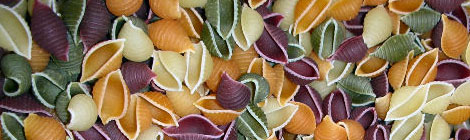
The pasta aisle is a thing of beauty, with its boxes and bags all lined up by color and size.
Though she may not understand why James needs to look at all of the pasta when he visits Target, she recognized that preventing him from doing it would result in a meltdown in aisle 13.
And look at the results: The situation was rapidly de-escalated. James was happy. He came back and picked out his cereal as promised, without any prompting. His mother had to wait for him, but an extra minute standing in the cereal aisle beats the hell out of trying to calm a kid having a meltdown in the cereal aisle.
Meet Us Where We Are
There is a lot of talk about how autistic kids (and adults) need to learn flexibility. We’re too rigid, have too many nonfunctional routines. There are elaborate systems for teaching flexible thinking (which is important, I get that). But maybe non-autistic people need to be more flexible, too.
For kids like James, Target is stressful. The noise, the lights, the people, the smells–any or all of these can be overwhelming to autistic individuals. (And yes, based on what I saw I’m assuming–perhaps wrongly, but I doubt it–that he’s on the spectrum.)
If looking at the pasta makes a kid feel better, is that a big deal?
For some parents it might be. Let’s face it–a kid who needs to not only look at the pasta, but to be sure he’s looked at all of it? A little weird. But so what? We all have our coping mechanisms and James has found a way to cope with the stress of Target.
And his mother, bless her, she seemed to get this. She doesn’t look concerned about people judging her for letting her son “have his way.” She doesn’t belittle or shame him for what is, in his mind, a very real need. She doesn’t complain that he’s wasting their time or being uncooperative.
Her response left me wondering how long it took them to get to this point. Because not only did James interrupt his study of the pasta aisle to come when she called him, he returned the second time and picked out his cereal without being prompted. For a kid with such an intense need to study the pasta aisle, this is huge. Huge.
In this one small exchange, he’s learning how to negotiate, how to compromise, how to satisfy his needs while being conscious of his responsibilities, how to keep a promise, how to regulate anxiety and/or sensory overload using coping mechanisms.
Yes, autistics can be rigid. Yes, we have some odd routines or habits. Sometimes this has to be addressed. If James needed to spend an hour studying the pasta aisle, then yeah, big problem.
But a few minutes in the pasta aisle, accepting that the pasta on the left is important, even critical, to this particular kid–that doesn’t have to be a problem at all.
When you have an autistic family member or friend, you’re going to run into situations that you find hard to understand. There will be times when we’re not where you think we should be or where you wish we were.
When this happens, try practicing a little flexibility. Meet us where we are. You might be surprised at the results.
As an adult aspie, I often feel that I need to self-censor in social situations. Don’t say the wrong thing. Don’t stare at people. (But don’t forget to make eye contact!) Don’t laugh at the wrong time. Don’t speak too loudly or too softly or too often or too infrequently. And above all, don’t stim.
Stimming makes people nervous. As a kid, I stimmed like mad. I’ve been rewatching old home movies and there I am stimming my way through Santa’s Land and Disney World and every birthday party ever. I’m bouncing, rocking, twitching, flapping, hopping. I’m hammering with anything that remotely resembles a hammer and rubbing my fingers over every nearby surface. I’m constantly in motion.
Four decades later, my stimming is more discreet. You’d have to be watching closely to notice that I’m rubbing my thumbs over the spacebar on my keyboard when I stop typing. Or that I’m fidgeting with a bottle cap under the table at a restaurant or playing with my hair while driving or folding and unfolding a piece of paper while I wait in the bank.
Stimming is so much a part of who I am that I when first read about autistic traits, I completely denied that I have stims.
That little kid in the home movies grew into a teenager who learned to stim more subtly to avoid drawing attention to herself. I’ve found socially acceptable stims like doodling or manipulating objects (pen, stress ball, cell phone) with my hands. I’ve tucked away my more obvious stims for use in private.
Well, mostly. The day of my Asperger’s assessment, I started out stimming discreetly during the interview with the psychologist. By the time I hit the three-hour mark in testing, I found myself rocking back and forth as I tried to work out the spatial reasoning puzzles.
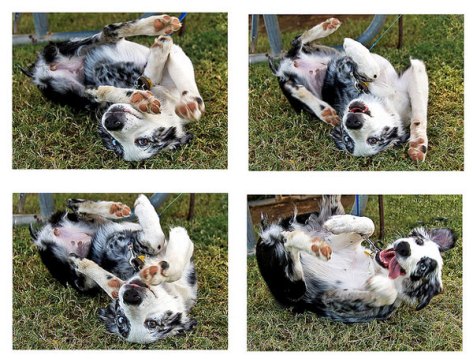
Happy stimming feels a lot like this
There is too much comfort in stimming–it’s too much of a biological imperative–for me to completely extinguish it.
I recently read that medicating a child to reduce stimming is a good way to help the child concentrate on school work. Yes, if the behaviors are self-harming or severely disruptive medication might be the answer (though if it were my child, redirecting toward a less harmful stim would be my first strategy).
But for kids who are rockers or fidgeters? I have a feeling that the medication does more to make the people around them feel better.
If anything, stimming improves my concentration. It’s a release, like sneezing or scratching an itch. Have you ever tried to ignore an itch? What if someone told you it was wrong to scratch yourself to relieve an itch? What would that do for your concentration?
Stereotyped Movement (Stereotypies)
Stimming is the most common term used to describe the repetitive movements characteristic of autism, but a more formal term (and the one used in the DSM diagnostic criteria) is stereotyped movement or stereotypies. In this case, “stereotyped” has a different meaning than the one we’re used to. In a behavioral science capacity, stereotyped movement refers to repetitive, nonfunctional movement.
Like so much of what the experts term nonfunctional about autistic behavior, I’d ask nonfunctional for whom?
The researchers concluded that stereotypic behaviors in captive animals aren’t truly abnormal; they’re a reaction to abnormal environmental conditions. In other words, monkeys should spend their days swinging from trees and running about in the jungle, not sitting in small cages. When the monkeys can’t indulge their natural behavioral tendencies, they resort to stereotypical movements like “pacing back and forth, running in circles, somersaulting, rocking, self-biting, earpulling, hair-pulling, eye-poking, etc.”
Sound familiar?
The article goes on to say:
“Many stereotypies are signs of frustration, with the subject being chronically thwarted from expressing basic activities (Reinhardt).”
Yes, stereotypies are related to frustration at being chronically thwarted from expressing basic activities.
Think about all of the things that feel like basic needs to an aspie. Being immersed in a special interest for long periods of time. Being alone. Sticking to routines. Avoiding excessive noise, strong smells, or crowds. How often do we feel thwarted when trying to pursue the things we find comforting? Chronically seems like a pretty good description to me.
When you look at it from the perspective of the animal researchers, aspies are engaging in stimming (stereotypies) not because we’re abnormal but because we’re constantly at odds with our environment.
While it’s impossible for the majority of us to indulge our aspie tendencies 24/7, it’s important to recognize the cost of self-censoring. When I’m happy, the urge to bounce up and down is nearly irrepressible. I’ve learned that it’s okay to bounce when I’m with my family. In fact, my husband’s reaction to my unbridled, childlike joy is often a huge smile. It makes him happy to see me happy, even if my way of showing it is more appropriate to a four-year-old than a forty-three-year-old.
Self-censoring is exhausting. Letting my aspie side rule feels liberating. Why would I want to extinguish that?
The blog will be on hiatus through the holidays. Thank you for reading, commenting and sharing these past few months. I hope you all have a safe, happy and peaceful holiday and I’ll see you in 2013!
—–
I was going to start this out by saying that being an aspie has certain challenges. I was going to acknowledge how those challenges can be quite severe and then talk about the positive traits of Asperger’s in a measured, careful way.
But you know what? Screw that. Today I’m going to celebrate being an aspie.
I’m going to celebrate myself.
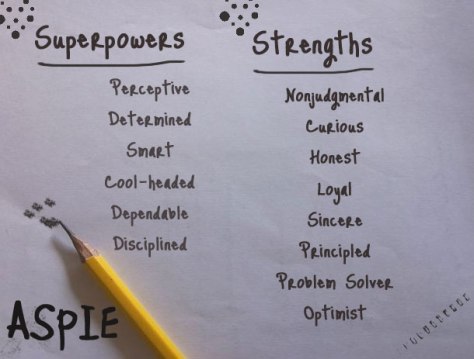
My Aspie Strengths (or How Asperger’s Has Made Me Awesome)
Many of my Asperger’s traits are double-edge swords, gifting me simultaneously with challenges and strengths. Impaired perspective taking? It makes it harder for me to work out people’s intentions but it also makes me nonjudgmental. Trouble with generalizing? That means I have to learn a similar lesson many times over, but gifts me with a dogged optimism and unconventional problem solving skills.
Curiously, some of my aspie strengths are a direct result of my funky wiring but many are coping mechanisms that I’ve developed to survive in a neurotypical world. Asperger’s has made me a survivor–forced me to adapt, by choice and necessity. The result is a unique set of strengths. Here they are, in no particular order:
I’m nonjudgmental. I take people at face value and will give someone the benefit of the doubt until they prove me wrong. A lifetime of being judged on appearance and first impressions will do that to you, I suppose.
I have a strong attachment to the truth. Telling it. Seeking it. Hearing it. If you ask me a question, you’ll get an honest answer. Perhaps more honest than you’d like. If you lie to me, I won’t forget it. I value honesty above many other traits–probably because I’m so bad at detecting dishonesty.
I’m curious. Insatiably so. I love learning, discovering, knowing. If you’re passionate about something and you want to share it with me, I’ll listen with genuine enthusiasm. My interests are wide-ranging and ever-evolving. My need for knowledge feels limitless, exciting and empowering. Give me an answer and I’ll have a handful of questions in reply.
I’m loyal. My attachments to people are few, but when I do form a bond with someone it’s a strong one. I will stand up for the people I care about in the face of a great deal of opposition. When Temple Grandin said that an autistic child will run into a burning building to save a person they love, she wasn’t kidding. That’s me in a nutshell.
I’m sincere. Perhaps naively so. I don’t have the patience or energy to be manipulative. I’m generally good-intentioned. When I do something for another person, I do it wholeheartedly. People often seem puzzled by my sincerity, disbelieving, as if being sincere is in itself some elaborate form of manipulation.
I have well-defined values. The black and white thinking of Asperger’s means that I’ve developed an elaborate and clearly delimited value system. This can be a blessing and a curse. There is a thin line between being principled and being stubbornly dogmatic. At most times, though, my values are my compass and my rudder, helping me navigate the ambiguities of a neurotypical world.
I’m an unconventional problem solver. I’m not afraid to ask wild questions or examine solutions that appear to have little hope of working. My instincts can get way ahead of my ability to verbalize them. Often, I’m told that things won’t work or don’t make sense–right up until I go ahead and do what I have in mind and it works. Or doesn’t. It’s a crapshoot, but that does little to dent my confidence and willingness to try.
I’m an optimist. I live in the here and now. I have few regrets. I view situations starting from zero. Aspies aren’t very good at generalizing from one occurrence to another similar occurrence, which I think leads to an irrational level of optimism. Sure something went wrong in the past, but (my brain always seems to say) this time will be different. Sometimes it is. Either way, I’ve found that taking the optimistic view of life makes me happy.
These are my strengths and superpowers. What are yours?
My Aspie Superpowers (or How Asperger’s Has Made Me Who I Am)
One of the myths of Asperger’s is that all aspies are savants–that we’re born with some profound skill, like the ability to name the day of the week for any date in history, draw the New York subway system from memory, or do complex mathematical calculations in our heads.
Some aspies are savants, but sadly, I have no savant skills. I’ve always been fascinated by people who do. I think it would be amazing to have a photographic memory or to instinctively understand a system like mathematics.
Like a lot of aspies, I do have a few overly developed traits. They aren’t at the level of a savant skill, but I’ve started to think of them as my aspie superpowers. They’re the things about me that people comment on as being out of the ordinary or above average. They’re a significant part of my self-identity:
I’m perceptive and detail oriented. I notice everything: changes and irregularities, patterns and habits. I can analyze the hell out of things. I see patterns where most people don’t. My affinity for details began as a coping mechanism, I think–a way to identify patterns in social situations that I couldn’t work out instinctively. Now it’s become my default mode for making sense of the world around me.
I have a high IQ. This may not seem related to Asperger’s until you think about what an IQ test is: logic, problem solving, pattern recognition. Especially pattern recognition. The question about what number comes next in the sequence? Pattern recognition. Which shape is missing in the grid? Pattern recognition. Is the sum of the odd numbers between 1 and 12 an even number? Yep, that one is pattern recognition, too. Or it is if your brain works like mine.
I’m calm in a crisis. If something goes wrong, I have an almost superhuman ability to separate myself from the situation and think clearly. Poor executive function combined with impaired perspective taking lets me focus on the facts at hand when others get overwhelmed by panic or “worst case scenario” thinking.
I’m dependable and disciplined. Both of these have roots in my Aspergarian need for routine. Once I get a routine in place, I can do the same thing day after day without tiring of it. I can keep the books, walk the dog, sort the mail–day after day, like clockwork–as long as it’s part of my daily schedule. I’m the kind of person people rely on. I get things done.
I’m determined. Perseveration has a huge upside. If a problem or task catches my attention, I’ll go at it like a doberman with a ragdoll. I’ll work at something long past the time when a more rational person would throw in the towel. A big part of success for me is simply not giving up too soon.
Okay, looking back on that list, it looks rather boring. There’s a reason The Scientist jokingly calls me “Data” at times. But Data saved the Enterprise as often as Picard, right? I like my boring superpowers. They’re useful. They’ve served me well.
Asperger’s or Personality?
The line between my aspie traits and my other more typical personality traits can be a fuzzy one. In the absence of Asperger’s would I still have the strengths that I do? Doubtful. I’d be a different person. Look at my list of strengths. Do you see compassionate, caring, or intuitive on it? How about spontaneous, sympathetic or a team player? I am all of things in varying degrees, but they aren’t my strong points.
My strengths are typically Aspergarian. Without Asperger’s I might be a less extreme form of myself–a blend of my current traits with neurotypical traits. I fear that I’d lose most of my superpowers, though I might gain other superpowers in place of them.
Do NTs have superpowers? Surely they must. I think The Scientist has social superpowers. He’s remarkably charming, persuasive, likeable, confident and intuitive. It’s as hard for me to imagine what he would be like with an aspie brain as it is for me to imagine myself as an NT.
Not that I ever really do. I like being an aspie. Sure it’s a pain in the ass sometimes, but take away Asperger’s and I’m no longer me.
I like me! Have I said that? Are you tired of hearing it yet? Because this is important. I’m autistic and I like myself. There are people who would find that hard or even impossible to believe.
I like being a little different. I like my aspie strengths and superpowers far more than I dislike my aspie weaknesses. Let’s face it, everyone has weaknesses. Everyone faces challenges. The perfect person, the perfect life–that doesn’t exist.
What Are Your Strengths and Superpowers?
The idea of a distinct set of aspie strengths has its roots in Tony Attwood and Carol Gray’s “The Discovery of Aspie Criteria.” They proposed seeing Asperger’s as a set of strengths and talents rather than a syndrome of deficits. If you’ve never seen the list, you can find it in that article–scroll down a few screens until you see the numbered lists. If you haven’t yet identified your aspie strengths and superpowers, it’s a great place to start.
When I learned that I have Asperger’s Syndrome, my first impulse was to read everything I could get my hands on. I was excited to discover that my town’s library has a large collection of books about Asperger’s and autism.
I went to the library, armed with my list of call numbers, and was surprised to discover that only two of the books listed as available in the online catalog were actually on the shelf. Puzzled, I brought up the entries for Asperger’s on the library computer and realized that I’d glossed over one key detail: most of the books about Asperger’s and autism were shelved in the library’s Disability Resource Center.
Looking down at the two books in my hand, I noticed the bright orange DRC stickers on the spines. The books I’d found in the general collection had been shelved there by mistake.
Some of the autism books that I borrowed from a nearby town library had a more generic “Health Information Center” sticker on the spine.
And so I was confronted with the question I’d been avoiding: am I disabled?
Like many people who discover they’re aspies later in life, I already have a fairly strong self-concept built around a set of labels I’ve carried with me most of my adult life:
woman
wife
mother
entrepreneur
From the start I was surprisingly okay with adding aspie to that list. It’s a label that explains much of what makes me different from other adults. It’s so much easier to say I’m an aspie than to try to catalog the long list of ways in which my brain functions differently from a neurotypical brain. Even when the Asperger’s designation is retired in 2013, I think I’ll still identify as an aspie because that’s how I entered the spectrum.
Autistic was a harder label to accept. I’d always thought of autistic people as nonverbal and cut off from the world. I now realize that I’d bought into a dangerous stereotype.
As part of the online autism community, I’ve learned a lot over the last few months. I’ve learned that the autism spectrum is as diverse as the neurotypical spectrum. I’ve learned speaking is not the only means of communicating with the world around us. I’ve learned that the autism spectrum is not hierarchical; we can’t quantify the people on it using neatly bounded phrases or concepts. I’ve learned that autistic adults have a responsibility to stand up, speak up and continue speaking up.
So, yes, I’m autistic and proudly so.
But disabled? I actually Googled a definition to see what the word means in a pure etymological sense. So here it is, straight from Google’s dictionary:
A physical or mental condition that limits a person’s movements, senses, or activities.
Undeniably, yes, that applies to me. Asperger’s is a neurological (physical) condition that limits (or at least alters the function of) my senses and my activities to varying degrees.
Still, I struggle with the Disabled label. My resistance has nothing to do with the appropriateness of a dictionary definition and everything to do with my biases against the negative connotation of the label.
There is a strong and growing movement in the ASD community to emphasize the strengths that result from being on the spectrum. There are many and, personally, I wouldn’t trade my aspie strengths for the ability to make small talk or not bump into the furniture with alarming regularity.
Well, on most days I wouldn’t.
But here’s the funny thing about labels. Even though I don’t think of myself as disabled, I still have to go into the Disability Resource Center to pick up books about people like me.
Do other people see me as disabled?
Undoubtedly some do.
Maybe the real question is, does this bother me?
I guess it does, on some level. Would I be writing about it if I didn’t?
I’d like to say that thinking and writing about complex issues like this helps me untangle them but sometimes I end up more uncertain than when I began. Instead of coming to a conclusion, I’ve come to an occlusion. I literally have nowhere to go with the rest of this piece because each path I start down leads me deeper into the weeds until I encounter thoughts so thick and overgrown that I have to turn back.
So instead of putting a bow on this and calling it done–something I’m sure I would regret doing because my understanding of this topic is still so poorly formed–I’m going to challenge myself to continue reading and thinking and learning, to dig deeper. I’ll be back in early March with an update–not necessarily with answers, but certainly with more thoughts.
———————–
some related posts by other bloggers about labels, how we identify and the significance of language:
I know there are many, many more smart thoughtful posts and articles about this topic. If there’s something you think I should add to this list, let me know. I’ll continue building it as I read and explore.
In honor of the annual airing of Rudolph the Rednosed Reindeer this coming Tuesday.
—–
When I was in elementary school, I was fascinated by the Island of Misfit Toys.
If you have no idea what I’m talking about, here’s an outtake from Rudolph the Rednosed Reindeer. Rudolph and his friends have just found themselves on the Island of Misfit Toys and the toys are describing their problems:
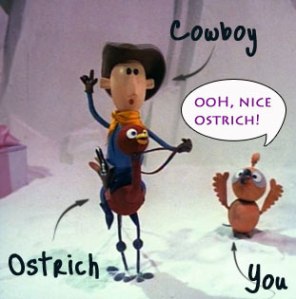
The Island of Misfit Toys is like aspie heaven–a place where no one measures up to conventional expectations and you’re not even allowed to stay if you might be the least bit “normal.” A place where it’s okay to be a bird that swims or a cowboy who rides an ostrich.
Because that’s the real issue with living in a neurotypical world, isn’t it? Conventional expectations. If 99% of people had aspie brains instead of neurotypical brains, then aspies would be the baseline. Imagine a world where making small talk was considered dysfunctional and hugging someone you’ve just met was frowned upon.
But we aspies live in a world filled with norms and expectations that we often don’t understand or that we find ridiculous. A world that isn’t going to conform to our standards. So the question becomes: move to the island of misfit toys or give up swimming and learn to fly like the other birds?
Much of the self-help information out there for adults on the spectrum is focused on learning to fly in formation. Learning to assimilate, to pass, to appear less autistic.
To a certain degree, assimilating is beneficial. If you’re the train with square wheels or the boat that sinks, learning basic life skills is necessary. We live in an NT world and refusing to acknowledge that fact is going to result in frustration and bitterness. A certain amount of assimilation makes life easier. Given all of the challenges aspies face, that doesn’t seem like a bad thing.
But what if you’re the cowboy riding the ostrich?
Well, does the ostrich make you happy? Can you ignore the strange looks and snide comments from some of the other cowboys? If you’re like me, you’ve probably developed a certain capacity for ignoring what other people think about you. Maybe you even like defying conventional expectations.
As adaptive strategies go, flying your freak flag sounds like a pretty good one to me.
Let’s Be Independent Together
Early on in Rudolph the Rednosed Reindeer, Rudolph and Hermey decide they’re going to fly their freak flags. They’ve had it with conventional expectations. Their efforts at assimilation have failed and they’re tired of being ridiculed for being different.
They come up with a solution that’s wonderfully Aspergerian: they decide to be “independent together.” It’s meant to be a silly play on words, but there’s a lot of wisdom in that phrase.
To be independent together is to accept our differences, to celebrate what makes us uniquely autistic, each in our own way.
To be independent together is to walk our paths, side-by-side, but not in lockstep.
To be independent together is something we can each do, right now, today.
Just look around until you find one of those unconventional cowboys. When you do, give ’em a smile and say, “Hey, that’s a cool ostrich you’ve got there.”
It’s that simple.
To be independent together is something we can each do, right now, today.
This is the last post in series about the lessons my husband (NT) and I (aspie) have learned during the 25 years we’ve been married.
Learn how to recognize your partner’s expressions of love
Aspies and NTs speak completely different languages when it comes to expressions of love. You can either learn to translate your partner’s “love language” or you can spend the rest of your marriage wondering if this person you’re sleeping next to every night really, actually loves you.
How does this translation work? Like this:
The Scientist: “You don’t have to make my lunch every morning. I can pick something up in the cafeteria.”
Me: “I don’t mind. It only takes a few minutes and I know you’d rather have something healthy to eat. This way you don’t have to waste time waiting in line.”
The Scientist: “So you mean you make my lunch because you care about me, right?”
Exactly.
Learning how to translate the ways your partner thinks about love and intimacy can be challenging in an aspie-NT relationship. Image via creative commons license from the Flickr photostream of DailyPic.
Accept that there are things you’ll never understand about your partner
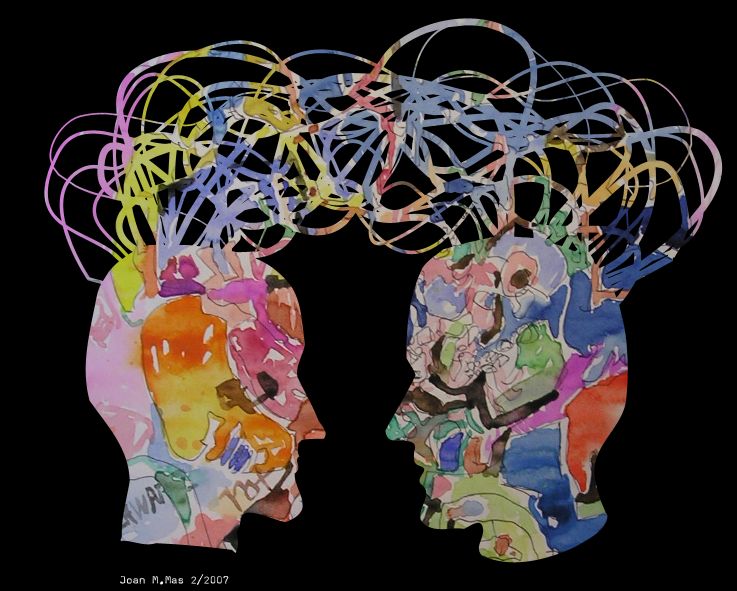
No matter how long you live together or how much you love each other, there will be moments when you feel like your partner is the most incomprehensible person on Earth. The aspie and NT brains have key differences. The sooner you accept this, the less frustrated you’ll be when your partner does something that leaves you scratching your head.
There have been many times when The Scientist has given up on a conversation with the words, “I just don’t understand you.” It’s not that he isn’t trying. He’ll ask me lots of questions to try to zero in on an explanation for something I’ve done or said. He’ll wait semi-patiently while I sit mutely and stare off into the distance, unable to put words to what I’m feeling. He’ll repeat things back to me to see if he’s hearing me correctly. But no matter how many different ways I explain it, it still doesn’t make sense to him because we’re both starting from fundamentally different places.
This goes both ways. The day The Scientist told me that he feels something–a physical sensation of warmth was how he described it–when he says, “I love you” I was stunned. I tell him that I love him every day but I’ve never associated a physical feeling with those words.
I can logically understand what this physical feeling might be like, but I’ll probably never know exactly what he feels. By the same token, I can tell him that when I sit in a crowded restaurant, my brain is tracking the conversations at all of the tables within earshot, but I don’t think he can ever replicate that experience in his own head.
We can make educated guesses at what’s going on inside the head of our partner, but there will always be some experiences that we can’t truly understand.
Have realistic expectations but don’t stop trying to grow and improve your relationship.
When faced with the day-to-day challenges of an aspie-NT marriage, it would be easy for both partners to simply give up in frustration. I can think of plenty of times when walking away would have been easier and less painful than trying to work things out.
Balancing realistic expectations–by both partners–with a concerted effort to improve can be a relationship-saver. Realistic expectations go both ways. The NT partner shouldn’t expect the aspie partner to morph into a typical person overnight. (The Scientist says he wouldn’t want this even it were possible.)
By the same token, the aspie partner shouldn’t expect the NT partner to simply put up with an endless barrage of unchecked aspie behavior. Knowing what can be changed and what can be tolerated is essential.
The second part of this equation is one that might draw some heat from aspies. I’m a firm believer in trying to improve my ability to function in an NT world. Before anyone jumps down my throat about the potential evils of assimilating, let me explain.
The day I explained to my husband about my Asperger’s, one of the first things he said was, “I love you exactly the way you are.” I treasure that and I know it’s not something he said just to make me feel better. He means it. But I also know that I’m hard to live with. I find myself hard to live with at times. So when I say I want to improve my level of functioning, it’s because I want to struggle less on a daily basis and because I want the people around me–the people I love–to struggle less. It has nothing to do with conforming to the expectations of an NT world and everything to do with making life less stressful and more enjoyable for myself and my family.









 Musings of an Aspie