Tag Archives: stimming

Scenes from an Autistic Childhood

Through the magic of old home movies (actually DVD transfers of grainy super 8 footage), I’ve been able to study bits of my childhood, looking for typical early childhood signs of autism.

Hindsight is not only 20/20 it’s very entertaining. I decided to liveblog scenes from my autistic childhood, so you can share in the fun.

Let’s go back in time . . .

DVD #1: The Early Years

Through most of the first disc I look like an average baby and toddler. Maybe a little hard to engage at times. I’m often staring intently at something off camera. I’m interested in objects as much as people. Give me a baby doll and I’ll probably hug her. Or wield her like a club. It’s a toss up.

I’m not the most expressive baby. I more often look panicked or confused or grumpy than happy. Hmmm, when I do look happy it tends to be the shrieking, hand flapping sort of happiness.

Then this happens:
filmstrip1
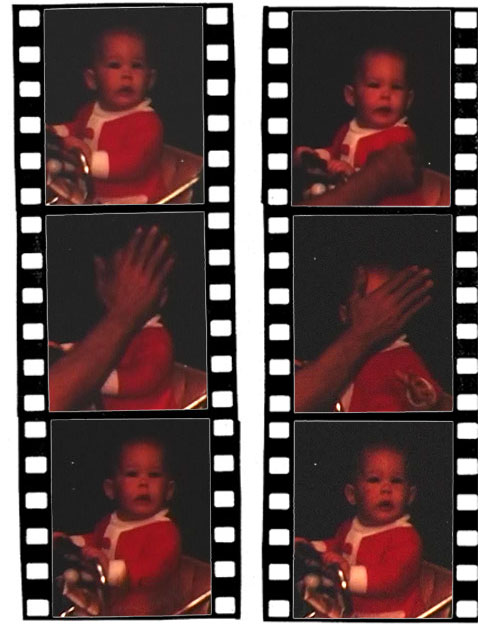
My dad is on the floor in front of me, just outside the cropped frames. At first he’s making noises and I’m laughing. After a few seconds of that, I look up toward the camera, suddenly oblivious to him. Frustrated, my dad puts his hand between me and the camera. Note the unchanged expression on my face before and after. He shakes my shoulder, tickles me, calls me, tries the hand thing a couple more times. Nothing seems to get through to me. I’m still staring at whatever’s caught my attention when the frame goes dark.

Doesn’t respond to his or her name or to the sound of a familiar voice.

Soon I see more clues:

51:55 – I’d rather sit and bounce on my ball than throw or kick it.

53:01 – The first of many shots of me happily swinging on my backyard swing set.

filmstrip2
54.35 – I’m intensely interested in hammering nails into a piece of scrap wood. With a real hammer! There’s an entire reel of hammering. Perseveration R Us.

58:38 – A little hand flapping for the goats at the petting zoo.

1:04:14 –  Here I am getting a haircut. I loved going to the hairdresser because it meant I got to play with the rollers and hair clips. And by play with, I mean sort by size and color.

Doesn’t play “pretend” games, engage in group games, imitate others, or use toys in creative ways.

DVD #2: Vacation!

Being away from home causes me to stim nearly nonstop. In the first twenty minutes, I’m 3 to 4 years old and still an only child. I wonder if being the first child–with no siblings to compare my behavior to–makes my autistic traits less obvious to my parents.

3:40 – Here I am rocking back and forth in my stroller at Santa’s Land.

5:21 – My parents prompt me to wave to the camera. Again. I rarely wave unless they tell me to.

Uses few or no gestures (e.g., does not wave goodbye)

8:12 – An entire reel of me sitting beside my inflatable pool, washing the grass off my feet. I’m still doing it when the camera shuts off. I seriously did not like having grass stuck to my feet. Or grass in my pool.

9:40 – Happily swinging on a porch swing.

9:52 – Really happily swinging on a chain link fence. Okay, more like happily full body slamming the chain link fence.

Flaps their hands, rocks their body, or spins in circles

10:39 – Staring intently at an animatronic display. So intently that I have my face pressed flat up against the glass.

11:40 – Swinging on a glider. A disproportionate amount of these movies are of me swinging on things.
filmstrip4
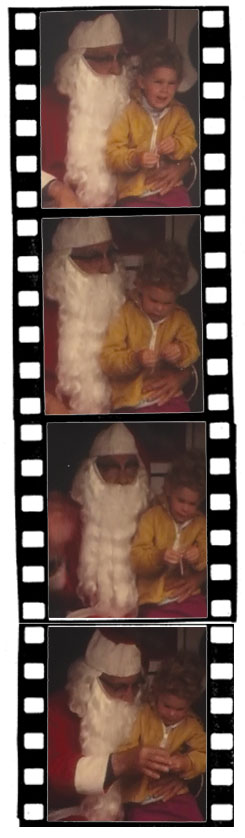
11:55 – Stimming with Santa! Here’s how my 4-year-old visit with Santa goes: I get on his lap. I sit facing away from him and never once look at him. I fiddle with the candy cane wrapper in my hand, examining it like it’s the most interesting thing I’ve ever seen. Santa says something to me. I pretend he doesn’t exist. I fidget with the wrapper some more. Santa says something and waves at the camera. I enter a state of serene bliss in which nothing exists but the wrapper. Santa waves some more. Santa tries to take away my candy cane wrapper. The screen abruptly goes dark.

Exhibits poor eye contact

12:42 – More rocking, this time while posing in front of a statue of a giant pig.

12:56 –  More intense staring at animatronic gnomes.They’re rocking gnomes. I love them. In fact, I love them so much, I’m rocking in time with them.

13:20 – More staring. This time at dwarves.

14:18 – Here I am rubbing Humpty-Dumpty’s egg-shaped body. Over and over again, my parents pose me on or next to something and I immediately start rubbing my thumb or palm over the closest surface.

Engages in repetitive gestures or behaviors like touching objects

15:49 – Swinging from the rope of the school bell in an old fashioned schoolhouse.

16:32 – Bouncing up and down with the White Mountains in the background.

You get the idea. Ten more minutes of vacation footage and I’m constantly in motion. Bouncing, rocking, fidgeting with my windbreaker zipper, kicking my feet, flexing my knees, jiggling my feet, rubbing surfaces, hand flapping.

Moves constantly

I’m thinking it’s time to shut the DVD off, assuming I’ve made my point, when I see my sister do something I haven’t done once in more than 90 minutes of video: she points. She’s about a year old, and she’s pointing at the petting zoo animals. That’s when it hits me. I have one of the classic early childhood autism symptoms–a failure to point at objects.

Doesn’t point, wave goodbye or use other gestures to communicate

Soon we’re at Disney World with a family friend. She and my sister point again and again at things they’re excited about. I don’t point at anything. Not once.

30:06 – I’m about six here and I’ve learned to wave at the camera without being reminded. I’m riding on a carousel and wave at the camera every single time I go by. Yep, I’ve got the waving thing down good.

35:36  – We’re at Gettysburg. I’m around seven years old. My mother and sister are posing by a canon, waving at the camera, chatting away. I’m climbing on the canon, rubbing the canon, pretending to ride on the canon, paying no attention to them or the camera.

Appears disinterested or unaware of other people or what’s going on around them

It’s interesting to see footage of my sister and I at similar ages. I see how much more likely she was to engage with the camera, to wave spontaneously, to be smiling or talking or paying attention to the people around her.

I also see that I took a lot of cues from her. She’s four years younger, but at times–like when we’re interacting with characters at Disney World–I’m obviously watching her and following her lead.

And now that I’m no longer the sole focus of the camera’s attention, I’m a lot more likely to just wander out of the frame.

DVD #3: A Slew of Holidays with a Dash of Empathy on the Side

12:10 – Back in time again, to my 2nd birthday party. It’s a huge one. Every cousin, aunt, uncle and grandparent wedged into our basement rec room. I’m looking a little overwhelmed, circling a pole in the background as my cousins mug for the camera. When it’s time to blow out the candles I bravely poke a finger into the icing, lick it off my finger and immediately grab a napkin to clean my hand. Some things never change.

17:51 – Halloween. I’m six years old and for the first time I see evidence of my inability to tell if anyone is paying attention when I’m talking. As I scoop the seeds out of my pumpkin I’m rambling on about something to my sister who is too young to understand and my mother who is bustling around the kitchen, not even in the frame half the time. I’m blissfully undeterred.

Tends to carry on monologues on a favorite subject

20:12 – A bunch of Halloweens flash by. I’m Raggedy Ann. I’m a nurse. I’m a cat. Every costume has a stiff plastic mask which I pull off repeatedly. After yanking off the cat mask, I tug at my hair with both hands. Even today, my single most vivid memory of Halloween is the warm wet sensation of plastic against my face as my breath condensed on the inside of those masks.

29:50 – It’s snowed! My eighteen-month-old self is skeptical. I touch the snow with one mitten. Look at my hand. Immediately begin flapping. Cut to a shot of me a few months later, enjoying a fine spring day by toe-walking up the driveway. Yet another thing I’d say I never did if I hadn’t seen it here.
filmstrip9
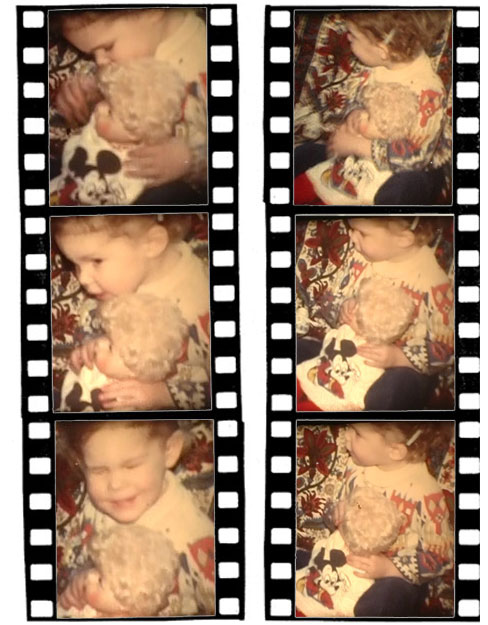
32:50 – I’m sitting on the couch with a doll. My parents have mounted a light on the camera to improve their movies. I peek toward the camera, grimace in shock (or pain?) and close my eyes. I not only don’t look at the camera again, I turn my doll’s head away too. Empathy! Does it still count if it’s for an inanimate object?

May be unusually sensitive to light, sound and/or touch

40:19 – My sister and I are playing with my dolls in my room. By playing I mean I’m lining them up against the wall by height while preventing her from touching them. She enjoys this about as much as you’d expect a toddler to.

Obsessively lines up or arranges things in a certain order.

Looking back at these old films through the lens of autism is really enlightening. I had telltale signs of Asperger’s syndrome at a time when AS didn’t exist. I don’t remember much of what I’ve related here, but I do remember being a generally happy kid in my preschool years. Because I didn’t attend nursery school or daycare, I guess spent my first five years in a bit of a bubble, happily stimming my way through Santa’s Land.
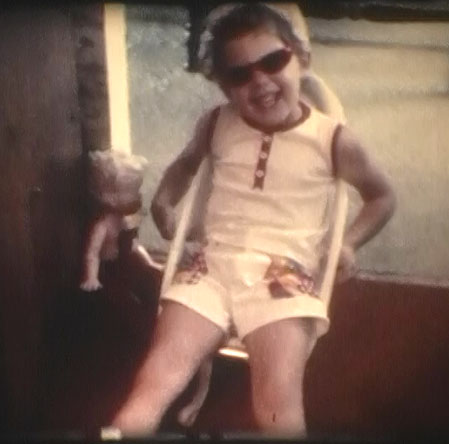
Was I a happy kid or what?

Signs of Autism in Early Childhood

While I’ve highlighted many of the early signs of autism in my observations of my younger self, each child is different. You can find comprehensive lists of early signs and symptoms at  Mayo Clinic: Autism Symptoms and/or the CDC’s ASD Signs and Symptoms.

Unlearning to Accept

Something is happening deep inside me, something unexpected and strange and fantastic. I’m not sure if I can describe in any sort of way that will make sense, but here goes.

*

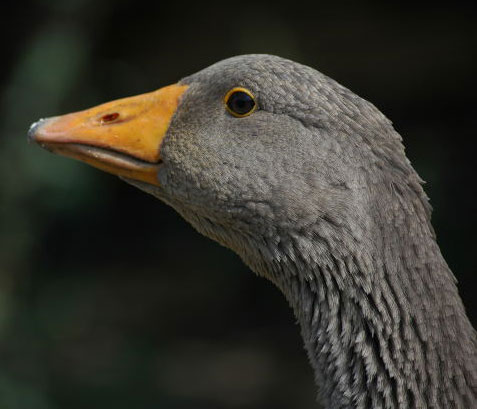
Last night I had a dream. I was in a railway station, crossing the platform to the exit, when I came upon a woman and her pet goose. As I accidentally stepped between the woman and the goose, the goose nipped at my pants. Surprised, I yelped and flapped my hands.

GOOSE

*

Here’s the strange part: I haven’t flapped my hands since I was very young. From watching old home movies, I know that I flapped as a toddler and preschooler. I’m not sure when I lost my flap but my best guess is very early in elementary school.

Here’s the unexpected part: I’ve never consciously stimmed in a dream. I didn’t realize the lack of stimming in my dreams until I woke up this morning and was overpowered by the memory of my dream flapping.

Which brings me to the fantastic part: In the dream, in that moment when I flapped, I was flooded with the sensation of being connected to my original self.

*

Huh?

I know.

I don’t think there are words to describe that last part properly. It felt like a wormhole to the past opened up and for the briefest moment I was able to experience my self as a very young child. Not imagine or remember, but actually experience it.

It was unlike anything I have ever felt, imagined, or experienced as an adult. I can’t even say that I clearly remembering feeling that way as a child.

Perhaps it has nothing to do with childhood. Perhaps the concept of original self transcends age and hinges instead on access.

I don’t know and I don’t really care. I have to give it a name so I can tell you about it, but in my mind, it doesn’t need a name. It is a state of being, as clear as any I’ve ever experienced.

It felt like untainted joy and freedom. It felt infinite. It felt like I was connected to the absolute most original version of my existence.

I can’t explain how I know that, but I do.

And it was so strongly tied to that flap–that startled, instinctive response provoked by the angry little dream goose.

*

But it was a dream, right? Dreams trick us into thinking all sorts of strange things.

Perhaps.

But dreams also tap into our subconscious in ways that we can’t access when our waking defenses are active.

*

All morning I’ve been thinking about why this happened. Why now?

What I’d like to think is this: I’m slowly rediscovering my original self.

Part of that rediscovery is tuning in to my urge to stim and setting it free. Too many years of reflexively quieting my body, of squeezing my stims down to their least noticeable versions, has disconnected me from myself in an essential way.

Slowly, slowly, the stims of my childhood are coming back. Last night as I was waiting for the pasta to cook, I found myself twirling in the kitchen and instead of stopping, I let myself enjoy it. I kicked out my foot and make a full spin to the right, then kicked out my other foot and twirled to the left. I did it again and again and soon I found myself laughing out loud.

Twirling around in the kitchen feels good. It feels right.

*

As I unlearn my habit of minimizing my stims, I feel like I’m reintegrating parts of myself that have been disconnected for a very long time.

And I find myself wondering if acceptance comes not from learning to accept but from unlearning a lifetime of rejecting.

The High Cost of Self-Censoring (or why stimming is a good thing)

As an adult aspie, I often feel that I need to self-censor in social situations. Don’t say the wrong thing. Don’t stare at people. (But don’t forget to make eye contact!) Don’t laugh at the wrong time. Don’t speak too loudly or too softly or too often or too infrequently. And above all, don’t stim.

Stimming makes people nervous. As a kid, I stimmed like mad. I’ve been rewatching old home movies and there I am stimming my way through Santa’s Land and Disney World and every birthday party ever. I’m bouncing, rocking, twitching, flapping, hopping. I’m hammering with anything that remotely resembles a hammer and rubbing my fingers over every nearby surface. I’m constantly in motion.

Four decades later, my stimming is more discreet. You’d have to be watching closely to notice that I’m rubbing my thumbs over the spacebar on my keyboard when I stop typing. Or that I’m fidgeting with a bottle cap under the table at a restaurant or playing with my hair while driving or folding and unfolding a piece of paper while I wait in the bank.

Stimming is so much a part of who I am that I when first read about autistic traits, I completely denied that I have stims.

That little kid in the home movies grew into a teenager who learned to stim more subtly to avoid drawing attention to herself. I’ve found socially acceptable stims like doodling or manipulating objects (pen, stress ball, cell phone) with my hands. I’ve tucked away my more obvious stims for use in private.

Well, mostly. The day of my Asperger’s assessment, I started out stimming discreetly during the interview with the psychologist. By the time I hit the three-hour mark in testing, I found myself rocking back and forth as I tried to work out the spatial reasoning puzzles.

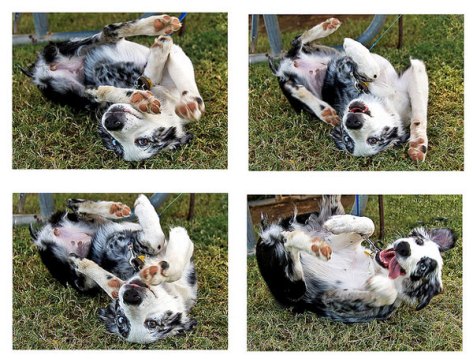
Happy stimming feels a lot like this

There is too much comfort in stimming–it’s too much of a biological imperative–for me to completely extinguish it.

I recently read that medicating a child to reduce stimming is a good way to help the child concentrate on school work. Yes, if the behaviors are self-harming or severely disruptive medication might be the answer (though if it were my child, redirecting toward a less harmful stim would be my first strategy).

But for kids who are rockers or fidgeters? I have a feeling that the medication does more to make the people around them feel better.

If anything, stimming improves my concentration. It’s a release, like sneezing or scratching an itch. Have you ever tried to ignore an itch? What if someone told you it was wrong to scratch yourself to relieve an itch? What would that do for your concentration?

Stereotyped Movement (Stereotypies)

Stimming is the most common term used to describe the repetitive movements characteristic of autism, but a more formal term (and the one used in the DSM diagnostic criteria) is stereotyped movement or stereotypies. In this case, “stereotyped” has a different meaning than the one we’re used to. In a behavioral science capacity, stereotyped movement refers to repetitive, nonfunctional movement.

Like so much of what the experts term nonfunctional about autistic behavior, I’d ask nonfunctional for whom?

A Little Insight from our Primate Cousins

Trying to understand what stereotypic movement is and why it happens led me to reading about stereotypic behavior in captive animals. In an issue of “Laboratory Primate Newsletter” (Volume 23, No 4, October 2004) I found a surprising answer.

The researchers concluded that stereotypic behaviors in captive animals aren’t truly abnormal; they’re a reaction to abnormal environmental conditions. In other words, monkeys should spend their days swinging from trees and running about in the jungle, not sitting in small cages. When the monkeys can’t indulge their natural behavioral tendencies, they resort to stereotypical movements like “pacing back and forth, running in circles, somersaulting, rocking, self-biting, earpulling, hair-pulling, eye-poking, etc.”

Sound familiar?

The article goes on to say:

“Many stereotypies are signs of frustration, with the subject being chronically thwarted from expressing basic activities (Reinhardt).”

Yes, stereotypies are related to frustration at being chronically thwarted from expressing basic activities.

Think about all of the things that feel like basic needs to an aspie. Being immersed in a special interest for long periods of time. Being alone. Sticking to routines. Avoiding excessive noise, strong smells, or crowds. How often do we feel thwarted when trying to pursue the things we find comforting? Chronically seems like a pretty good description to me.

When you look at it from the perspective of the animal researchers, aspies are engaging in stimming (stereotypies) not because we’re abnormal but because we’re constantly at odds with our environment.

While it’s impossible for the majority of us to indulge our aspie tendencies 24/7, it’s important to recognize the cost of self-censoring. When I’m happy, the urge to bounce up and down is nearly irrepressible. I’ve learned that it’s okay to bounce when I’m with my family. In fact, my husband’s reaction to my unbridled, childlike joy is often a huge smile. It makes him happy to see me happy, even if my way of showing it is more appropriate to a four-year-old than a forty-three-year-old.

Self-censoring is exhausting. Letting my aspie side rule feels liberating. Why would I want to extinguish that?

Anatomy of a Meltdown

Last weekend, I had a meltdown and the next morning I tried to capture some scattered impressions of it to share. I’ve purposely left this raw and unedited, the way it unspooled in my head, to give you a feel for how chaotic a meltdown can be. While meltdowns are different for everyone, this is how I experience them.

——————————————-

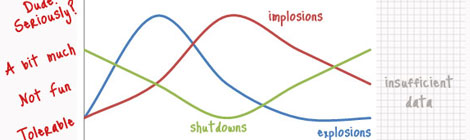
A meltdown can go one of two ways: explosion | implosion.

Explosion

Everything flies outward. Words. Fists. Objects.

Implosion

Have you ever seen a building implode? The charges go off somewhere deep inside and for a moment you swear nothing is going to happen and then seconds later–rubble and dust and a big gaping hole in the ground.

——————————————-

It feels like a rubber band pulled to the snapping point.

——————————————-

What I don’t want to hear:

It’s okay.
(It’s not.)
You need to pull yourself together.
(I will, when I’m ready.)
Everything will be fine.
(I know.)

——————————————-

I’m not looking at you because I don’t want to see you seeing me this way.

——————————————-

It feels like the end of the world. It feels like nothing will ever be right again.

——————————————-

What I need:

  1. Space
  2. Time
  3. Absence of judgment

——————————————-

The headbanging impulse is intermittent but strong. I stave it off as best I can because:
a) my brain is not an infinitely renewable resource
b) headbanging scares other people

——————————————-

Meltdowns are necessary. Cleansing. An emotional purge. A neurological reboot.

——————————————-

Please don’t ask me if I want to talk about it, because:
a) there’s nothing to talk about
b) I don’t have the resources necessary for talking

——————————————-

meltdowns

Evolution of meltdowns over a lifetime:

For my first 12 years, I internalize well. So well that I end up in doctor’s offices and emergency rooms with mysterious headaches, high fevers, stiff necks and stomach bugs. At various times I’m told that I don’t have meningitis, migraines, appendicitis. What I do have . . . that’s never conclusively decided. Things come and go, seemingly without rhyme or reason.

Puberty hits. Hormone surges make internalizing impossible. I slam doors, sob uncontrollably at the slightest provocation, storm out of the house, crank up my stereo. My anger becomes explosive. I pinball between implosions and explosions.

Early twenties, into my thirties, the explosions become rare but the implosions grow worse. I can’t get through an emotionally charged conversation with my husband–let alone a fight–without imploding. The headbanging impulse appears. Muteness takes center stage.

My forties–I can count the explosions on one hand. The implosions are down to a couple a year at most. As the meltdowns have lessened, the shutdowns have increased. This is lateral movement, not progress.

——————————————-

It feels like my whole body is thrumming, humming, singing, quivering. A rail just before the train arrives. A plucked string. A live wire throwing off electricity, charging the night air.

——————————————-

I’m 90% successful at staving off headbanging. The thing is: when that impulse arises, headbanging feels good. It’s . . . fulfilling?

——————————————-

Will comforting me help?
No.
Do I want the meltdown to be over?
Yes, but not prematurely.
Would I like a hug?
No.
Am I in danger?
No. I’m conscious of the boundary between stimming and serious self-harm.
Do I want company?
If you’re okay with sitting silently beside me.
Can you do anything to make me feel better?
Probably not. But you can avoid doing the things that will make it worse.

——————————————-

Muteness: Complex speech feels impossible. There is an intense pressure in my head, suppressing the initiation of speech, suppressing the formation of language.

——————————————-

My meltdowns aren’t so much about triggers as thresholds. There is a tipping point. A mental red zone. Once I cross into that zone, there’s no going back.

——————————————-

It feels like dropping a watermelon on the pavement on a hot summer day. The bobble, the slip, the momentary suspension of time just before the hard rind ruptures and spills its fruit, sad and messy, suddenly unpalatable. And no one knows whether to clean it up or just walk around it.

——————————————-

A shutdown is a meltdown that never reached threshold level. Either my threshold is rising or I’m becoming less sensitive to the precursors as I age.

——————————————-

Meltdowns are embarrassing. A total loss of control. Humiliating. They make me feel like a child. They are raw, unfiltered exposure.

——————————————-

Panic. Helplessness. Fear.

——————————————-

Imagine running as far as you can, as fast as you can. When you stop, that feeling–the utter relief, the exhaustion, the desperate need for air, the way you gulp it in, your whole body focused on expanding and contracting your lungs–that’s what crying feels like during a meltdown.

——————————————-

Please don’t touch me. Don’t try to pick me up, move me, or get me to change position. Whatever position I’ve ended up in is one that’s making me feel safe. If it makes you uncomfortable to see me curled up in a ball on the floor, you should move–remove yourself from the situation.

——————————————-

There is emotion at the starting line, but a meltdown is a physical phenomenon: The racing heart. The shivering. The uncontrollable sobs. The urge to curl up and disappear. The headbanging. The need to hide. The craving for deep pressure. The feeling of paralysis in my tongue and throat. The cold sweat.

——————————————-

The physical cascade needs to run its course. Interrupt and it’ll just start all over again a few minutes later. Patience, patience.

——————————————-

What I need when I’m winding down:

  • deep pressure
  • quiet
  • understanding
  • to pretend it never happened

——————————————-

The recovery period is unstable.

Exhaustion comes first. Mixed with anger, at myself mostly, for losing control.

My filters don’t come back online right away. Unless you can handle an unfiltered aspie, proceed with caution.

Finally, there is euphoria. A wide open feeling of lightness, of soaring, of calm.

——————————————-