An Open Invitation to Infodump

It’s rare these days that the thread of comments on a post isn’t two or three or five times as long as the post itself. This makes me happy. Happy that so many of you feel comfortable sharing your thoughts here. Happy that each post becomes a jumping off point for discussions that wind in all sorts of interesting directions. Happy that we can learn from each other.

I enjoy reading your comments–and I do read every single one of them. I especially enjoy the longer ones where a subject catches someone’s interest and they go off on an enthusiastic tangent. This happens a lot.

You know what else happens a lot? Apologizing. No sooner does someone finish writing their long detailed informative comment than they’re apologizing for it. A recent exchange with Ischemgeek made me realize how often we apologize for simply talking. I do it in the comments too and this is my blog!

And I’ve lost count of the number of times I’ve started to write a comment on someone else’s blog, then deleted it for fear that it was too long or irrelevant. I bail on comments more often than I finish them. The ones I do leave, I often end up wishing I’d said less or came across sounding more chatty and less. . . . fact-y.

No one likes a smarty-pants right? I learned that lesson early and well.
allyouare

Does Infodumping Have a Place?

We’re autistic–we have deep knowledge of certain subjects, we’re passionate about our knowledge and we want to share. This should be a good thing, but so often it’s something that we’re made to feel bad about and have been since childhood.

In that exchange I mentioned above, Ischemgeek said:

I like hearing others monologue at me (love learning & reading stuff), but I’m used to having to apologize for it when I do it, yeah. When I was a kid, I’d be told I was being domineering or rude and then made to apologize… which didn’t have the effect of teaching me not to monologue because I’m usually 5-10 minutes in before I realize I’ve been talking a while, it just taught me to apologize when I realize I’ve monologued.

Monologuing or infodumping is part of our nature. I understand why it’s discouraged in children. Monopolizing the conversation is rude. So is talking about a subject the other person isn’t interested in.

If you’re told enough times that talking about what interests you is rude, it’s easy to start thinking that talking itself is rude. Because what would we talk about, if not what interests us? We’re black and white thinkers–we come to conclusions like this as a matter of course, especially when we’re younger.

But like Ischemgeek points out, that doesn’t necessarily teach us not to infodump. It teaches us to reflexively apologize every time we say more than three sentences.

Is that necessary as adults? What if the other person expresses interest in the subject? Like Ischemgeek, I will happily listen to someone infodump on a wide range of subjects. Not only that, I’ll often prolong their monologuing by asking lots of questions. I love learning new things and am fascinated by details. When someone has an expert level of knowledge on a subject, their enthusiasm for the subject is contagious. At least I think it is.

I’ve learned about fascinating subjects I never would have pursued on my own thanks to someone else’s passion for them. Ancient Egypt. Aboriginal camp dogs. Unknown unknowns. Primate social behavior. Poaching in Africa. The epidemiology of cancer in Hispanic populations in the US. Given enough time to think about it, I could fill a page at least with topics of memorable conversations like those.

The Scientist and I are both monologuers at times. We indulge each others’ topics of interest. I know far more than the average person about a whole bunch of subjects thanks to his passionate interest in them and the same is true of him. That’s not to say all or even most of our conversations are one-sided monologues. Simply that we both enjoy learning new things and not every conversation we have has to be a typical back and forth, each person talking for equal amounts of time type of conversation.

Making Our Own Rules

I think, because we’re adults and because we can, we should put a moratorium on apologizing for sharing information that we find interesting. Starting here, in the comments. The asynchronous nature of blog comments makes this a low risk place to infodump.  We can each choose to read or skip over comments as we see fit. No one has to read what you wrote (well, except probably me).

If you have something to say that you think is interesting and adds to the conversation, say it. Don’t apologize for being passionate about what interests you or for sharing it.
Interoception: How Do I Feel?

Let’s talk about interoception. I bet you’re already on the edge of your seat, right?

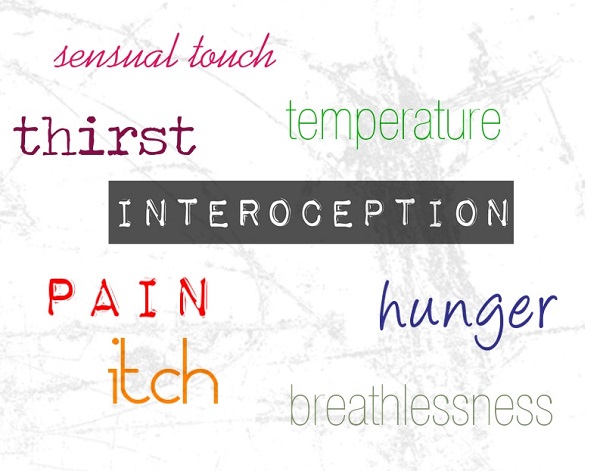
Okay, okay, first a definition. Interoception describes our sensitivity to sensations that originate in our bodies. Think pain, temperature, itch, sensual touch, sensations from our organs and muscles, hunger, thirst, and breathlessness.

All of these sensations combine to give us a sense of sentience. I’m hungry therefore I am.

interoception

Our Body’s Dashboard

Interoceptive feedback is important for keeping our bodies in good working condition. Think of them as the body’s dashboard. Are we low on fuel? Running too hot? Has it been too long since some critical service was performed or is a warning light flashing? Interoceptive sensations provide the feedback necessary for troubleshooting and correcting imbalances in the body.

Emotions often arise from our interoceptive sensations, too. When someone asks how you feel, you probably subconsciously check-in with your body, and realizing that you’re tired, hungry, hot, or achy, you reply, “not too great.” Or conversely, if your interoceptive sensations are in balance, you might report feeling happy or at least content.

Obviously not all emotions are tied to interoception, but it’s hard to be happy when you’re in pain or content when you’re itchy. For many people being hungry or tired is a direct route to being cranky and short-tempered. Those of us who are alexithymic experience this even more strongly, often struggling to identify the difference between emotions and physical sensations. I can’t explain how my body confuses “upset” with “cold,” but sometimes it does. Now I know that if I’m feeling cold when no one else around me is, I need to check in with my emotions. And put on a hoodie.

Engage Interoceptive Dampeners

But what if your interoceptive system is dampened? What if a sensation needs to be in the red zone before it comes up on the dashboard? Well, then you forget to eat or stare in wonder at your bleeding toes or don’t realize you might be in pain until you pass out. Sound familiar?

Many autistic people have dampened or muted interoception. We just don’t seem to notice what’s going on in our bodies until it reaches a level that other people would find intolerable. And often when we do notice it, it goes from “oh that’s happening” to intolerable really darn fast.

As often as I experience this in minor, inconvenient ways, I’m occasionally reminded of how dangerous it can be. Because hindsight is 20/20, I can see in retrospect that I recently had a UTI coming on for days before I picked up on the symptoms. One of the main symptoms is pain and other than a vague crampy feeling, I wasn’t experiencing any. Easy to ignore, so I did.

Then some harder to ignore symptoms started happening and my daughter, who I was visiting at the time, said, “you need to go get this checked now.” Left to my own devices, I probably would have taken a wait-and-see approach which would have been bad. Because a few hours later, shortly after getting my prescriptions filled, I was in intense pain. An hour early, at the walk-in clinic, the doctor asked me if I had any pain and, after thinking about it for a moment, I said, “maybe a little?”

My body had gone from zero to “MAKE IT STOP” in less than hour.

And thanks to my body’s poor interoceptive workings, I was rewarded with a kidney infection because unlike most women who dash off to the doctor at those first signs of a UTI, I wasn’t getting enough data to trigger my internal alarms. It wasn’t until I started having more obvious symptoms that I realized something might be wrong and took to Google to figure out what it could be. By the time I started getting the right antibiotics in my body, a common minor ailment has progressed to a potentially serious illness that I’m just starting to recover from two weeks later.

Unreliable Indicators

One of the purposes of interoception is to drive behavior.

Hungry? Eat.

Tired? Sleep.

Pain? Seek help.

Interoceptive sensations–especially pain–may be unreliable indicators in autistic individuals. Medical professionals often rely on pain and other self-reported symptoms of discomfort to assess the presence or seriousness of an illness. In my case, my interoceptive sensations were saying “meh” but my fever (which I didn’t realize I had) and high bacterial count were saying, “hey, big problem here!”

When you combine muted interoception with poor executive function–which may be further impaired by the stress of illness–you’ve got a recipe for disaster. This is why I need someone else to say, “we’re going to the doctor now.” It’s also why recognizing that autistic people may have unique pain, distress or illness signals is important for medical professionals, caregivers and loved ones. This can potentially lead to misdiagnosis or underdiagnosis.

Our nonstandard brain wiring can mean that we miss common warning signs or have difficulty knowing when to act on distress signals.

Decoding the High Functioning Label

Aspies are often labeled high functioning by default. Some people even seem to think it’s a compliment.

“You must be very high functioning. You don’t seem autistic.”

“Why, thank you. And you’re not especially ugly.”

Because, yeah . . . being told you’re “not that autistic” like it’s a good thing is hard to swallow.

Functioning Labels in Practice

Applying functioning labels to autistic people is problematic. Maybe an example will help illustrate why.

I’ll describe two autistic women, Mary and Joan. See if you can tell which one is high functioning and which one is low functioning:

Mary is a wife and mother. She’s been steadily employed since age 16, has a BA degree and runs her own small business. She exercises regularly and is health conscious. When her daughter was younger, she volunteered for parent committees, hosted sleepovers, coached softball and drove carpool. As the more detail-oriented spouse, Mary has always managed the family finances and investments. She has a diverse set of hobbies and pastimes that include dog training, target shooting, reading mystery novels and fiction writing.

Joan is a wife and mother too. Her marriage has been rocky at times, thanks to her undiagnosed ASD, and she has no close friends. Joan works at home, avoids speaking to people on the phone and prefers to spend most of her days alone. Joan sometimes needs to be reminded to brush her hair, shower or put on appropriate clothing before going out. She’s never negotiated a lease or car purchase by herself and has never lived on her own. She enjoys going to the zoo, vacations at Disney World, animated movies and has several stuffed animals that she likes to hug after a hard day.

It’s obvious that Mary is high functioning and Joan is low functioning, right?  Continue reading Decoding the High Functioning Label

A Cognitive Defense of Stimming (or Why “Quiet Hands” Makes Math Harder)

Thanks to Daniel Kahneman’s fascinating book, “Thinking, Fast and Slow” I’ve discovered the concept of ego depletion.

Coined by Roy Baumeister, the term ego depletion simply means that we have a limited pool of energy to devote to both self-control and cognitive tasks. If we devote energy to, for example, suppressing temptation, we’ll be less willing to solve a difficult math problem or run an extra lap around the track.

Baumeister did a series of landmark experiments to prove the link between self-control and our willingness to engage in difficult cognitive tasks. He found that people who were asked to resist eating chocolate cookies and candy were quicker to give up on solving challenging puzzles than those who were allowed to indulge in the sweets.

What the heck does this have to do with autism, you ask? A lot.

The types of things Baumeister tested for are all related to executive function (EF)–our brain’s ability to regulate our cognitive processes. EF includes things like planning, problem solving, working memory, attention, and initiating, sustaining and inhibiting actions. That last part is really important–that’s where self-control enters the picture.

When we look at the tasks that Baumeister asked his subjects to do, they all call on the brain’s executive function reserves. And impaired EF is a central feature of the typical autistic brain.

What’s More Important: Quiet Hands or Long Division?

Many therapists, teachers and other professionals believe that extinguishing a child’s stimming is necessary for learning to take place. Their justification is that stimming diverts the child’s attention away from the information or task. To help the child focus, they insist on “quiet hands” or “quiet bodies.” The assumption that a child can learn better if he or she suppresses stims has been widely disputed by autistic adults and by some parents, teachers and therapists.

The obvious reason for objecting to “quiet hands”-type instruction is that it shames the child for moving in a way that is natural and comforting for them. Others have written eloquently and in great depth about this subject; I’ve linked to some key pieces below rather than repeating what has already been said.

The case I want to make against “quiet hands” is that in addition to being emotionally damaging, it’s cognitively counterproductive. Think back to the experiment where the people who were told to resist eating chocolate gave up more easily on solving puzzles. Substitute stimming for chocolate and learning long division for solving puzzles. Add in the fact that autistic people have impaired executive function to begin with, making inhibition of actions more challenging, and you can see why asking a child to resist stimming is counterproductive if you’d also like them to learn a new skill.

An Illustration (or Let’s Pretend EF is Something We Can See)

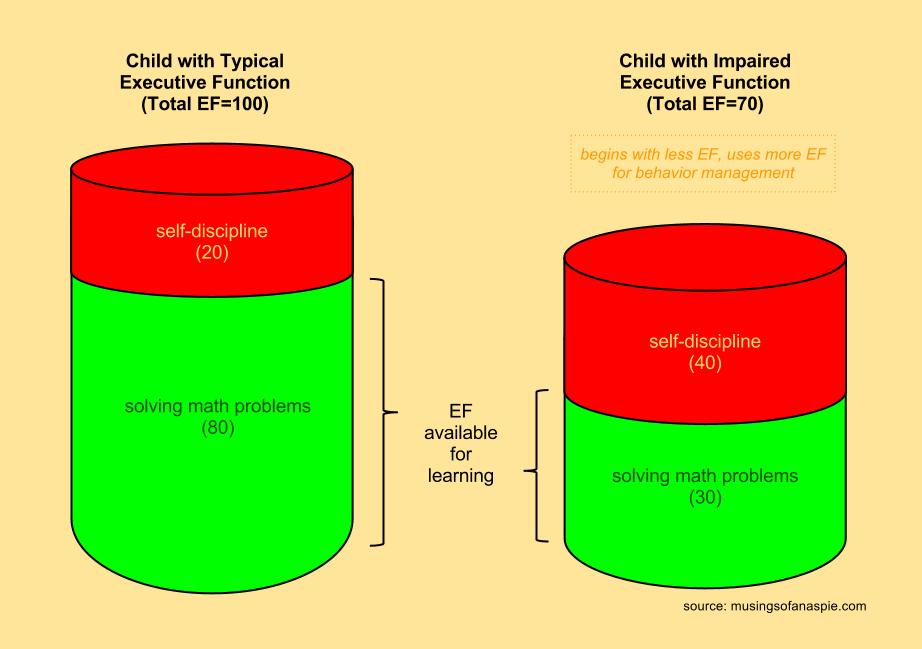
To help us think about executive function in concrete terms, imagine two children in the same math class. Since we can’t actually see or measure EF in a simple way, let’s use imaginary EF “units” to talk about typical versus impaired executive function.

The typical child has 100 units of EF available for math class. The child with ASD has impaired EF, meaning s/he begins the math lesson with 70 units of EF.

Assume the typical child has to exert some self-discipline to attend to the math lesson: 20 EF units, which are devoted to things like staying seated, paying attention, and not talking to classmates. That leaves 80 units that can be devoted to learning math.

Assume the autistic child has to devote twice as much EF (40 units) to self-discipline. Not only does s/he have to do all of the things the typical child is doing (staying seated, paying attention, not talking to classmates), s/he has to inhibit the natural urge to stim. That means s/he is starting out with less EF and devoting more of that small reserve to self-discipline.

typical_ef

Look at the amount of EF each child has left for doing their math work. The autistic child starts off at a disadvantage and is further disadvantaged by a classroom rule that has supposedly been put in place to help him or her.

A Brief Clarification

Before you say, “but how can s/he learn math while spinning around/headbanging/bouncing up and down” let’s clarify what stimming is. Yes, sometimes stimming is all of those things, but it is also fidgeting with a toy, chewing on a chewy, bouncing a leg/foot, flapping a hand, flexing fingers, rocking gently, moving around on an exercise ball used as a chair, or any number of other things that can be done while sitting at a desk.

In fact, every time I stop typing to think of what I want to say next, I start rhythmically tapping my fingers in sequence on my keyboard. That’s stimming. I don’t think about it. I don’t do it on purpose. It isn’t a “behavior.” It happens naturally. It helps me organize my thoughts and stay on task.

It’s the opposite of a distraction.

The Cost of Inhibition

So when I say that a child should be allowed to stim and that stimming is more likely to be cognitively beneficial than distracting, that’s the kind of stimming I’m talking about. Note that in my example, the autistic child was expected to do the things the other typical children were expected to do, such as sitting in their seat and not talking to classmates. They aren’t being allowed to do “whatever they want”–an assumption some people will jump to when anyone raises the notion that autistic children should be allowed to stim.

Maybe while they’re sitting in their seat and working on their math problems, they’re also manipulating a piece of string or a fidget toy with one hand. Maybe they’re sitting on an exercise ball so they can gently roll from side to side. Maybe when they pause to think they flap their hands.

Imagine the red self-discipline portion of the graph shrinking for these kids when they’re allowed to stim while they work. When that happens, the green “solving math problems” portion can grow. When they no longer have to spend EF resources on not stimming, those resources can be repurposed for learning.

If you find it hard to imagine how difficult it is to inhibit stimming for an extended period of time, try this: imagine you have a bad case of poison ivy, you’re not allowed to put any medication on it or to scratch where it itches . . . and I’m going to teach you how to find the limit of a function as x approaches a fixed constant.

How much of that math lesson do you think you’ll retain? Would you even care?

A Few Words About Socially Acceptable Behavior

There is another argument against stimming at school or in other public places: we need to teach autistic kids socially acceptable behavior so other kids/people don’t think they’re weird. Well, I have two things to say about that.

Yes, autistic children should be taught the same social rules as typical children. They should be taught to respect others and all of the rules of politeness and civility that go along with it. But here’s the thing: I was an autistic kid and I can tell you for certain, stimming or not, the other kids already think we’re weird.

Instead of insisting that autistic children adopt unnatural behaviors for the sake of social acceptance, how about working toward changing what is socially acceptable?

**** I’ve used children as an example throughout this piece, but everything here applies to autistic adults as well.

Further Reading:

Quiet Hands by Julia Bascom

The Cost of Compliance is Unreasonable by Beth Ryan

Another Way to Silence – Shame by Ariane Zurcher

My Decision, Not Yours by Alyssa

On Stimming and why “quiet hands”ing an Autistic person is wrong by Rose

It’s Not Your Fault

It’s not your fault.

*

Some days I feel like I should get this tattooed on my forehead.

*

When I withdraw into myself and fall silent, it’s not because of anything you did.

When I blow up over some inconsequential thing you’ve said, know that the real trigger happened hours ago.

When you do something that unexpectedly makes me feel trapped or panicked, there was no way you could have known until I told you.

When I zone out in the middle of a conversation, it has nothing to do with how interesting the conversation is.

When I ignore you because I’m engrossed in writing or reading, it’s not a reflection on how I feel about our relationship.

When I twist out of your embrace or push your hand away, it doesn’t mean you’ve done something wrong.

When I forget to call you, it’s not because I’ve forgotten you.

When I don’t look at you during a conversation, it’s not because you’re boring me.

When you suggest doing something together and I say no, it doesn’t mean I don’t like you.

When I can’t explain my feelings or actions, it has nothing to do with how hard you’re trying to understand.

Because I didn’t mean to hurt you doesn’t mean it doesn’t hurt.

*

I say these things, but the sting of my actions isn’t lessened.

To bridge all the gaps would be a full time job.

Understanding helps, as does lowered expectations for everyone involved, but ultimately I know that I’ll keep running up against these unintended hurts that I see only in retrospect.

This is who I am, how I am.

*

It’s not you. It’s me?

What’s Your Function?

Nonfunctional. This word drives me nuts.

I’ve seen it used to describe autistic behavior in the context of “nonfunctional routines” and “nonfunctional play.”

Raise your hand if you think your routines are “nonfunctional.” I will happily concede that my routines are inflexible and specific, even weird and inexplicable at times, but nonfunctional? No way.

My routines have purpose. Without them, I risk becoming paralyzed or adrift. My carefully organized life goes all to hell. The plants don’t get watered. The dog may or may not get fed. I forget to shower. I get anxious about what’s for lunch before I’ve even finished breakfast. I spend too many hours happily chasing after this idea or that, forgetting that the rest of the world exists.

In the absence of routines, I just plain forget to do things. I drift. I perseverate and spend way too much energy on the blizzard of little choices that typical people find effortless and aspies find exhausting, never getting around to the more important stuff. I become all details and no big picture.

Take breakfast, for example. I find it fascinating that some people (a lot people?) wake up not knowing what they’ll have for breakfast. Presumably they walk into the kitchen or the diner or 7-11 and just decide on the spot what they’d like. This is an amazing feat of executive function and one that I would find stressful beyond words.

I eat the same thing for breakfast everyday. It frees me from having to think about what I’m in the mood for in the context of what we have in the house, the comparative calories and nutritional value of my choices, how much time it would to prepare each choice, the possibility that I’ve left some better choice off my list not to mention the fact that I’d have to shop for these choices at some point, thereby having to choose not once but twice.

Instead, I grab a bowl, slice up some fruit, dump in my favorite cereal and pour milk over it. It’s simple and it makes me happy and I don’t have to use up precious brain resources before the sun is barely over the horizon. That seems pretty damn functional to me.

Routines give my life structure. Within my routine, I always know what I need to do next or I at least have a limited number of “preprogrammed choices” to pick from. While this doesn’t entirely prevent unwanted surprises, it reduces them to a tolerable level.

If you’re not thinking “yes, exactly!” at this point, you’re probably thinking I’m the most boring rigid monotonous person in the history of humankind.

Fear not, I can be flexible if I have to. Let’s stay with the breakfast example. There are times when breakfast at home isn’t an option. Vacations. Special occasions. Power outages. This used to upset me, but I’ve learned that being grumpy at breakfast when there are so many delicious things to choose from is not only an example of a nonfunctional attachment to routine but a real drag.

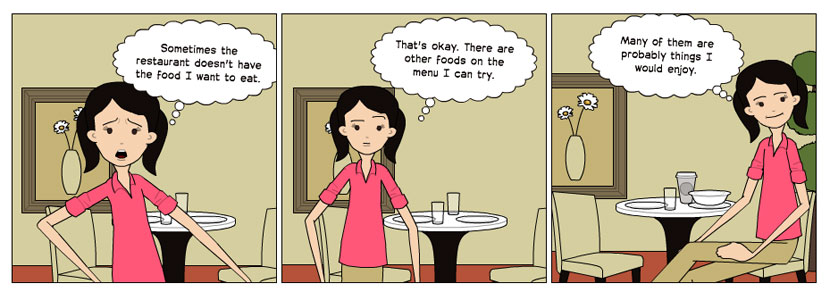
At first I had to do the adult equivalent of a social story: Sometimes the restaurant doesn’t have the food I want to eat. That’s okay. There are a lot of other foods on the menu that I can try. Many of them are probably things that I would enjoy.

(That doesn't look like me at all but I have zero drawing skills so I had to rely on the stock characters at Pixton for an assist)
(That doesn’t look like me at all but I have zero drawing skills so I had to rely on the stock characters at Pixton for an assist)

Yes, I felt a bit odd having to repeat this to myself, but over time it worked.

Which isn’t to say that I’m routine-free on these magical breakfasts away from home. I can be happy with coffee if the restaurant doesn’t have chai. I can enjoy French toast as much as an egg sandwich or a bowl of oatmeal.

You won’t catch me spontaneously ordering a mango smoothie or freestyling my way through the make-your-own-omelet choices. I still have a routine for breakfast; it’s just different.

I’ve discovered that it’s not routines themselves that are problematic, it’s the appropriateness of the routine I choose to run. At home, I need to run the home breakfast routine; when I’m out, I need to run the restaurant breakfast routine. The restaurant breakfast routine has more options. It’s not one that I’d want to run everyday, but I can do it as needed without the kind of negative consequences I’d face if I had no routine at all.

What does no routine at all look like?

The Scientist and I went to a new lunch place last week. First of all, it was one of his totally unplanned let’s be spontaneous adventures so I was already a bit flustered by the last-minuteness of it all. The menu was blessedly limited, except for the all-day breakfast option, which I considered then eliminated on principle, although I’m still wondering even as I type this if I should have factored the breakfast items into my decision.

Anyhow, I ended up choosing a grilled ham and cheese but not before I’d analyzed the pros and cons of everything on the menu that I’d even remotely consider eating. I cycled through a half-dozen choices before settling on the ham and cheese, mostly because that was the choice I was thinking about when the waitress appeared in front of me. If she’d arrived a minute earlier, I would have had a BLT. Before that I was settled on a burger. Thirty seconds later and I might have ended up with ham and egg sandwich.

I have no idea how long I would sit there looking at the menu if I wasn’t forced by circumstances to make a final decision. Ten minutes? A half hour? Indefinitely?

Choosing what to eat at a new restaurant probably sounds trivial to anyone who is running at full executive function capacity. For those of us who have impaired EF, every single one of these decisions uses up resources that could be better spent on important stuff like being productive at work, home or school.

Routines may look nonfunctional and even limiting, but they’re often just the opposite. They allow me to spend less time sweating the small stuff, freeing up my brain for the more important aspects of adulting.

Monday Morning Musings (6/10)

E-book Released

I Think I Might Be Autistic: A Guide to Autism Spectrum Disorder Diagnosis and Self-Discovery for Adults went live yesterday at Amazon.com. If you have a Prime membership and a Kindle, you can borrow it for free.

Thank you to everyone who helped me refine the cover art last week and cheered me on. That last mile was more difficult than I anticipated.  Now I need to do some promotion so I can get my giveaway idea off the ground. Strangely, I’m really good at promoting other people’s stuff and am probably going to be terrible at promoting my own.

Another Adult ASD Research Study

This week, I received information on two more research studies. If you live to fill out questionnaires, are over 18 and have an ASD diagnosis, read on. Both studies are by being conducted by Kathrine Birt as part of her Doctoral research at Deakin University in Australia. The goal of the studies is to better understand the impact of Autism Spectrum Disorder (ASD) diagnoses on intimate couple relationship development (in adulthood).

The first is a questionnaire that takes about 20 minutes to complete. To participate, you need to be over 18 and have an ASD diagnosis. You don’t need to currently be in a relationship to be eligible, but if you are in a relationship, you’ll be presented with additional and more detailed questions. (I’ve completed both questionnaires, because I like to be sure I know what I’m sharing information about.) More info about the first study is here.

Study number 2 is for adults with ASD and their intimate partners. Both partners must be over 18 and one must have an ASD diagnosis. The questionnaire for the individual with ASD takes about 30 minutes to complete. After completion, a link is provided for a second (10-15 minute) questionnaire to be completed by that person’s partner. More information about study #2 is here.

Note that for both studies, clicking the “continue to study” button on the first page takes you to a second page with more details about things like the type of information collected, how the information will be used and privacy protections.

Not Quite a Hippity Hop

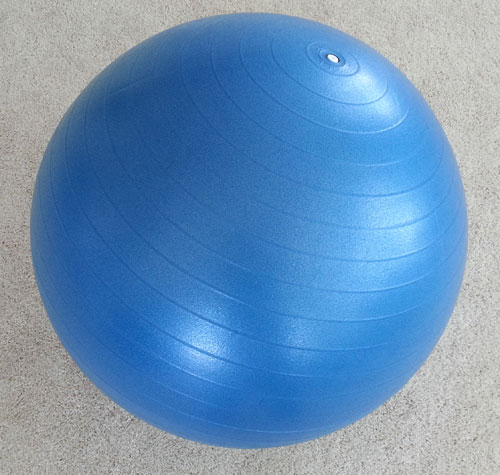
This is my new exercise ball:

ball

I’ve been using the exercise ball at the gym after my twice-a-week workouts and decided I needed one at home. It’s a fun sensory toy and a good way to stretch and release the tension that I seem to perpetually carry in my upper back and shoulders. Once, a yoga instructor who told me that I carry my negative emotions between my shoulder blades. My slightly less interesting explanation is that I unconsciously put myself in awkward postures that create tension in my body, maybe as a kind of stim. The exercise ball is a good way to consciously check in with my muscles and release the tension so it doesn’t build up into nagging injuries.

Sadly, it doesn’t have a handle so I can’t hop around the living room on it.

Some Girl Stuff

Last week Asparagus Girl wrote a blog post about perimenopause and Asperger’s. Not much has been written about menopause by women on the spectrum so I was excited to see her tackling the subject. The post mainly focuses on mood swings, which should be called mood slingshots or mood boomerangs or something more violent and dangerous and in line with reality.Think PMS on steroids.

I’ve noticed an uptick in meltdowns over the last few years as my hormones become more wacky. I’m definitely more irritable, too, and sometimes I find myself in a strange, unpleasant moods for no obvious reason. There’s other stuff–some that’s TMI even for me–and taken together all of these changes have me wondering if women on the spectrum experience perimenopause differently from typical women. Not necessarily if we have worse symptoms, but if our funky brain wiring creates unexpected side effects of the hormone fluctuations that precede menopause.

Predictably, this isn’t any substantial research on autism and menopause. Like a lot of aspects of being an autistic adult, I’m finding the best source of information is other women who are going through or have done through the process already.

Shape Shifting

Recently The Scientist said, “I’m concerned that your world is shrinking.”

I asked him why. He elaborated. I didn’t say anything substantial in response because, as so often happens, I didn’t have a coherent answer at the time.

But that statement has been roaming my brain for the past few days, measuring my current state of affairs against times past.

Shrinking implies something that was once larger or more abundant. Two years ago I was finishing up my long-put-off university degree. I was spending three days a week on campus, surrounded by people, interacting all day, commuting an hour each way, expanding my intellectual horizons. The Scientist and I also had frequent social engagements because we lived in an area where we knew quite a few people.

Since then? I’m back to working at home. My days have a predictable rhythm: wake up, workout, write, work, eat a few times in between. Some days the car never leaves the garage. The geography of my social interaction is smaller than it was when I was going to school. Or years before that, when I was working at a job that required interacting face-to-face with people all day long or when my daughter was in school and I had to shuttle her to events and such.

There was a time in between all those other times–a time when you could say that my world shrunk very small–and I found the kind of internal quiet that I hadn’t known existed. The Scientist and I moved far away from our roots, to the desert, to a place so remote that we regularly encountered coyotes on our evening walks and the nearest gas station–the nearest anything–was a fifteen minute drive.

In that place, I found a deep internal sense of quiet. I let go of a lot of old hurts. I started to understand myself.

Of course, life gradually crept in again. We formed ties. We put down new roots. I decided to go back to school. Gradually I began to feel a creeping sense of unease. The quiet I’d found receded as I found myself having to back out of that peaceful place I’d created for myself. One by one, I backed out of the rooms in my mind, turned off the lights and closed the doors, shutting away the parts of myself that I instinctively sensed wouldn’t survive being exposed to the outside world.

Until something inside me rebelled and refused to close another door. The place I’d found–it was hard to leave and harder to close away without knowing if I’d be able to find my way back. In retrospect, that internal rebellion–the tension that arose between the security of the peaceful place I’d found and the stimulation of the outside world I was being drawn back into–was the first step toward discovering that I’m autistic.

I didn’t know that then. All I knew was that something had to give.

The tension grew in a way it hadn’t before. I became acutely aware of the two very different places I lived in. There was this new place, which existed mostly when I was alone, that felt very natural. It was secure and comfortable and, most of all, quiet. I hadn’t been in a place that internally quiet in a very long time, certainly not since I’d reached an age that had two digits in it instead of one.

Then there was the other place, the one I’d taken for granted as being life, the one where I kept a stranglehold on everything to keep it from flying apart. It was a place that pushed me to grow and expand myself, but one where I lacked the natural ease I felt in the new place I’d discovered.

I tried shifting between the two places but that turns out to be impossible for me. In typical aspie fashion, I have no idea where the middle ground is. I can be here or there, but commuting between them isn’t something I can do on a daily basis. When I do shift–like I did after my recent trip, moving from the intense interaction of being with people 24/7 for 10 days to the quiet of home–it can take me weeks to rediscover my equilibrium.

That got me thinking about where the source of that equilibrium lies. I think it lies in my true self, the one that is more fragile than I’d like to admit and that I can close off inside a nice safe cocoon when I need to, safe from harm but inaccessible.

It’s scary to realize that I can intentionally dissociate myself, scarier even to think that for years I’d been doing exactly that without consciously being aware of it. At some point–probably very early on–closing off parts of myself became my main defense mechanism, a way to survive in a world I find hard to navigate and harder to understand.

That can’t be healthy. I don’t enjoy it. I wish my quiet self was strong enough to go into the world without having to close all those doors. Perhaps the place I’m in now, this revival of my quiet period as I’m starting to think of it, is my way of nurturing and fortifying my quiet self for whatever comes next.

On my trip, I felt like I had to close off myself less than I did in the past. There are some doors I can leave ajar, some lights that I can dim instead of extinguishing. Thanks to understanding my autistic brain better, I have coping mechanisms available to me now that I didn’t before.

It may be a few years before life shifts again and takes me into a new phase as it inevitably does. For now, I’m planning to make the most of this quiet period, writing and thinking and being with myself. I think a certain amount of withdrawal from the world–a redirection of my resources–is necessary for me to expand myself internally.

Is my world shrinking?

Days later I let The Scientist know that I’d found my answer. What may appear from the outside to be smaller is on the whole simply changing shape. Again.

Monday Morning Musings (6/3)

Yale Autism Seminar Video Series

I’ve been watching the Yale Autism Seminar video series (available free from iTunesU). It’s advertised as the only autism-specific college course and is basically a chance for you to sit in on the lecture portion of the course as it was given at Yale a couple of years ago. The videos cover a wide range of topics, with a strong focus on childhood autism. Each video is a 60-90 minute lecture on a single topic. A few of the lecturers include videos or other visual media to illustrate key points, but generally think “text-heavy Powerpoint presentation” for the lecture format.

Because each topic is covered by a different specialist, the quality of the lectures varies. I especially liked “Communication in Autism” by Dr. Rhea Paul. It was packed with information about how children develop language from birth through adolescence. I’ve also enjoyed Dr. Ami Klin’s presentations.

Be forewarned that there is triggery content in most episodes–not so much the factual information but the language that many of the lecturers use and sometimes their attitudes toward autistic people. I consider myself pretty resilient to triggery content but I can’t watch more than one (and sometimes only half) every few days. It’s eye-opening to see how professionals who work with autistic people view autistic people.

Not Very Neanderthal

Back in March I spit in a little tube and sent it off to 23andme to get my DNA genotyped. Last week, I finally received the results. The biggest surprise is that my body doesn’t make the lactase enzyme. I guess I’m lactose intolerant but didn’t know it? My 40s are turning out to be a banner decade for stuff like that. I also have an elevated risk for Type II diabetes. That’s good to know, because I can actually do something about it. Not so much on the elevated risk of Alzheimer’s or restless leg syndrome.

There are some fun facts among the results: I can blame my higher than average caffeine consumption on my genes and I have a significantly lower than average percentage of Neanderthal DNA (in the 8th percentile). I never put much stock in the aspie-Neanderthal theory, but I gotta admit I was curious.

I Made a Thing

I’ve been putting my Adult ASD Diagnosis series together into e-book format. This is what I have for a cover design at the moment. Yeah? No?

cover

I’ve added about 5,000 words to what’s been posted here on the website: primarily background material about ASD and the DSM-V criteria plus a big list of questions I developed to help people identify autistic traits in themselves. My main goal in making it into an e-book is reaching a wider audience. When I first went looking for information about ASD, I went to Amazon.com and did some web searches. Neither of those was very helpful. Unfortunately, I didn’t discover the blogs of autistic adults until later.

The material that’s posted on the blog will stay, so no worries about anything disappearing. I’m also hoping that I can use the proceeds from the book to do some giveaways here. I thought about donating to an autism-related charity but then I thought “hey, I know plenty of autistic people!” and wouldn’t it be better to do a giveaway of something like a weighted blanket to an autistic person who will directly benefit from it. I have no idea how this is going to work, but that’s my dream outcome.

ETA: I accidentally fell way behind on bringing over the survey replies from Survey Monkey for the final survey ! Executive Function fail.  I’m so sorry and am in the process of getting caught up. There are about 20 additional responses that I will post this morning.

(Not) a Little Slow

There is a moment I dread in conversations with strangers: the moment when that stranger–that person I’ve been talking to for a minute or two or five–decides I’m “a little slow.”

It doesn’t happen with every stranger, but it happens often enough that I can pinpoint the moment a conversation turns. To start, we’re both on our best interacting-with-a-stranger behavior, a bit wary, a bit too friendly, whatever. Then I slip. I miss some key bit of information, ask the other person to repeat something one too many times, stutter, backtrack, repeat myself, interrupt  again, lose the thread of the conversation, take a joke literally, perseverate. There are a lot of ways it could play out.

The response–the one that makes my skin heat up and my heart race and the blood in my ears pound–is subtle but sudden.

A note of condescension slips into the other person’s voice. I  may suck at reading body language, but I’m pretty good at gauging voice tone. Maybe they start speaking more slowly or repeating themselves. They downgrade their vocabulary to smaller words. They repeatedly ask questions like, “are you following me?” and “does that make sense?” They get pedantic, having decided I require some sort of instruction.

In short, they’ve decided I’m a little slow on the uptake.

At the first sign of this shift, I get a sick feeling in the pit of my stomach. I’ve been categorized by this person who knows next to nothing about me and is forming an opinion based on my spotty verbal skills, tallying them up with my inconsistent eye contact and my incongruent body language and all the other ways my body says “not like you.”

Am I Slow?

Literally speaking, I guess I am.  My verbal processing–both receptive and expressive–is impaired to the point that I often need more time than the average person to understand or respond to someone.

I have all sorts of communication glitches. I struggle with verbal instructions. If there’s background noise or other distractions, my auditory processing lags to the point that it can take a few seconds to process speech from noise into words. My verbal responses default to scripts–sometimes not even the right scripts–or become minimal when the conversation takes an unexpected turn, moves too fast or is too unstructured.

There is a significant disconnect between my verbal skills and my intelligence or literacy or whatever you want to call it.

In short, I look better on paper. If I was a shelter pup, there would be a note in my file that said, “Does not show well.”

Generally, this isn’t a problem for me. I’ve engineered my work life so that I first “meet” people via email or some other text-based correspondence. By the time we talk on the phone or meet in person, the other person has (hopefully) formed an opinion of me that will withstand some verbal glitching.

I’ve gravitated toward text-based medium in general, spending my days working primarily with the written word. Still, I have to do things like go to the doctor, contact the super in my building for repairs, and navigate the university records office to correct my transcript–all situations in which I’ve encountered the dreaded conversation shift. Situations in which I went from feeling like I was on equal footing with another adult to feeling patronized, belittled or ignored.

And here’s the thing: I am an adult. Whether I speak eloquently and fluently or not, I’m still an adult. My ability to communicate verbally has no impact on my ability to understand the way a ground fault interrupter works or what the risk factors for breast cancer are or how to read my college transcript. I don’t need to have these things explained to me like I’m a child.

What do I need, you might be thinking? My wishlist:

  1. Treat me like a competent adult.

  2. Be patient. I might need a little extra time to compose my answer or to process what you’ve said.

  3. If I ask for clarification, try explaining in a different way. If I didn’t understand the way you explained the first time, an exact repetition probably won’t help.

  4. Assume that if I don’t understand something, I’ll say so.

  5. Don’t rely on my body language or other typical cues for feedback about whether I understand what you’re saying. Unless you’re also autistic or know me very well, you probably can’t read my body language any better than I can read yours.

  6. Give me time to write down key information if I need to.

  7. Don’t oversimplify your language or speak unusually slowly or loudly.

  8. If you’re giving me verbal instructions, break them down into specific steps and explain one step at a time.

  9. If I keep repeating a question or statement, I need a stronger acknowledgement that you’ve heard and understood me.

  10. Treat me like a competent adult.

Some of the stuff on that list comes under the heading of accommodations. These are things I have to ask for because they are outside the norm and others may not know that I find them helpful.

But some of it–like #1 and #7–those should be the bare minimum we can expect when interacting with other adults, regardless of how typically or atypically we present.

one woman's thoughts about life on the spectrum