Tag Archives: acceptance

Decoding the High Functioning Label

Aspies are often labeled high functioning by default. Some people even seem to think it’s a compliment.

“You must be very high functioning. You don’t seem autistic.”

“Why, thank you. And you’re not especially ugly.”

Because, yeah . . . being told you’re “not that autistic” like it’s a good thing is hard to swallow.

Functioning Labels in Practice

Applying functioning labels to autistic people is problematic. Maybe an example will help illustrate why.

I’ll describe two autistic women, Mary and Joan. See if you can tell which one is high functioning and which one is low functioning:

Mary is a wife and mother. She’s been steadily employed since age 16, has a BA degree and runs her own small business. She exercises regularly and is health conscious. When her daughter was younger, she volunteered for parent committees, hosted sleepovers, coached softball and drove carpool. As the more detail-oriented spouse, Mary has always managed the family finances and investments. She has a diverse set of hobbies and pastimes that include dog training, target shooting, reading mystery novels and fiction writing.

Joan is a wife and mother too. Her marriage has been rocky at times, thanks to her undiagnosed ASD, and she has no close friends. Joan works at home, avoids speaking to people on the phone and prefers to spend most of her days alone. Joan sometimes needs to be reminded to brush her hair, shower or put on appropriate clothing before going out. She’s never negotiated a lease or car purchase by herself and has never lived on her own. She enjoys going to the zoo, vacations at Disney World, animated movies and has several stuffed animals that she likes to hug after a hard day.

It’s obvious that Mary is high functioning and Joan is low functioning, right?  Continue reading Decoding the High Functioning Label

A Cognitive Defense of Stimming (or Why “Quiet Hands” Makes Math Harder)

Thanks to Daniel Kahneman’s fascinating book, “Thinking, Fast and Slow” I’ve discovered the concept of ego depletion.

Coined by Roy Baumeister, the term ego depletion simply means that we have a limited pool of energy to devote to both self-control and cognitive tasks. If we devote energy to, for example, suppressing temptation, we’ll be less willing to solve a difficult math problem or run an extra lap around the track.

Baumeister did a series of landmark experiments to prove the link between self-control and our willingness to engage in difficult cognitive tasks. He found that people who were asked to resist eating chocolate cookies and candy were quicker to give up on solving challenging puzzles than those who were allowed to indulge in the sweets.

What the heck does this have to do with autism, you ask? A lot.

The types of things Baumeister tested for are all related to executive function (EF)–our brain’s ability to regulate our cognitive processes. EF includes things like planning, problem solving, working memory, attention, and initiating, sustaining and inhibiting actions. That last part is really important–that’s where self-control enters the picture.

When we look at the tasks that Baumeister asked his subjects to do, they all call on the brain’s executive function reserves. And impaired EF is a central feature of the typical autistic brain.

What’s More Important: Quiet Hands or Long Division?

Many therapists, teachers and other professionals believe that extinguishing a child’s stimming is necessary for learning to take place. Their justification is that stimming diverts the child’s attention away from the information or task. To help the child focus, they insist on “quiet hands” or “quiet bodies.” The assumption that a child can learn better if he or she suppresses stims has been widely disputed by autistic adults and by some parents, teachers and therapists.

The obvious reason for objecting to “quiet hands”-type instruction is that it shames the child for moving in a way that is natural and comforting for them. Others have written eloquently and in great depth about this subject; I’ve linked to some key pieces below rather than repeating what has already been said.

The case I want to make against “quiet hands” is that in addition to being emotionally damaging, it’s cognitively counterproductive. Think back to the experiment where the people who were told to resist eating chocolate gave up more easily on solving puzzles. Substitute stimming for chocolate and learning long division for solving puzzles. Add in the fact that autistic people have impaired executive function to begin with, making inhibition of actions more challenging, and you can see why asking a child to resist stimming is counterproductive if you’d also like them to learn a new skill.

An Illustration (or Let’s Pretend EF is Something We Can See)

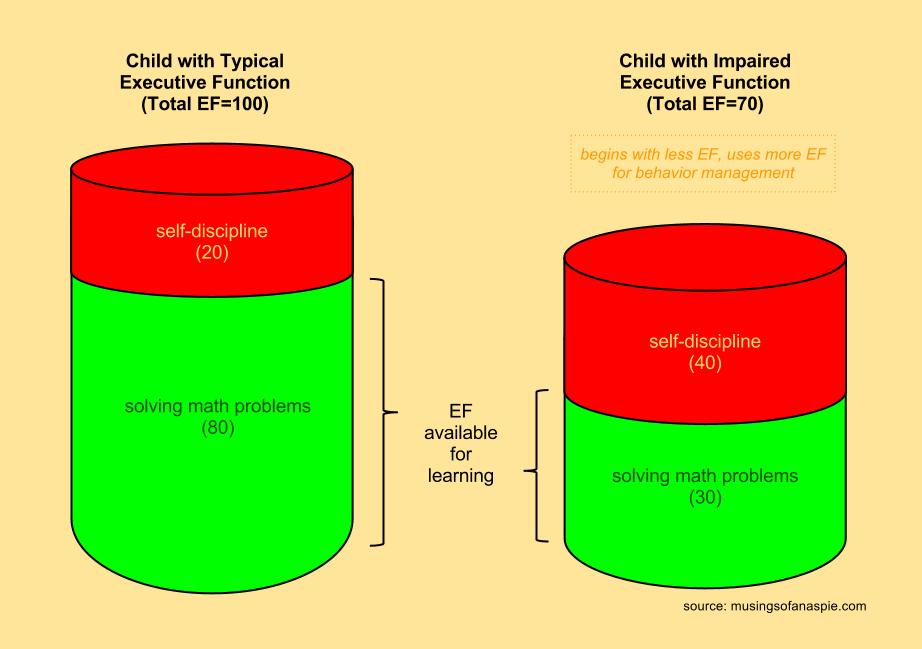
To help us think about executive function in concrete terms, imagine two children in the same math class. Since we can’t actually see or measure EF in a simple way, let’s use imaginary EF “units” to talk about typical versus impaired executive function.

The typical child has 100 units of EF available for math class. The child with ASD has impaired EF, meaning s/he begins the math lesson with 70 units of EF.

Assume the typical child has to exert some self-discipline to attend to the math lesson: 20 EF units, which are devoted to things like staying seated, paying attention, and not talking to classmates. That leaves 80 units that can be devoted to learning math.

Assume the autistic child has to devote twice as much EF (40 units) to self-discipline. Not only does s/he have to do all of the things the typical child is doing (staying seated, paying attention, not talking to classmates), s/he has to inhibit the natural urge to stim. That means s/he is starting out with less EF and devoting more of that small reserve to self-discipline.

typical_ef

Look at the amount of EF each child has left for doing their math work. The autistic child starts off at a disadvantage and is further disadvantaged by a classroom rule that has supposedly been put in place to help him or her.

A Brief Clarification

Before you say, “but how can s/he learn math while spinning around/headbanging/bouncing up and down” let’s clarify what stimming is. Yes, sometimes stimming is all of those things, but it is also fidgeting with a toy, chewing on a chewy, bouncing a leg/foot, flapping a hand, flexing fingers, rocking gently, moving around on an exercise ball used as a chair, or any number of other things that can be done while sitting at a desk.

In fact, every time I stop typing to think of what I want to say next, I start rhythmically tapping my fingers in sequence on my keyboard. That’s stimming. I don’t think about it. I don’t do it on purpose. It isn’t a “behavior.” It happens naturally. It helps me organize my thoughts and stay on task.

It’s the opposite of a distraction.

The Cost of Inhibition

So when I say that a child should be allowed to stim and that stimming is more likely to be cognitively beneficial than distracting, that’s the kind of stimming I’m talking about. Note that in my example, the autistic child was expected to do the things the other typical children were expected to do, such as sitting in their seat and not talking to classmates. They aren’t being allowed to do “whatever they want”–an assumption some people will jump to when anyone raises the notion that autistic children should be allowed to stim.

Maybe while they’re sitting in their seat and working on their math problems, they’re also manipulating a piece of string or a fidget toy with one hand. Maybe they’re sitting on an exercise ball so they can gently roll from side to side. Maybe when they pause to think they flap their hands.

Imagine the red self-discipline portion of the graph shrinking for these kids when they’re allowed to stim while they work. When that happens, the green “solving math problems” portion can grow. When they no longer have to spend EF resources on not stimming, those resources can be repurposed for learning.

If you find it hard to imagine how difficult it is to inhibit stimming for an extended period of time, try this: imagine you have a bad case of poison ivy, you’re not allowed to put any medication on it or to scratch where it itches . . . and I’m going to teach you how to find the limit of a function as x approaches a fixed constant.

How much of that math lesson do you think you’ll retain? Would you even care?

A Few Words About Socially Acceptable Behavior

There is another argument against stimming at school or in other public places: we need to teach autistic kids socially acceptable behavior so other kids/people don’t think they’re weird. Well, I have two things to say about that.

Yes, autistic children should be taught the same social rules as typical children. They should be taught to respect others and all of the rules of politeness and civility that go along with it. But here’s the thing: I was an autistic kid and I can tell you for certain, stimming or not, the other kids already think we’re weird.

Instead of insisting that autistic children adopt unnatural behaviors for the sake of social acceptance, how about working toward changing what is socially acceptable?

**** I’ve used children as an example throughout this piece, but everything here applies to autistic adults as well.

Further Reading:

Quiet Hands by Julia Bascom

The Cost of Compliance is Unreasonable by Beth Ryan

Another Way to Silence – Shame by Ariane Zurcher

My Decision, Not Yours by Alyssa

On Stimming and why “quiet hands”ing an Autistic person is wrong by Rose

(Not) a Little Slow

There is a moment I dread in conversations with strangers: the moment when that stranger–that person I’ve been talking to for a minute or two or five–decides I’m “a little slow.”

It doesn’t happen with every stranger, but it happens often enough that I can pinpoint the moment a conversation turns. To start, we’re both on our best interacting-with-a-stranger behavior, a bit wary, a bit too friendly, whatever. Then I slip. I miss some key bit of information, ask the other person to repeat something one too many times, stutter, backtrack, repeat myself, interrupt  again, lose the thread of the conversation, take a joke literally, perseverate. There are a lot of ways it could play out.

The response–the one that makes my skin heat up and my heart race and the blood in my ears pound–is subtle but sudden.

A note of condescension slips into the other person’s voice. I  may suck at reading body language, but I’m pretty good at gauging voice tone. Maybe they start speaking more slowly or repeating themselves. They downgrade their vocabulary to smaller words. They repeatedly ask questions like, “are you following me?” and “does that make sense?” They get pedantic, having decided I require some sort of instruction.

In short, they’ve decided I’m a little slow on the uptake.

At the first sign of this shift, I get a sick feeling in the pit of my stomach. I’ve been categorized by this person who knows next to nothing about me and is forming an opinion based on my spotty verbal skills, tallying them up with my inconsistent eye contact and my incongruent body language and all the other ways my body says “not like you.”

Am I Slow?

Literally speaking, I guess I am.  My verbal processing–both receptive and expressive–is impaired to the point that I often need more time than the average person to understand or respond to someone.

I have all sorts of communication glitches. I struggle with verbal instructions. If there’s background noise or other distractions, my auditory processing lags to the point that it can take a few seconds to process speech from noise into words. My verbal responses default to scripts–sometimes not even the right scripts–or become minimal when the conversation takes an unexpected turn, moves too fast or is too unstructured.

There is a significant disconnect between my verbal skills and my intelligence or literacy or whatever you want to call it.

In short, I look better on paper. If I was a shelter pup, there would be a note in my file that said, “Does not show well.”

Generally, this isn’t a problem for me. I’ve engineered my work life so that I first “meet” people via email or some other text-based correspondence. By the time we talk on the phone or meet in person, the other person has (hopefully) formed an opinion of me that will withstand some verbal glitching.

I’ve gravitated toward text-based medium in general, spending my days working primarily with the written word. Still, I have to do things like go to the doctor, contact the super in my building for repairs, and navigate the university records office to correct my transcript–all situations in which I’ve encountered the dreaded conversation shift. Situations in which I went from feeling like I was on equal footing with another adult to feeling patronized, belittled or ignored.

And here’s the thing: I am an adult. Whether I speak eloquently and fluently or not, I’m still an adult. My ability to communicate verbally has no impact on my ability to understand the way a ground fault interrupter works or what the risk factors for breast cancer are or how to read my college transcript. I don’t need to have these things explained to me like I’m a child.

What do I need, you might be thinking? My wishlist:

  1. Treat me like a competent adult.

  2. Be patient. I might need a little extra time to compose my answer or to process what you’ve said.

  3. If I ask for clarification, try explaining in a different way. If I didn’t understand the way you explained the first time, an exact repetition probably won’t help.

  4. Assume that if I don’t understand something, I’ll say so.

  5. Don’t rely on my body language or other typical cues for feedback about whether I understand what you’re saying. Unless you’re also autistic or know me very well, you probably can’t read my body language any better than I can read yours.

  6. Give me time to write down key information if I need to.

  7. Don’t oversimplify your language or speak unusually slowly or loudly.

  8. If you’re giving me verbal instructions, break them down into specific steps and explain one step at a time.

  9. If I keep repeating a question or statement, I need a stronger acknowledgement that you’ve heard and understood me.

  10. Treat me like a competent adult.

Some of the stuff on that list comes under the heading of accommodations. These are things I have to ask for because they are outside the norm and others may not know that I find them helpful.

But some of it–like #1 and #7–those should be the bare minimum we can expect when interacting with other adults, regardless of how typically or atypically we present.

Survey: Acceptance, Gender, Sexuality and Body Image

This is final batch of survey questions. 😦

Answers to the other surveys continued to come in for weeks after I posted them. If you want to go back and take a look, here are links to past weeks:

Special Skills and Fun Stuff

General Coping Strategies

Relationships

Sensory Sensitivities

Work and School Strategies

This week’s questions are about acceptance and gender/sexuality/body image. You can answer here or at Survey Monkey, wherever you feel most comfortable. (I’m going to break from pattern and answer anonymously this week, because . . . reasons.)

I’ve created two separate surveys at Survey Monkey:

Acceptance survey questions

Gender/sexuality/body image questions

As always, this is open to anyone, regardless of official diagnosis.

Acceptance

  1. Do your friends and family ask you about your diagnosis? Do you feel supported by them?

  1. Do you ever feel ashamed to be autistic/technically disabled/different? Especially after spending a big chunk of your life as a ‘normal’ person?

  1. Do you all experience a lot of double standards regarding your autism, and how do you deal with this? For instance, it annoys me so much that an NT person can move their hands around, fiddle with clothing etc, but when I do it, it’s stimming and therefore A Bad Thing in the eyes of others.

  1. If you could be neurotypical, would you want to be?

  1. How often do you hear someone use autistic as a pejorative?

  1. Before you realised you were autistic did you ever understand yourself as being somehow not human or not from your culture of birth? (e.g. an alien from the wrong planet or born into the wrong country, century or species etc)

Gender/Sexuality/Body Image

  1. How do you relate to gender? What is your understanding of the word/concept?

  1. Has there been a point in your life when you felt that you wanted to be, or were meant to be, a gender different to the one you were raised as? (If so, why do you think this was, how old were you, how long did this last?)

  1. Do you currently believe in or follow gender roles and stereotypes? (for example, roles/rules about how you’re meant to dress and present yourself, what interests you’re meant to have, how assertive/emotional/nurturing/etc you’re supposed to be, what role you’re supposed to take in personal and professional relationships, etc)

  1. If you are some variety of transgender or answered that you’re gender nonconformist in some way, do you think that this is in any way related to your autistic traits? Do you think you ‘do gender’ or ‘do transgender’ differently to other people because you’re autistic?

  1. Is your sexuality, romantic orientation or preferred relationship structure different from our cultural norms in some way? If so how does this differ and do you think this is related to your being autistic?

  1. Have you ever had any difficulties with your self image, if so how did these manifest? (such as physical/bodily gender dysphoria, body dysmorphia, eating disorders)

Survey: Special Skills and Fun Stuff

Tuesday!!!!!! I’m so excited. I’ve missed our interactive Tuesdays.

This week’s survey questions are all about special skills and fun things that didn’t quite fit in the other categories. You can answer here in the comments or answer anonymously at Survey Monkey.  Question #10 has 4 parts because Survey Monkey only allows 10 questions on their free surveys and I didn’t want to break this into 2 surveys.

Answer as many as you like. Tell us about your awesomeness. Have fun!

Special Skills and Fun Stuff

  1. What is your favourite thing about being autistic?

  1. Do you have hyperfocus? Do you like it? How long do you focus for, on average?

  1. If you like numbers, what’s your favourite number game?

  1. What is your autistic superpower? (data processing, attention to detail, math, super-concentration, beautiful flapping, lucid dreaming, synasthesia etc)

  1. What cool thing about being autistic do you wish that neurotypical people could experience?

  1. Do you use echolaelia to learn foreign languages?

  1. Apparently, most people feel that their inner self has a particular age unrelated to their chronological age. How old are you inside? Are you older or younger than when you were a child?

  1. If you have a photographic memory, how do you cope with physical locations becoming crowded with all of the history?

  1. Do you have childish or otherwise ‘age inappropriate’ interests or did you at an earlier point in life, such as during your teenage years?

  1. And a multi-parter for number 10 because Survey Monkey only lets me make 10 questions. Do you:

[A] experience synesthesia?

[B] regard yourself as hyperlexic?

[C] think in words?

[D] understand the body language of animals?

Some Rambling about Insomnia, Melatonin, Nightmares, Anxiety and Autism

Last November I wrote about my insomnia and nightmares. Since then, I’ve been conducting some experiments. Here’s an update on what I’ve learned:

Sleep Study

In early December I started taking melatonin and I immediately felt like I was sleeping better. To be certain I wasn’t just imagining that my sleep had improved, I conducted a 2-week sleep study on myself.

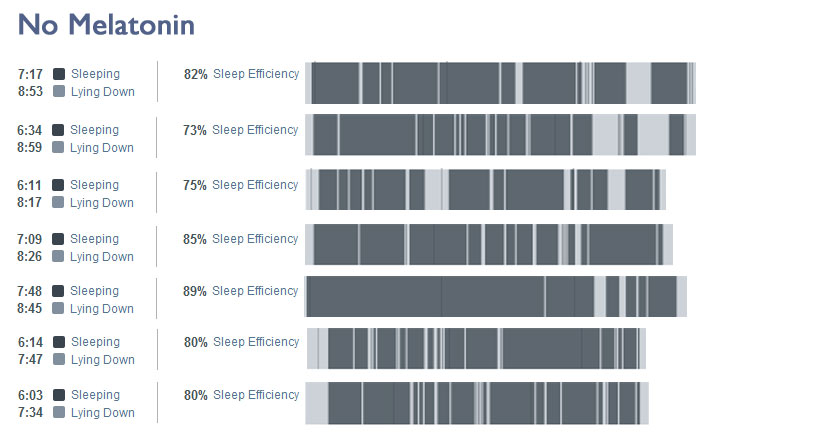
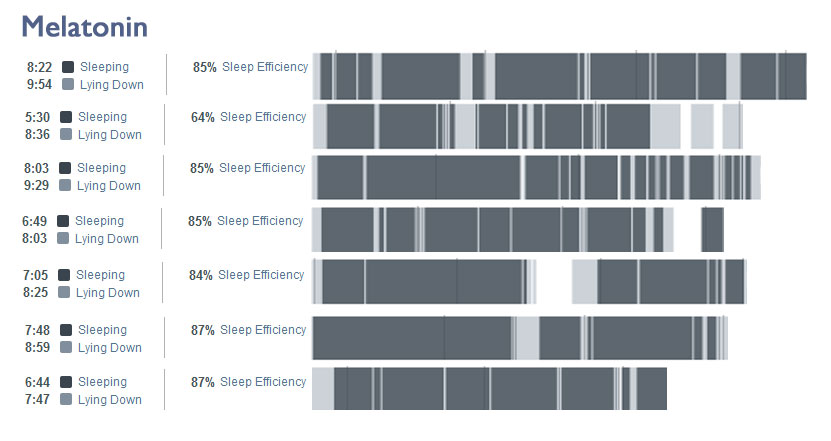
The Scientist hooked me up with an armband that monitors sleep quality. I wore it while I slept for two weeks, one week on the melatonin and one week off. Thanks to the software that came with the armband, here’s a graphic representation of how well I slept during each of the weeks:

sleep_nomelatonin
Dark gray areas=sleeping; Light gray areas=lying down, not sleeping; White areas=not lying down/sleeping
Dark gray areas=sleeping;  Light gray areas=lying down, not sleeping;  White areas=not lying down/sleeping
Dark gray areas=sleeping; Light gray areas=lying down, not sleeping; White areas=not lying down/sleeping

I was surprised by how frequently my sleep is interrupted on any given night. There is one night out of each week that I got a long uninterrupted period of sleep. On most nights the longest period of continuous sleep is a couple of hours or ninety minutes. I knew that my sleep patterns were disrupted, but I didn’t know the problem was this bad.

Some statistics:

Sleep efficiency (time spent sleeping/time spent lying down)

  • with melatonin: 82%

  • without melatonin:  80.5%

Average hours of sleep per night

  • with melatonin: 7 hours 10 minutes

  • without melatonin: 6 hours 45 minutes

I also found it interesting that I have to spend 9-10 hours in bed to get 8 hours of sleep.

So does the melatonin work? I averaged 25 minutes more sleep per night when I was taking it, which added up to an additional 3 hours of sleep for the week.

Melatonin

Since doing the sleep study two months ago, I’ve continued taking melatonin and it feels like my sleep has continued to improve. There are still nights where I only get 5 hours of sleep (last night, in fact) or I’m wide awake at 3:30 AM, but they’re less frequent. In general, I fall asleep more quickly. The melatonin creates a pleasant drowsiness that makes it easier to fall back asleep when I wake up during the night. Some days I feel a little sleepy in the morning, but that fades after I exercise, which I do first thing after getting out of bed.

If you’re considering taking melatonin as a sleep enhancer, there are some things you should know:

  • Melatonin makes you sleepy. Take it only at bedtime. I take 5 mg about 30 minutes before bed.
  • High doses of melatonin have been associated with increased depression and psychosis in people already suffering from these conditions. Also, women who are pregnant or trying to become pregnant, nursing mothers, and individuals with cancer, leukemia, lymphoma, multiple myeloma or Hodgkin’s disease should not take melatonin. It’s a good idea to consult with your doctor before starting the use of a melatonin supplement, especially if you are being treated for any other condition or taking any type of medication.
  • In the US, you can buy melatonin over-the-counter at stores that sell vitamins and supplements. It comes in 0.75 to 5 mg doses. Taking the smallest effective dose is safer.
  • Melatonin makes you feel drowsy and relaxed but not drugged, so you should still be able to easily wake if necessary, for example to respond to an emergency call from a family member.
  • It’s often recommended that you take melatonin every other day so you don’t inhibit natural production. (Personally, I think my natural production is already screwed beyond all hope and always has been, so I take it every day.)
  • Some people take melatonin for a few weeks then take a week off on the belief that it loses it’s effectiveness if taken continuously. I’ve been taking it for 5 months with only two weeks off (one due to illness and one for the sleep study). I haven’t seen a drop in effectiveness.
  • If you feel groggy in the morning, try reducing the dosage.
  • Some people experience nightmares when taking melatonin. (I’ve found that my nightmares have lessened–more on that in the next part).
  • Other side effects can include: mild headache, upset stomach, lower sex drive and depression. Again, reducing dosage can alleviate side effects. Most people don’t experience any side effects at a dosage of 1 mg.
  • Some people experience rebound insomnia when they stop taking melatonin. I stopped twice for about a week each time and didn’t feel like my insomnia was any worse than it had been before beginning the melatonin. One way to avoid potential rebound insomnia is to taper off, using lower dosages over 1-2 weeks if you decide you no longer need to take it.

My Nightmare Journal

When I wrote about nightmares, I suspected that they were connected to unprocessed bouts of anxiety. To identify trigger events, I started a log of my nightmares along with some details like possible triggers and whether I’d felt like I processed the triggering event. My goal was to become more aware of triggers and spend time working through them during my waking hours rather than letting my sleeping brain get creative with them.

According to my log, here is # of nights that I had nightmares each month:

  • Nov 15th-30th: 4 nights
  • December: 10 nights
  • January: 3 nights
  • February: 1 night
  • March: 0 nights
  • April : 0 nights

I know what you’re thinking: You did it! You learned to identify your triggers and process your anxiety!

Well, no. I tried that all through December and failed miserably. Then in January, I said “fuck you, anxiety” and I wrote this.  And hey, the nightmares disappeared!

Two things seem to be at work here. First, melatonin helps me sleep more deeply, which makes my dreams harder to remember and less vivid. Of the 14 nightmares I had after starting on the melatonin, I rated 6 mild and 2 moderate. That alone is a relief.

The other thing that’s happening? I’ve become autistic in my sleep! On January 23rd, I got my flap back in a dream. After that, I had only 2 nightmares and 1 of them didn’t fit my typical nightmare profile at all. I’ve started dreaming in an entirely different way.

In my dreams now, I often tell people that I’m autistic or consciously think of myself of as autistic. That’s completely new. Twice, when it seemed like someone was going to attack me, setting off a typical nightmare scenario in which I had to physically defend myself, the police showed up and took the threatening person away! That’s never happened before. Another time, I was lost and couldn’t find my new (in the dream) apartment. I told some people who worked in the building that I was autistic and couldn’t remember where I lived and they all offered to help me. That never happens in my dreams either.

This is really exciting. I feel like the way I’m thinking about myself and my relationship with the world around me is changing in a profound way. The changes to my dream life are concrete evidence of this.

That’s not to say I don’t have any disturbing dreams. I have plenty. I dream that I’m late for important events. That I need to call 911 but no one answers or the phone doesn’t work. That I need to run  but my legs don’t work. That I’m blind. That I’m in school but don’t know my class schedule. That I have a baby but keep forgetting to care for it.

I also still have weird, inexplicable dreams. That I’m playing golf, but in the opposite direction of everyone else on the course. That I’ve accidentally rubbed the ink from my tattoo off and when I check it in the mirror I notice that I’m also pregnant.

All of those dreams are unsettling, but they aren’t nightmares. I don’t wake up sweating with my heart pounding out of my chest. I don’t cry myself awake. I don’t startle awake because the dream has become so intensely physically painful that I can’t stand it anymore. I don’t spend most of the next day trying to forget frightening images. I’m not reluctant to go to sleep the next night.

I’m okay with having occasionally unpleasant dreams, as long as the really bad nightmares stay away. Will they? Who knows. I’m in a fairly stressful period right now, one that would have typically triggered a nightmare cycle in the past. So far, nothing.

If they return, I’ll be back to ramble some more.

—–

A related link about sleep disturbance and ADHD that talks about melatonin and light therapy as ways to lessen insomnia: findings from a study about ADHD and sleep dysfunction

Adult ASD: Moving Forward After Diagnosis

This is part 12 in the “I Think I Might Be Autistic” series.

The decision to pursue a diagnosis was difficult to make. There were times when I doubted my choice. Was it necessary to have a professional diagnosis? Would it make a difference?

Having gone through the process, the answer to both questions is yes. I have a strong need for closure. I don’t deal well with gray areas and uncertainty. That piece of paper that says, “299.80 Asperger’s Syndrome” closes off an avenue of doubt for me.

It also allows me to say this: if you think you’re an aspie or autistic–if you’ve done the research and talked to other people on the spectrum and see yourself in them, if you’ve identified a long list of autistic traits in yourself and come to the conclusion that ASD describes your particular set of neurological differences–then you are very likely correct. With or without an official-looking paper diagnosis, I think we are our own best judges of our neurology.

So, yes, getting diagnosed was worth the time, effort and expense for me. Yes, I’m fortunate to be in a position to have access to the resources I needed to pursue it. Yes, I also believe that self-diagnosis can be valid.

One of the reasons I’ve written in detail about the process is because I know that not everyone can afford or has access to a diagnosis. Not everyone is ready to pursue getting diagnosed. Not everyone has the executive function or the emotional resources to run the gauntlet of medical and mental health providers. Not everyone needs or wants a formal diagnosis.

But I think everyone who has bothered to read 11,000+ words of this series probably shares my interest in self-discovery. We know that we’re different and we want to know why and how and what that means. I spent less than 8 hours with the people who diagnosed me, but I’ve spent hundreds and hundreds of hours researching and writing about being autistic. That, ultimately, is what matters most to me.

My diagnosis, though it allowed me to put one set of questions to bed, has raised plenty of others.

  • Are there things in my life that I want to change?

  • Should I go for therapy?

  • Who should I tell?

  • How?

  • What does it mean to be Autistic?

These aren’t questions I can answer conclusively, even today.

Time to Change?

Once the newness of the diagnosis began to wear off, I was faced with the question of what to do with this new knowledge. I have a 10-page report from the neuropsychologist listing my cognitive strengths and weaknesses. I’ve become more familiar with and conscious of the areas where I struggle.

I’ve been told, not for the first time, that therapy would be beneficial. It’s an idea that I keep kicking to the back of the line, intent instead on rigorous self-examination. Like everything else I write about here, that’s my personal choice and not necessarily one that’s going to be right for anyone else. I’m not even sure if it’s entirely right for me.

Slowly, I’ve been working at making specific changes. I’ve written about being more flexible, allowing myself to stim more, trying to reduce my insomnia and nightmares, learning to translate from aspie to NT and back, and exploring my emotions.

I’ve also written about the things I’ve decided need accepting rather than changing: my lack of empathy, my anxiety, my tactile defensiveness, my love of being alone. My litmus test for change vs. acceptance is simple: is the cost of changing this thing higher than the benefit I’ll gain from the change?

Some changes require little more than mindfulness or occasional reminders; other changes require me to move out of my comfort zone and face some hard truths. The outcome–or at least the goal–is that I struggle less with some aspect of my life. Those are the good changes, the ones I’m eager to make.

Other changes feel pointless to me. These are often the changes that would make other people more comfortable by making me seem less odd. With all of the things I could be working on, I don’t see the point of investing my limited energy in those types of changes.

In fact, since getting diagnosed, I’ve become more echolalic, more stimmy, less conscious of censoring myself. I’ve become gentler and more compassionate with myself. I push myself less; cut myself slack where I wouldn’t have before. Not because I see myself as disabled, but because I see myself as a person in need of care.

I never really gave much thought to self-care before. I often demanded a level of performance and perfection from myself that I wouldn’t have expected from another person. I was so busy pushing myself to be better, to get things right, that I often neglected to be kind to myself.<

Perhaps that’s the biggest change I’ve made so far: I’ve resolved to be kind to myself.

Obviously, these are very personal decisions. The constellation of things that I choose to work on changing is unique to me. It continues to shift and grow. There are days when I think, “screw this, why should I change anything?” There are days when I think it would be nice to be “normal” for a day, to not have to struggle so much with simple things.

Then there are days when being autistic recedes into the background, not because I’m less autistic, but because I’m more comfortably autistic. Little by little, I feel myself healing old wounds, integrating the shiny new realizations, and becoming more myself.

That’s the best change of all.

Up Next: Disclosure

The Seductive Illusion of Normal

Ninety-eight percent of the time I’m good with being autistic. I was going to say “fine with being autistic” or “okay with being autistic” but I don’t want to use tepid adjectives. I really truly feel good about myself most of the time.

Then there’s the other two percent. The hard, ugly, maybe I shouldn’t be saying this but I’m wishing for normal two percent.

When I was four or five years old, I wished I was a boy. Boys got to roughhouse and play cool sports and go shirtless in the summer.

I tried the shirtless thing. It landed me in trouble, though as far as I could tell I looked no different from the shirtless boys in the neighborhood. Later, I hung around the pick-up games and sometimes the older kids let me play. I learned to throw a tight spiral and catch a long pass no matter how bad it made my ice-cold hands sting afterward. Eventually, I learned to fight.

The desire to be a boy faded.

In third grade, I wished my curly hair was straight like Marsha Brady’s. All of the cool older girls-and by older I was thinking fifth graders–had straight hair. Somehow, it seemed like straight hair would magically make me popular.

A couple of years later “Farrah Fawcett hair” was all the rage, and if I spent enough time with my mother’s blow dryer and roller brush, I could feather my hair perfectly. It didn’t make me popular but it cured me of the illusion that better hair was the key to eternal happiness.

I’ve wished for other things over the years. To be taller: more clothing choices. To be more coordinated: I didn’t make the cut for high school sports. To be more feminine: I’m not sure why, exactly.

hearts

As I’ve gotten older, the wishes have become more amorphous.

Now I find myself trying to sort out where this wishing to be normal falls. Is it like wishing for Marsha Brady hair–that one elusive change that will make me magically popular? Or is it like wishing to be a boy so I can play shirtless in the summer?

Surprisingly, I think it’s more of the latter–more of a practical wish. You see, when I most find myself wishing to be normal is when I see the people around me struggling with the–well, for lack of a better term, let’s call it the side effects of my autism.

I don’t live in a vacuum. I say and do stuff. People around me are affected by it. Even though they know I struggle with certain things–they know this logically. That doesn’t prevent them from being affected by my words or actions or lack of words or actions.

This is when the wish to be normal sneaks up and grabs me.

I’m using normal and not neurotypical here for a reason. Normal is an illusion and I know it’s the illusion that I’m wishing for at these times. I’m not wishing for a different neurology so much as a fantasy version of life.

It’s easy to be seduced by the idea that being normal would solve everything, that it would make the lives of the people around me easier. But, of course it wouldn’t. We’d have some other problems instead, because life is like that.

And still it’s there, born out of frustration and insecurity, of a sense of never quite being good enough or right enough or just plain enough.

Maybe it’s a self-esteem issue. Mine has never been especially good. I seesaw between overconfidence and underconfidence, with no idea where the sweet spot in-between lies. Does anyone truly know this? I’m not sure.

I’m not sure it even matters. This will all pass. It always does.

At some point, I see the illusion for what it is, and the desire fades.

It always has.

—–

This post is also available in Portuguese

Autistic People Are Everywhere

This post is a part of today’s “Autistic people are . . .” flashblog. You may have seen the news this week that Google has promised to eliminate the problematic “Autistic people should” autocompletes in response to last week’s flashblog. They’ve said it will take time to engineer, so while the hateful autocompletes are still appearing, hopefully they’ll soon be gone.

We can make a difference by speaking up.

——-

Autistic people are everywhere.

We sit next to you at school and on the bus. We give your dog his rabies shot, teach your kids, make your latte and sweep the floor at your grocery store. We pass you on the sidewalk and stand beside you on the subway. We eat in the same restaurants, shop in the same stores, go to the same gyms that you do.

We are mothers and fathers, husbands, wives and partners. We are sons and daughters, sisters and brothers, aunts, uncles and grandparents.

We are everywhere, all around you.

*

If you don’t see us, it’s because we’ve mastered the art of hiding in plain sight.

We don’t come neatly labeled. Many of us don’t “look” autistic. You can interact with us and not realize you’ve talked to, worked with, studied with, played with, cursed out, fallen in love with, or are related to an autistic person.

We often don’t share our neurological status unless we feel that we absolutely have too, and even then sometimes we don’t.

There is no payoff for calling attention to our differences. There is no reward for being openly autistic. The risks are real.

Many of us remain quietly, even silently, autistic.

We are everywhere, sitting beside you, walking past you, interacting with you. Do you see us?

Autistic People Should . . .

This post is part of today’s “Autistic People Should” flash blog where Autistic bloggers are writing about positive things that Autistic people should do. Why? Because if you type “Autistic people should” into either Google or Bing’s search engine query box, the autocomplete results–the most popular searches starting with those words–are disturbing and upsetting, especially if you’re Autistic or love someone who is.

Trigger Warning:  I’ve posted a screenshot of the text from Google’s autocomplete at the end of this post and as I said above, it may be very upsetting if you are Autistic or care for someone who is.

——

Autistic people should: question everything.

When we’re given an autism spectrum diagnosis, we’ve also given a model of what it means to be autistic.

Question the model.

Start here:

A wordmap of Autism Spectrum Disorder diagnostic criteria
A wordmap of Autism Spectrum Disorder diagnostic criteria.  The larger the word, the more frequently it appears in the diagnostic definition.

What does your word cloud for autism look like?

Question the assumptions.

Is there a right way to play?

To learn?

To think?

To love?

To communicate?

Question the research.

Who says?

How do they know?

Who paid for it?

Now what?

Question the stereotypes.

Nonverbal headbanger?

Idiot savant?

Inspirational angel?

Boy genius?

Lovable eccentric?

Unloveable recluse?

High-functioning aspie?

Dangerous loner?

Question the experts.

How do they know?

Are they sure?

What if they’re wrong?

Question the language.

Disorder, deficit, disability, difference?

Cured, recovered, coping, adapting, passing?

Label, slur, identity?

Person with autism, autistic, Autistic, aspie, autie?

Locked in, trapped, uncommunicative, nonverbal, nonspeaking, unvoiced?

Question the hype.

Epidemic?

Tragedy?

Burden to society?

Really?

Says who?

Question the fundamental fabric of humanity.

What is empathy?

What is love?

What is communication?

Question

every

single

should

must

can’t

won’t

never

always

Question this:

An excerpt from promotional material for a college textbook about Autism.
This textbook author says that Autistic people don’t recognize that other people have minds.

and this:

The lead for an article in a UK newspaper.
This Uk newspaper devoted an entire article to an autism expert who wants us to believe that autism is an “exaggeration of male habits.”

and this:

Excerpted from the "signs of autism" at a popular autism information website.
This popular autism information website wants you to believe that Autistic children play the wrong way because they lack imagination and creativity.

and this:

Autistic people rarely get married or have children? That's what these experts at Yale and  want you to think.
Autistic people don’t get married or have children? That’s what these experts at Yale and UC-San Francisco want you to think.

Question everything.

Question what you read, what you hear, what you see, what you are told.

Question what you think.

Most of all . . .

Question the hate.

If you type "Autistic people should" into a Google search box, these are the results that Google suggests based the most popular recent searches.
If you type “Autistic people should” into a Google search box, these are the results that Google suggests based the most popular recent searches.