All posts by musingsofanaspie

Improving Access to Health Care for Autistic Adults

When I posted about my kidney infection saga last summer, a lot of you shared similar stories about difficulties with getting the right treatment for an illness.  Often the stories revolved around how hard it is to get proper diagnosis and treatment when your body and brain are atypical in ways that a lot of doctors are not used to seeing. There were a few themes from that post that stayed with me:

  • We often have atypical symptoms and atypical reactions to medications
  • We often have difficulty describing our pain, symptoms or illness in a way that doctors understand
  • Many of us have had bad experiences with the medical system because of communication barriers or the way we experience our bodies
  • Sensory sensitivities, communication barriers and bad past experiences can cause us to avoid seeking out medical care when we need it

Today’s post at Autism Women’s Network touches on all of these issues plus a few more that I’ve encountered in reading other autistic adults’ experiences: Accessible Health Care for Autistic Adults

In an ideal world, health care providers would receive training in making care more accessible to autistic adults, and maybe that will be the case in the future. Until then, those of us who feel comfortable doing so have some self-advocacy options:

  • Ask our health care providers for the accommodations that we need to make care more effective. This is a hard one because there is an inherent power differential in the doctor-patient relationship. Sharing general information articles like today’s AWN post and the information for providers at the AASPIRE website can be a good way to start a conversation.
  • Share information about doctors who are autistic-patient-friendly. AWN is creating a crowdsourced directory for women’s healthcare providers which is a great way of making information available to a larger number of people. Within the autistic community, there is also the opportunity for informal sharing among people who live in the same city or community.
  • Take advantage of resources like a personalized AASPIRE report to share our specific needs with doctors we see regularly. The AASPIRE reports are very detailed and probably beyond the scope of a short one-time visit to a new doctor, but they could play an important role in an ongoing doctor-patient relationship.
  • Enlist allies. Sometimes medical appointments are more successful when we bring along an ally who can act as our cognitive interpreter or support person. This is especially true when an illness is interfering with our communication or decision-making abilities.

I’m sure I’ve missed things, both here and in the AWN article so, as always, I’m looking forward to your comments.


The Importance of Play

This morning as I was lying on the floor wrestling with my dog for her tennis ball–complete with fake growling on my part and some real growling on her part–I realized how important play is in my life.

Still. At the age of 45.

Since childhood, I’ve enjoyed playing board games and card games, solving puzzles and competing at (some) sports. Basically if there’s a game and I can potentially win at it, or at least enjoy trying, I’m there. But I’m also a huge fan of spontaneous, unstructured, completely pointless play.

Play in its purest form.

Play that arises in the moment and leads to unexpected, unbridled fun.

Which is probably why the assertion that autistic children don’t play “right” is so offensive to me. Why have autism researchers and therapists and clinicians forgotten the meaning of play? Worse, why are autistic kids so often described as not understanding how to play?

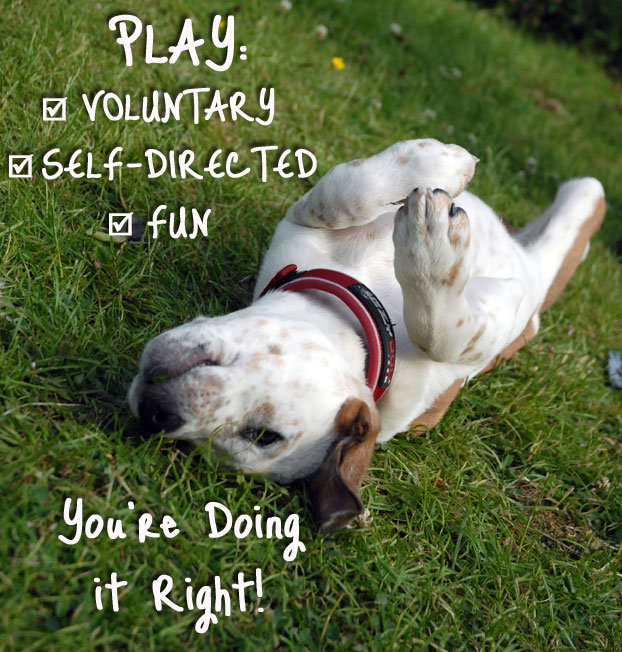
In reality, there is no wrong way to play. According to that bastion of knowledge known as Wikipedia, play is “a range of voluntary, intrinsically motivated activities normally associated with recreational pleasure and enjoyment.”  If a child is engaging in an intrinsically motivated activity and they’re enjoying it, then they’re doing it right!

The activity could be socially-focused, like having a tea party or goal-focused like disassembling a toaster. It could be something that appears to be completely pointless like watching a bug crawl on a stick or running in circles around the perimeter of the playground or studying the way the wind blows leaves around as they fall from a tree.

dogplay

Educational Play

But, the experts say, play should be educational–it should promote cognitive, social and physical development.

Kids are little sponges, absorbing knowledge every moment of the day. Filling their growing brains with new and important skills, many learned through play. But does play always have to promote a child’s development? Of course not. Much of the play that typical kids engage in is pointless fun.

But those poor autistic kids, the experts intone somberly, with their delayed development and clueless approach to socializing–they need to suck up every possible ounce of learning from every waking moment.

Thanks to this attitude–to the experts who have forgotten not only what play is supposed to be but what it’s like to be a child–autistic kids get social skills training disguised as play and developmental activities disguised as play and behavioral interventions disguised as play and occupational therapy disguised as play . . .

Except that these things aren’t play at all, because they’re not intrinsically motivated. The child is not directing the activity. The child is not choosing how to fulfill their needs or create enjoyable recreational activities. The child isn’t exploring the world around them in a way that suits them. They’re not discovering their passions and likes and dislikes.

They’re being led by an adult in a structured activity that has the goal of producing desired outcomes for which the child will receive extrinsic rewards. That’s the opposite of play. In fact, that’s the dictionary definition of work.

It’s commendable that clinicians and therapists want therapy to be fun for kids, but interventions disguised as play are a poor–if not a dangerous–substitute for actual play. Autistic kids have the same rights to a childhood as other children. Therapies and supplemental educational activities should be done in addition to playtime, not in place of it.

dandelions

More Than One Way to Play

Somewhere along the line we’ve taken the notion that play is a valuable educational activity and twisted it to mean that one specific type of play is valuable and all play–especially all play engaged in by developmentally disabled children–must be educational.

This is bit like saying “doctors are valuable to society therefore all adults should be doctors.”  If that were the case, we would all quickly starve and/or freeze to death because we would be homeless, hungry, and naked, among other things.

Society needs all kinds of people. It needs the kids who play house and school and tea party. And it needs the kids who take apart their toys or categorize their toys or couldn’t care less about conventional toys. It needs the kids who enjoy staring at clouds and the kids who would rather figure out the iPad by themselves than ask a parent and the kids who are content to spend their recess period digging in the dirt with a stick.

Notice that I didn’t say we need the kids who play in social ways but we also need the kids who play in other ways. I said and. This is an intentional word choice. The kids who play in goal-oriented, atypical or apparently pointless ways are equally valuable members of society. They are not the “but also” group, tacked on to the end of the sentence like second class citizens.

I was the kid who spent hours organizing her toys. I was the kid who wandered aimlessly in the woods. I was the kid playing board games alone in her room. By all accounts, I spent my entire childhood playing “wrong.” The funny thing is, nobody told me. My parents encouraged my interests, no matter how odd they were for my age. I learned to follow my passions and I learned to approach the world with curiosity.

That’s true to this day and that’s far more important to me than whether I make small talk properly. I wouldn’t trade my intrinsic motivation, my passion for self-directed learning or my love of discovery for all the social skills in the world. As a child, I intrinsically knew what I needed to learn; through play I built up the skills that have seen me through adulthood.

Because autistic children perceive the world differently, they need to learn different things through play than typical children do. All those hours I spent organizing my stamps and coins and baseball cards and Barbie clothes taught me about pattern recognition and rules–two things that I rely heavily on to navigate the world. Time spent alone in the woods taught me that quiet solitude is essential to surviving in a world that is unnaturally noisy to my senses. Hours of board games played against myself taught me about options and strategies and roleplaying and the countless ways a situation can be approached and still turn out okay.

We are born with an incredibly strong intrinsic motivation for exploring and adapting to the world around us. Forcing an autistic child to play in a certain way not only takes aways their intrinsic drive for exploration, it prevents them from discovering their strengths and finding ways to cope with the complex and often confusing world around them.


#Autismisnotacrime Flash Blog

Today Gretchen Leary is hosting a flash blog with the theme #Autismisnotacrime in response to the recent (and not so recent too) stigmatizing media portrayals of autism and autistic people.

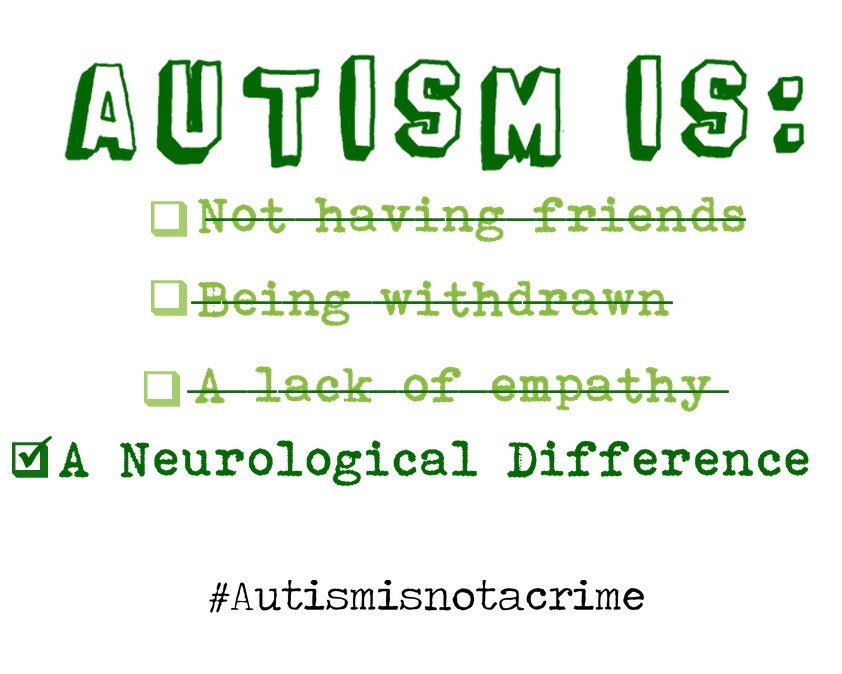
I’m low on words but after reading some of the ongoing coverage of the UCSB shootings, I made a couple of graphics:

aut-fb

 Image description: Green text on white background that reads “Autism is:” followed by four choices that read “Not having friends, Being withdrawn, A lack of empathy and A neurological difference.” The first three phrases are struck out and the last phrase has a check mark next to it. Below the choices is the text “#autismisnotacrime”. 


as-fb

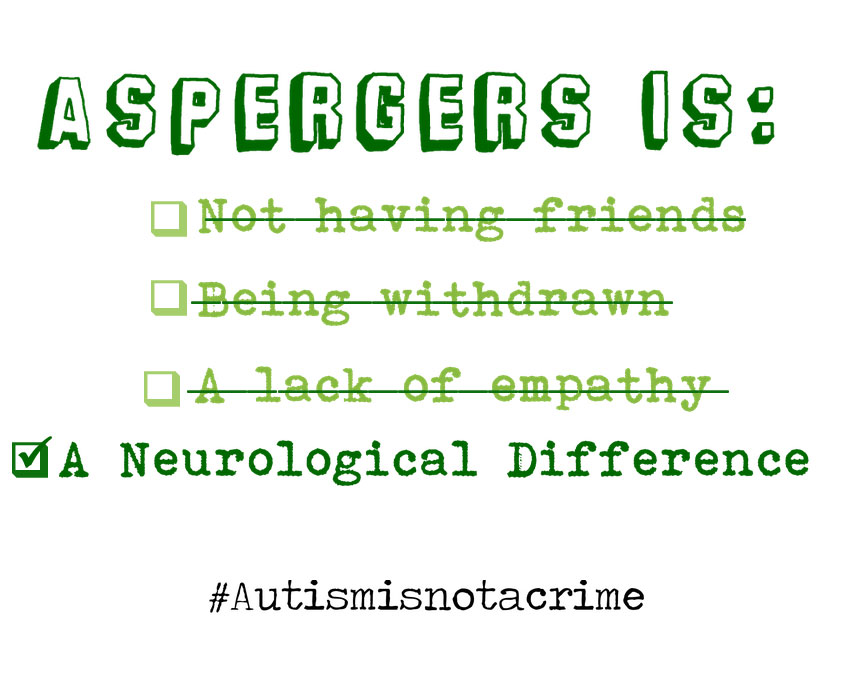
 Image description: Green text on white background that reads “Aspergers is:” followed by four choices that read “Not having friends, Being withdrawn, A lack of empathy and A neurological difference.” The first three phrases are struck out and the last phrase has a check mark next to it. Below the choices is the text “#autismisnotacrime”. 

**Because the news articles of the past two days are using the Aspergers label almost exclusively, I made graphics that use both Aspergers and autism. Feel free to share/use either or both.


Let Me Repeat Myself

In the comments on the Why Talking is Hard post, a few people mentioned that they have a tendency to repeat themselves when speaking and, oh boy, can I relate to that. I’ve spent a lot of time thinking about my tendency to say things over and over to someone, because it’s a rather embarrassing habit to have as an adult.

The underlying causes are probably a bit different for each of us, but I’ve come up with a few ideas about why autistic people are often prone to repetitive speech:

Poor inhibition

This feels like the most obvious culprit. Once we get started on a favorite subject, look out. We just can’t seem to stop, even when it’s obvious that the other person is getting bored or uncomfortable. Part of infodumping is often going over the same facts or stories repeatedly, as if we aren’t sure the other person is really grasping why this subject is so freakin’ awesome.

Poor inhibition is a component of impaired executive function–a plain old lack of ability to put the brakes on speech. Infodumping or monologuing about a special interest feels closely related to poor inhibition. Repeating the same information within an infodump is likely an extension of the phenomenon that leads to infodumping in the first place.

Basically it’s all one big case of “Help–I’m talking and I can’t stop!”

Perseveration

This is more of a “broken record” kind of repetition. It’s asking someone the same question or making the same statement over and over, even though the other person has already answered or acknowledged it.

I do this a lot to The Scientist, especially in relation to making plans.

“Let’s run tomorrow morning.”

Ten minutes later: “Tomorrow is a running day, right?”

A half hour later: “I want to run in the morning. Oh, wait, I said that already, didn’t I?”

Which doesn’t stop me from wanting to say it another ten times as the evening wears on. With practice I’m learning to silently think the question or statement and then remind myself that it’s already been answered. That works in a mostly-but-not-always kind of way.

This aspect of repetitive speech feels like lack of inhibition combined with compulsive thinking.

Catastrophizing

This is the one that eventually earns an exasperated “Would you just let it go already?!” response from whoever happens to be unlucky enough to be on the receiving end. It’s the kind of repetition that other people quickly tire of because it comes across as irrational and anxiety-laden. A worst-case scenario that just won’t die.

Catastrophizing = poor inhibition + perseveration + anxiety.

Normally, when I repeat myself in a perseverative way, the other person’s response temporarily quiets the need to do it again. But when I’m catastrophizing, the other person’s response is unfulfilling and I continue to say the same thing in different ways, trying to elicit a more reassuring response. Which is impossible, because no response other than “yes, that highly unlikely disaster is sure to happen” would be satisfying.

Short term memory deficit

This one occurred to me while watching the videos that I made for my attempt at video blogging. At times, I simply forget that I’ve already said something or made a point. I forget what I was talking about, have talked about or wanted to talk about and get stuck in a loop of similar thoughts that keep coming out in slightly different ways.

I also noticed that I echolalically repeat myself, reusing phrases or words within a conversation. It’s hard to say why–maybe as touchstones or because they’re caught in my conversation buffer. The funny thing is, it’s rarely the same words or phrases that get repeated from one conversation to the next.

Missing social cues

I think sometimes I repeat myself because I’m not getting the social communication cues to confirm that the other person has heard me. I need very obvious cues, like verbal affirmation. The cues that work for typical people–sustained eye contact, affirmative body language–are usually lost on me.

If I don’t get the expected verbal affirmation, I keep repeating what I said until I’m sure the other person is getting my point. Closely related to this is the difficulty I often have in actually making my point verbally. In way, my repetition is an attempt to edit my spoken words after the fact, which I don’t think is how talking is supposed to work.

Big Picture? What Big Picture?

Two weeks in my new town and I’m finally starting to orient myself geographically.

It takes me a good long while to get a feel for a new town or a new neighborhood or even a new Starbucks. It’ll be weeks or  months before I stop asking The Scientist things like, “do I turn left here to get to the center of town?” and “which road goes to that grocery store I like?” If I’m driving alone, I rely on Waze for directions.

It’s not just my poor sense of direction that throws me off–though that’s a big part of it. It’s my difficulty with putting all of the elements together to see the big picture. In fact, The Scientist jokes about how ironic it is that I finally figured out not just the layout of our old town but all of the best shortcuts–just in time for moving away.

In the past, I knew to expect the disoriented feeling of being in a new place but I didn’t know why it happened. I think I’ve finally figured out the why, at least in part. It’s that big picture thing that autistic people are always being told we have so much trouble with. I learn a new place based on the individual parts of it that interest me most–the details–and it takes a long time to integrate those details into a functional whole that I can not only visualize but use to navigate.

Until that happens, I know where the grocery store that I like is and I know where Target is. I know that Route A takes me from my home to Target and Route B takes me from my home to the grocery store. But ask me to go from Target to the grocery store and I’m reaching for Waze. I struggle with visualizing how “home” and “Target” and “grocery store” are related to each other in the gestalt concept of “city.”

Continue reading Big Picture? What Big Picture?

#My Writing Process Blog Hop

Last week was quiet around here because my dad was hospitalized on Sunday and I was away from the computer for most of the week. However, Jeannie Davide-Rivera of AspieWriter.com invited me to participate in a writer’s blog hop (and gave me a deadline!) so here I am. Jeannie is the author of a terrific memoir, Twirling Naked in the Streets and No One Noticed, which I was lucky enough to get to read as she was writing it. She also blogs on a wide variety of autism-related topics, including a series of answers to frequently asked questions that she’s recently started adding to her regular blog. Jeannie’s blog was one of the first I ever discovered and I learned a lot from reading her writing as I was exploring whether I might be autistic too. If you’re not familiar with her blog, check it out.

The Writing Process blog hop is basically (for me, at least) a chance to do a structured infodump on a life-long special interest: writing. The cool thing about this blog hop is that it’s migrated from nonautistic writers to writers on the spectrum and is now making its way through the autistic community (Mike Monje was also tagged by Jeannie and will be posting this week.).

On to the questions . . .

What am I working on?

Um, nothing? I’ve finished up the final major edits on Nerdy, Shy and Socially Inappropriate, which will be released by Jessica Kingsley Publishers in September (yay!). The book is a combination of revised bits from this blog and new material, organized thematically into a sort of “user’s guide” to life on the spectrum. I’m really happy with how it turned out and am looking forward to holding the printed book in my hands.

Technically, I should be working on a piece that I’ve been invited to submit to an anthology and some new blog posts and the next article for AWN, but writing gets a little harder with each passing week, so mostly I’m working on being kind to myself around the writing process.

I’m working on writing a lot on days that I can feel the words and the mistakes are few.

I’m working on not melting down on days when I discover that nearly every sentence I’ve written has multiple errors.

I’m working on writing without judgment, on writing and rewriting and rewriting some more.

I’m working being satisfied with what I can do, even if I don’t quite feel like I’m being as clear or as articulate or as precise as I’d like.

I’m working not being embarrassed when I write a ten word tweet and discover an hour later that two of the ten words aren’t actually there.

I’m working on letting the process take me where it does and having fewer expectations.

I’m working on relying less on words, on supporting others through showing up and being present and hoping they understand.

I’m working on not giving up hope of getting back to a place where words have feeling and shape again.

key

How does my work differ from others in the genre?

This is hard because there is so much diversity among autistic writers. I feel like we’re each very different in our approach and writing style and the topics we write about.

I do a lot of research and try to blend research with my personal experiences. Autism is one of my current special interests, so I enjoy digging into a topic and reading about it in depth as background for a post. In some ways that often makes my writing wonkier and more technical than the average blog. Also longer.

For last few months I’ve been enjoying interviewing other autistic women and including their stories in the articles for AWN. I was starting to get tired of writing about myself all the time so that’s been a refreshing change of pace. It’s forced me to develop a slightly different writing style, which I don’t quite feel comfortable with yet, but I’m eager to keep working at.

Why do I write what I do?

I started blogging for myself–to understand myself better. I never really expected it to go anywhere beyond being an outlet for processing my own realizations and giving me a place to infodump about what was quickly becoming a massively time consuming special interest. That people found what I was writing interesting was a happy surprise.

A few years ago, I tried to talk my way into a creative nonfiction class at the university where I was doing my economics degree. The professor asked me about my writing experience and specifically whether I’d ever written any memoir. Well, no. Needless to day, I didn’t get into the class. At the time, I couldn’t imagine what on earth I could possibly write about myself that would be of interest to anyone. I figured creative nonfiction meant the stuff I so enjoy reading in the New Yorker but the professor had other ideas and deemed me an unsuitable candidate.

Life is funny like that, I guess. I’ve always loved to write. Fiction for fun and nonfiction for work. But writing about myself–opening up my life and thoughts and experiences to strangers–was the last thing I expected to ever do. It’s been an interesting process, one that’s made me stronger and more vulnerable as a person.

Along the way, something else that’s very important to me has happened too–this has developed into a space where people feel comfortable sharing their stories too.  That was something I’d hoped for in a “wildest dreams” kind of way. Hopefully, by creating a place where we can learn from each other, I can give back to the community some of what I found when I first wandered into other autistic writer’s blogs looking for clues about myself.

How does your writing process work?

New ideas nearly always originate in real life. A conversation had or overheard. An observation that raises a question. A quirky detail that I can’t quite figure out. Something I’ve read and found exciting or annoying or confusing.

Once I have the seed of an idea, I like to let it germinate in my mind. I’ll come back to it throughout the day or while I’m contemplating the meaning of life at 3 AM. Often I take tough ideas out for a run, literally. Some of my best thinking is done while running or walking the dog. Eventually the idea will take on a specific shape and that’s when I start writing.

I usually write as much as I can off the top of my head, then begin researching to fill in background, answer questions or challenge my own theories. If a topic is difficult, I might start with background reading, let the idea grow in my head a bit, then go back to more serious research. Generally, though, I like to get some fresh thoughts down before I start reading what others have to say about a subject.

I rarely start at the beginning of a post and almost never know how a piece of writing will end. Half the fun of writing is seeing where an idea will take me. If I know the ending, there’s no point in even beginning to write but there’s no sense of mystery or discovery along the way.

Finally, I revise a lot. Right now I have 23 draft posts in my Google docs folder, all in various states of revision. Some posts I’ll write in an hour and have ready to publish in a few days. Others I’ll let sit for months, going back to look at each occasionally until I find the right way of saying what I want to say. And some never see the light of day.

Up Next

Part of this blog hop deal is tagging other writers to participate. Hop on over to these blogs to check out what they’re up to and read their responses to the blog hop questions next week:

Sparrow Rose Jones is the author of “No You Don’t: Essays from an Unstrange Mind“, a terrific collection of essays about her experiences as an autistic adult. She blogs about autism and advocacy related topics at Unstrange Mind and is also a fantastic musician and has taught me a great deal about autistic culture and history.

Alyssa is a prolific blogger who writes about autism-related topics at Yes That Too. She’s been in China for the past academic year and is returning to the US soon. In addition to writing nonfiction, fiction and poetry, she’s an artist who creates cool visual patterns, which you can find at Because Patterns.

Renee Salas blogs on autism and neurodiversity related topics at S. R. Salas, is a frequent contributor to Autism Parenting magazine and a champion Tweeter and a tireless advocate. She is the author of Black and White: A Colorful Look at Life on the Autism Spectrum, a positive look at life on the spectrum.


Behavior is Communication: Are You Listening?

Behavior is communication.

This has become a catchphrase in the autism community. And for good reason. It’s certainly true.

A child runs from a store and experts assure the frustrated parent that behavior is communication.

A parent asks for advice about why their recently diagnosed child bursts into tears at bathtime and experienced parents nod in sympathy. “Behavior is communication,” they say.

A child refuses to eat anything but raw carrots and pancakes and the child’s occupational therapist isn’t the least bit surprised. Behavior is communication.

A child flaps at a wind-up toy that’s stopped moving and the experts . . . somberly intone that the child doesn’t know how to communicate . . . that he isn’t aware of the adults around him and is “trapped in his own world”, unable to share his joy with others.

An adult walks away from an autism researcher who is treating him as less than competent, preferring instead to tend his garden, and . . . cue the tragic music as the researcher looks on gravely and the viewer is made to believe that the autistic adult simply doesn’t know how to have a proper conversation.

What’s going on here?

Why is certain behavior treated as communication and other behavior treated as a failure to communicate, often in the same person?

Somehow a phrase that started out as a positive step toward understanding autistic behavior in the absence of language has become associated primarily with meltdowns, self-injurious stimming, eloping and other obvious signs of distress.

Why is that? Do autistic people only communicate distress through their behavior?

In case the answer to that question isn’t obvious: No, we communicate a whole range of emotions and messages. But much of it seems to get lost in translation.

That toddler flapping at the wind-up toy? It looks to me like he’s saying, “that was fun, do it again!” It’s not his fault that the so-called experts in the room don’t speak autistic as a second language.

Going Beyond the Obvious

Meltdowns. Elopement. Biting. Hitting. Crying. Refusing to eat certain foods. These are not the only autistic behaviors that are communication.

Stimming is communication. It’s not enough to simply assume, “this person is stimming so they must be stressed or anxious.” Sometimes stimming is about anxiety or sensory overload. But it’s about so much more than that, too.

My stims are a language unto themselves. I have a stim for every mood, and while the physical movements may sometimes be similar, the feelings that go with them are distinctly different. My happy flapping is different from my grossed out flapping. My excited bouncing is different from my nervous bouncing. The autistic body is constantly communicating and it’s saying so much more than “I’m in distress.”

“Lack of communication” is communication. Autistic attempts to interact with others are often overlooked because they are atypical.

Did you know that an autistic person may express interest in something by studying it for a long time rather than directly engaging at first? Many of us like to understand how all the parts of an object work or how a person responds in different situations before we feel comfortable interacting. And persistent questioning, monologuing, or echolalia–often dismissed as unidirectional communication–are all signs that an autistic individual is seeking to connect.

Eye contact (or lack thereof) is communication. But it’s not the kind of communication that most people assume. If I’m staring off to the side while you’re talking to me, that’s a sign I’m intensely concentrating on what you’re saying. And if I’m making intentional intermittent eye contact? I’m more focused on “passing” to avoid looking odd than I am on listening to what you’re saying.

listening

And that’s just one simple example of how using a neurotypical “dictionary” to interpret autistic behavior and body language can lead to chronic miscommunication. Understanding that behavior is communication is a good first step. But it’s not enough to look at autistic behavior and guess, based on neurotypical experience, reasoning and cultural norms, what that behavior means or doesn’t mean.

Only through accurate translation of autistic behavior can real communication occur.

For that to happen, autistic individuals–including autistic children–need to be allowed to communicate a broad range of messages in the ways that are natural for them. Forcing a child to make eye contact or to stop flapping is the equivalent of forcing them to speak a foreign language. It’s telling them that if they want to use behavior to communicate more than distress, they’ll have to speak another language because theirs is substandard and the people around them can’t be bothered to learn it.

“Behavior is communication” has to apply to more than just a small subset of behaviors or it’s no better than “quiet hands” masquerading as acceptance.

This post is part of the 2014 Autism Positivity Flash Blog happening today

screen-shot-2014-04-21-at-6-45-04-pm


You Are Getting Very Sleepy

Note: The annual Autism Positivity flashblog is being held again this April 30th. Visit the website to find out how you can participate.

—-

For the past few weeks I’ve been getting ready to move. That’s meant making lots of phone calls to change over utilities and insurance and such. And packing. Lots of packing. Of course packing also means deciding what to keep and what to toss and what to donate, plus a good amount of organizing and reorganizing. Because, you know, it’s important that my entire file cabinet go into the box in the best possible order, with not a single scrap of unnecessary paper cluttering up my system.

I’m happy to say that nearly everything on my list is done. Which is good, because the moving truck arrives in less than forty-eight hours. I’d also like to say it all got done smoothly and according to plan, but that would be a lie.

You see, I have this thing that happens when an anxiety-inducing event is imminent: I suddenly feel very very sleepy. I don’t just mean that I feel a little tired–I mean I feel 2 AM tired.

Mostly it happens before social events. The Scientist will be busily showering and shaving and choosing an outfit and I’ll be calculating down to the minute how late I can start getting ready.

Fortunately, it doesn’t take me long to make myself presentable. That means I can safely put off getting ready until the last ten minutes before we need to get out the door. Any sooner and I’ll be all ready to go while simultaneously wanting to lie down on the couch  and take a quick nap.

The strange thing is, even when it’s happening, I know the tired feeling is an illusion. It’s my brain trying to get my body to play enabler, to somehow avoid the anxiety-inducing event. Some people get butterflies in their stomach or a need to pace. I get a sudden urge to hibernate in a blanket fort for a week or two.

sleepy2

So in addition to all of the usual chaos of getting ready to move, I’ve been trying to outsmart the sleepy feeling. Not surprisingly, actually sleeping doesn’t work. In most cases, it isn’t even an option because the thing I need to do is both imminent and time sensitive. But even with most of the moving tasks, where I could grab a nap and then do them later, there is no actual sleeping to be had. Because if I lie down, all I’m thinking about is the task I should be doing. So then I’m both sleepy and annoyed with myself for procrastinating.

It helps a bit to think of the feeling as something other than sleepy–to call what it really is, which is some sort of defensive withdrawal. When I look at it that way, I understand intellectually that I don’t need or want to sleep. I also know from experience that the best “cure” is to do the anxiety-producing thing. Often, I simply need to get started and the feeling clears.

To get the stuff on my moving list done, I used a lot of the same tricks I use to manage my executive function deficits: lists, rewards, schedules, telling myself that I just have to call one insurance company instead of all three or pack up a box of clothes, which is easy, rather a box of dishes, which is harder. Once I get on the phone or haul out the packing materials and tape and boxes, it’s much easier to just keep going. It’s the getting started–getting past that initial wall of do not want–that’s the real trick.

Addendum

When I told The Scientist that I planned to write about this topic, he suggested that I also write about, “the way you yawn when you’re bored during a conversation.” My yawning habit (for lack of a better description) has long been a source of annoyance for both of us. The Scientist assumed I was bored but not telling him; I was flummoxed whenever he brought it up because I usually wasn’t  feeling bored when it happened.

yawn

Coincidentally, a New Yorker article about the science of yawning popped up on my Tumblr dashboard within hours of the The Scientist’s suggestion. Buried beneath a lot of other more complicated theories is the suggestion that in addition to yawning when we’re bored, tired or hungry, we sometimes yawn when we’re anxious. That makes sense to me. Yawning definitely helps me clear my head and it gives my nervous system a poke, both of which help me stay focused. Coincidentally, that’s a pretty accurate description of the effects of stimming too.

These days I mostly catch myself before I yawn during important conversations. When that familiar feeling creeps up, I get up to pace or intentionally engage in a stim that has the same effect as yawning. But it was interesting to learn that there are all sorts of theories about yawning and they aren’t all centered around boredom or fatigue.

Addendum to the Addendum

The article I linked to above also mentions that autistic people are less likely to be contagious yawners. I’m curious whether autistic readers think this is true? I’m very susceptible to contagious yawning, to the point that I yawn when my dog yawns. In fact, I’ve been yawning pretty much constantly while researching, writing and proofreading the last two sections of this post.


Taking the SPD Checklist

This week’s test is more of an inventory of traits than a quantitative test. The SPD checklist is intended to help identify areas of atypical sensory processing, including hyposensitivity, hypersensitivity and sensory seeking.

Sensory processing disorder (SPD) is a stand alone diagnosis, however, there is substantial overlap between SPD and the atypical sensory processing that autistic people experience. In fact, now that sensory sensitivities are included in the DSM-5 diagnostic criteria for autism, we may start to see fewer kids getting diagnosed with SPD plus an alphabet soup of other conditions. Because the odds are really high that a kid with concurrent diagnoses of SPD, ADHD, and ODD is really just an autistic kid in disguise. But that’s a rant for another day. . .

I’ve written quite a bit about atypical sensory processing, so I’m going to get right to taking this week’s test.

Taking the Test

There several online versions of the SPD Checklist. The one I’m linking to for this post has a couple of nice features: it’s (mostly) worded as an adult checklist, it’s printable so you can complete it on paper, and the links at the top of the page allow you to filter the questions by type, in the event that you want to focus on just one area of sensory processing.

To get started, go to the SPD Checklist webpage. This a “paper and pencil test”, so your options are: print it out and sharpen your pencil, create a tally sheet to add up your scores, or copy/paste into a word processing application.

Edited to add: Anna very kindly made us a spreadsheet that totals up the scores for each section: SPD Checklist (recommend that you save it to your computer or make a copy before using it)

To take the test, read each item and numerically score it as follows:

0 – Never (not at all)

1 – Rarely (a little)

2 – Sometimes (moderately)

3 – Often (quite a lot)

4 – Always (severe)

I assigned words to the scale to help me better understand how to use the numerical scores. The instructions also say that you can score an item as P for “previously experienced but no longer present” however there is no explanation of to interpret P numerically.

Interpreting the Results

The checklist has 138 total items, for a total possible score ranging from 0 to 552. There are no guidelines available for interpreting the numeric scores and I think that’s because this checklist is meant to be a qualitative guide to a person’s sensory processing rather than an indication of a diagnostic threshold. Of course, I still couldn’t resist adding up my numerical scores.

The items on the checklist are divided into 8 categories:

General Modulation (scoring range: 0 – 36): The 9 items in this category are broad and were some of the hardest to answer because they felt so vague. I scored 22.

Over-Responsiveness (0 – 100): The 25 items here cover hypersensitivity to sensory stimulus, with a heavy emphasis on tactile and auditory sensitivities. I scored a 61, with the highest scores on tactile and general environmental items and the lowest on vestibular and taste items.  No surprise there–I’m tactile defensive, easily overloaded by stimulating environments and a vestibular/proprioceptive/taste sensory seeker.

Under-Responsiveness (0 – 36): These 9 items cover hyposensitivity, mostly in the interoceptive category. I scored 13, with high scores on the interoceptive items and low scores on the rest.

Sensory Seeking (0 – 80): The 20 items in this category measure tendencies to intentionally seek out strong sensory experiences. I scored 48 + 1 P (knuckle cracking, which I did habitually as a teenager and have stopped doing). Most of my high scoring items are in the proprioceptive, vestibular and taste categories.

Sensory Discrimination (0-104): These 26 items relate to our ability to filter sensory information. I scored 42. This feels like the weakest area of the checklist. I know from experience that I have significant difficulty filtering sensory information but the items in this section didn’t accurately capture the difficulties I have. Difficulty licking an ice cream cone neatly? Not something I encounter on a daily basis.

Sensory Based Motor Abilities (0 -80): The 20 items in this category are related to fine and gross motor skills and would probably be more accurately described as such. I scored 41. Most of my high scores were in the area of fine motor skills.

Social and Emotional (0 – 88): I would classify this entire category as secondary traits because I think they’re more a product of having sensory sensitivities than “symptoms” of SPD. Also, this is where the line between autism and SPD becomes really fuzzy. There isn’t a single item among the 22 here that isn’t also an autistic trait or is strongly present in many autistic people. I scored 48, mostly due to high scores on the social and resistance to change items.

Internal Regulation (0 -28): This is another weak section. Difficulties with interoception are common in people with atypical sensory processing and the 7 items here were clearly written by someone who doesn’t experience interoceptive weirdness. I scored 17, with moderate scores on everything, simply because the questions are worded so vaguely. More questions with more specific traits would create a better picture of a respondent’s interoceptive issues. For example, “do you not realize that you need to use the bathroom if you are engaged in an interesting activity” or “do you sometimes forget to eat until you are feeling weak, dizzy or nauseous from hunger” would be much easier to answer than the current “under sensitive or over sensitive” wording.

Overall score (0 – 552): For what it’s worth, I scored 292 out of a possible 552. The overall score seems useless because, like an IQ score, it’s an aggregate of a set of disparate subscores.

The best approach is probably to look at the categories we score especially high or low on, and then drill down into the subsets of high/low scores within each category. For example, within the over responsiveness, under responsiveness and sensory seeking categories, there were clear patterns in my answers that identify which areas I’m hypo- and hypersensitive in.

This test also suffers at times from imprecise wording, making some of the questions hard to answer. I had no idea how to score “hates to be barefoot or hates to wear shoes/socks” because I prefer being barefoot and generally dislike shoes and socks, expect in situations where being barefoot would be painful. So is that 4 for disliking shoes and socks or a 0 for loving to be barefoot or what? Seems like a completely useless question. Same for “love to touch and be touched, have to touch everything.” Anyone who is simultaneously tactile seeking and tactile defensive knows that those are three completely different things.

The Bottom Line

The SPD checklist would benefit from the input of people who experience sensory sensitivities. A few of the questions felt unanswerable and some of the others could use refinement. However, completing the checklist can help someone with atypical sensory processing identify which areas they have the most challenges in. For those new to the concept of atypical sensory processing, it can also be a good introduction to the potential ways that atypical sensory processing affects our daily lives.

——-

Note: Take a Test Tuesday will be on hiatus for a while after today. I’m moving and not sure how long it will take for me to get settled in. Also, I’ve run out of test ideas again. If anyone has ideas for other tests that might be, let me know in the comments and I’ll start rebuilding a queue.

Honoring Our Choices

The final post in the autistic motherhood series is posted at Autism Women’s Network: Autistic Motherhood: Honoring Our Personal Choices

It was a challenging one to write. My original thought was “I’ll write about the decision to have or not have children as an autistic woman.”  Which turns out to be an incredibly personal and complex topic. You’d think I would have seen that coming, right?

Ultimately, what I concluded, is that each woman’s choice when it comes to parenthood is the best choice for her and each person’s situation is unique. There is no “decision” in the broad conceptual sense, just many individual decisions made for countless reasons and sometimes not for any particular reason at all. I hope that comes across in the article, because I very much want it to be respectful of our choices and of the circumstances that are unique to parenting as a disabled person.

A Postscript to the Series

There’s also something that I wanted to address at some point in this series–something that’s been on mind for months as I’ve been writing about motherhood–but I never found a way to say that I felt comfortable with. Since I’m among friends here, I’m going to just throw it out there as food for thought and hope for the best.  Continue reading Honoring Our Choices