The One Where I Talk to Myself About Shame

You’ve been putting off writing this for a while, haven’t you?

Yep.

Weeks?

More like months.

And how’s that working for you?

Well, I wrote posts about functioning and the verbal-nonverbal disconnect and executive function to avoid what I really wanted to write about.

Which is?

Shame. All the things I’m supposed to be able to do. The ways executive function undermines developmental expectations. What it means to be independent and what it means to be developmentally delayed and why those two things are not mutually exclusive.

Because I don’t live “independently.” I never have. I don’t know if I could or not. I probably could if I had to, though maybe not as successfully as I’d like to pretend.

You’re doing it again, veering into an easier topic to avoid that shame thing a little longer.

Right. Shame. Hang on.

shame

Hey, enough with the Googling! Get back here and write something.

Relax. I needed context. How about this:

Shame is rooted in our perceived defects. When those defects are revealed to others, we see ourselves in a negative light. Shame creeps in.  Continue reading The One Where I Talk to Myself About Shame

Monday Morning Musings (8/5)

Doing What I Want Experiment: Week 1

Some reflections from the first week of my “What do I want?” experiment:

The first two nights I dreamt about making decisions. My brain is  uber-serious about this experiment.

Side note: I’ve been having weird disturbing dreams all week. Not sure if that’s related to pushing myself out of my comfort zone with decision making or something else.

Decision making seems to be a multi-step process:

1. realize that a decision is required
2. sense my wants
3. align the wants with possible options for fulfilling them
4. choose among them based on convenience, preference, etc.

. . . okay, clearly more work is needed on the “just feel it” part of decision making

I made two big decisions:

The first was emotionally hard. I was proud of myself because I overrode my instinct to make the other person happy. It took a lot of effort but I felt accomplished when I decided to do what would be best and healthiest for me.

The second was a situation where I would normally have defaulted to making plans based on what the other person was doing, but I overrode that and thought about what I really wanted. The end result is I’m going to be doing something in the fall that I find a little scary but exciting.

I tried setting a 30-second time limit on minor decisions. Meh. I need a better strategy for minor decisions.

When a decision feels frightening, it might be because I don’t have enough information so I should ask for more details.

Funniest moment: The Scientist was rearranging the couch/hassock for TV watching and asked where I like to sit. I replied “however you like it is fine—no, no, wait, wait, in the hole” which he magically understood as “I like to sink into the crack between the cushions so put the hassock where I can do that and still put my feet up comfortably.” The magic of being married forever. Also, look at how I caught myself defaulting to his preference and changed strategies – yay!

Key realization: I’m an adult. I can decide how to use my time. If I’m bored, I can actively choose to do something else. This probably sounds stupid but I’m throwing it out there because it was a revelation to me.  Continue reading Monday Morning Musings (8/5)

Procrastination or Executive Function Fail?

There’s a spot on my kitchen floor, a little cluster of dried reddish drips. I don’t know what it is. If it’s from 3 days ago, it’s tomato sauce. If it’s been there longer . . .  who knows.

I’ve walked past it dozens of times. I look at it. It annoys me. I wonder how it got there. I wish it would go away. It doesn’t occur to me that I can make that happen.

The greasy smudgey fingerprints on the cabinet that I can only see in exactly the right light? The 8-inch long thread that’s been hanging off the bathroom rug since the last vacuuming? The dryer sheet on the laundry room floor? Same thing.

What is this? Why can I sit here and catalog all of these little annoyances yet I still do nothing about them? It’s not like fixing them would take a huge amount of time or effort.

In fact, to demonstrate how minor they are, I’ll take care of them right now.

.

.

.

.

.

Done. It took me less than five minutes to wipe down the kitchen cabinets, trim the thread and toss in the trash, pick up the dryer sheet, and clean the spot off the floor. I bet it would also take only a few minutes to vacuum up the bits of dirt and grass scattered in the entryway from my running shoes.

But I’m sitting writing and not doing it, aren’t I?

Maybe later.

And this is how days go by and I keep right on walking around the mess, getting more and more annoyed by its existence yet still not doing anything about it.  Continue reading Procrastination or Executive Function Fail?

The Self-Employed Aspie

This is the first in a 4-part series on self-employment for people on the autism spectrum

Part 1: The Self-Employed Aspie

The majority of people with Asperger’s are either unemployed or underemployed. For an adult aspie, this is a scary statistic. It’s easy to hear it and feel like the deck is stacked against you.

In some ways it is. A job interview is heavily weighted in favor of social skills. Employees are generally expected to be team players. Often, getting ahead in the workplace is as much a matter of who you know as what you know. All jobs have rules, both written and unwritten, and employees are expected to follow them.

So much of what happens in a workplace is second nature to neurotypicals and a complete mystery to the average aspie.

Or at least I assume it is. My last workplace was a McDonald’s. I was eighteen.The expectations were low. As long as you didn’t steal from your register or hold the place up at gunpoint they didn’t fire you. I’m not exaggerating. Those were the only two things people were fired for in the year that I worked there.

So if you’re looking for advice about getting or keeping a traditional job–with or without Asperger’s–I can’t help you.

But if you’re curious about being self-employed, I have a lot of experience. I’ve been the owner or co-owner of a business since I was 19. I lucked into the first business–it was something my husband started around the time we got married. It made sense for me to help him out rather than going out and getting a job.  Continue reading The Self-Employed Aspie

What Do I Want?

The Scientist has proposed a 30-day experiment. He says I need to practice doing what I want to do. He says, in addition to being good for me, it will help him to get to know me better. We’ve known each other for 28 years, so this feels a little late in the game for getting to know each other better. And yet . . .

What really intrigued me about his proposal is how it might help me get to know myself better. If you’re a long time reader, you might remember that last year I wrote about how much difficulty I have figuring out what I want. I often haphazardly make minor decisions, only to find I’m unhappy with the results. Here’s an example, the one that sparked the idea for the experiment:

I tried out a new recipe for dinner last week–a light summer mix of fresh tomatoes, red onions, squash and fried okra from the farmer’s market. When The Scientist tasted it, he said the flavor was too strong for him but he’d make some pasta to toss the veggies with. Since I was already cooking, I made the pasta, and for some reason I mixed all of the veggies with the pasta instead of setting my half aside. The resulting pasta dish tasted okay, but it wasn’t what I had in mind when I chose the recipe.

After dinner I was feeling gloomy, silently perseverating. As we were sitting down to watch TV, I blurted out, “I have no idea why I ate that. It wasn’t what I wanted.”

The Scientist, surprised by how upset I was, asked why I ate it if I didn’t want it. My answer: “I don’t know.”

A longish discussion ensued. The next day. Because we’re slow to process things. One of the conclusions we came to is that I sometimes do things to please other people at the expense of own preferences. Strangely, this seems to be more of a reflex action than a conscious choice.

So the experiment is this: for 30 days, I’m supposed to do whatever I want. This is alarmingly vague.

What do I want? Decision making–even the simplest decisions–can tie me up in knots. My primary decision-making strategies:

1. What do you want? I’ve noticed that other people often have stronger preferences or are more aware of what they want or like than I am. If what they suggest isn’t objectionable to me, I’ll go along with their choice. Decision making by proxy. Simple. Efficient. And probably one of the main reasons I have so much trouble figuring out my own wants and preferences.

2. I don’t want A. By default I must want B. If someone says “do you want Chinese food or Pizza?” it rarely occurs to me that I actually want a burger.

3. This is too hard. I give up. When there are too many options, I don’t know where to start. I choose the first option that isn’t terrible. These are often the choices I end up feeling most ambivalent about.

4. I want A but it’s too much work. I’ll just settle for B. This is how I made decisions when I’m overloaded. I would love ice cream right now but going out to get it sounds exhausting so I’ll have this peach instead.

5. I want this thing and nothing else. This sounds great. It’s not. What I want is often imaginary. In my head it’s this perfect thing. In reality, it turns out to be a pale shadow of what I anticipated.

6. I want A, but I can tell you want B. If one of us has to be disappointed, I’d rather it be me. This makes me sound like such a martyr. Honestly,  it’s an annoying reflex response that I need to cure myself of. Done too often, it breeds resentment.

Writing this out helps me understand better why I often feel ambivalent or unsatisfied with minor decisions. I need new strategies. The Scientist says to try just feeling it. This is hard. I’m used to making decisions based on logic and reasoning.

But . . . 30 days of being with this question of “what do I want?” might change that. We’ll see.

Stop Signs For Tommy

Hi Tommy,

Your mom told me that you like stop signs a lot. When I was your age, I really liked old coins and when I got a little older, I really liked baseball cards and now that I’m grown up, one of the things I like a lot is old buildings that people don’t use anymore. I especially like looking at pictures of old buildings and I spend a lot of time searching online for them.

So when your mom said you like to look for stop sign pictures, I thought it would be fun to ask my friends who read my blog to take some stop sign pictures for you. They asked their friends and a whole bunch of people went out and took photos of stop signs all over the world just for you.

We hope that you like them!

Cynthia

P.S. If you click on the photos, some of them have bigger versions and you’ll be able to see the stop signs better.
P.P.S. Some people took a bunch of photos so I put one here and linked to the others. Go have a look!

Continue reading Stop Signs For Tommy

Monday Morning Musings (7/22)

Stop Signs

Thank you to everyone who shared their stop sign photos over the past week. We have a couple dozen so far. I’m going to post them next week so there’s still time to share yours! Don’t be shy.

From the Unfiltered Aspie File

Last Friday The Scientist and I went to buy dog food. We couldn’t find the usual brand so we were walking around the store browsing when I spotted an employee standing in a doorway near the back. I asked him about the brand I was looking for. He said it had been recalled and we talked about alternative brands. He seemed a little skittish as he said he would show me the brands he’d mentioned but I dismissed it as the usual sort of effect I have on strangers.

When we got out in the parking lot, The Scientist said, “Did you realize that the guy you asked about the dog food was standing in the doorway to the employee bathroom?”

“Uh . . . no?”

“He was drying his hands.”

*headesk*

All I saw was a doorway and a few cartons stacked against the wall, which led me to assume it was a storeroom. No wonder the guy looked so nervous.

traings

Trainspottng

For the past few months I’ve been living across from a train station. It’s a small historic depot that still has freight and light rail commuter trains coming through all day and night. When we looked at the apartment, the salesperson cautioned us that the trains are required to blow their whistles as they come through the intersection at the corner. She warned they’d be louder in the front of the building.

We ended up at the back of the complex–for reasons that have nothing to do with the trains–but I still hear the whistles plenty loud. I can’t say I mind much. They give a rhythm to the day. And if it’s a freight train and it’s moving fast enough, I can hear the rumble of the engines–two or three usually–and the long line of cars they’re pulling.

Predictably, stereotypically, I’ve always been drawn to trains. The model train set I had as a kid. The big empty echoy boxcars that used to park behind my dad’s workplace. Trains I spied from the backseat,  passing in front of our parked car and alongside highways. My first real train ride, through the countryside of a place as foreign and unreal as the new life I’d suddenly stepped into. Then, years later, living in the Southwest, where you can see an entire train at once, a hundred or more cars long, racing beside you on the highway, stretched out across a mesa, end-to-end, small against the infinite sky.

But it wasn’t until recently, standing beside the tracks, that I figured out the attraction for me: patterns and sounds. The resonance of the freight trains. Standing next to the tracks, feeling the rumble resonating in my chest is one of my new favorite sensory treats. That and watching the cars pass. Tankers. Box cars. Flatbeds. Grain cars. If you just stare at one point, you get car-space-car-space-car-space, over and over and over, at regular intervals,six of this kind, ten of that, almost never just one of anything.

Lost in Space

I think I was born to be in motion. I have difficulty resting when I’m at rest.

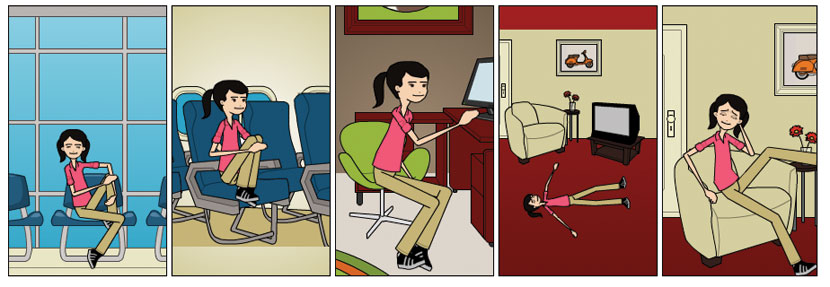
If I have to sit in one place long enough, I’ll cycle through dozens of postures without thinking about it. I slouch. I splay. I pin one foot under the other. I pull one knee up, then two, hugging my shins with a hand or arm. I sit on my foot, ankle or calf. I sit crossed legged, even on chairs. I put my elbows on the table, lean my head or chin on my hand, interlace my hands on top of my head. I perch on the edge of my chair, turn sideways, tangle my feet in the legs of nearby furniture.

The variations are endless but they have one thing in common–they orient my body to my surroundings. Without a steady stream of proprioceptive feedback, I start to feel disoriented and disconnected from my body. I feel lost in space. Confused. Physically disorganized..

When I’m at home, sometimes I just go lie on the floor to give my body a break from being upright. Because being upright requires figuring out where to put my hands and arms and legs and feet and often no sooner do I get that all sorted out than that restless feeling starts nudging at my leg or foot or spine and I need to move again.

lostinspace

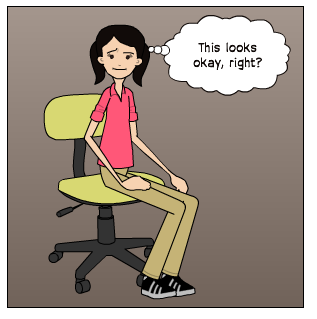
It’s not that I can’t sit like a proper adult. I often start out sitting with both feet on the ground, arms relaxed at my side. In fact, in new social situations, I make a conscious effort to sit properly. Because I’m not four years old. I’m an adult–often an adult in a situation where I’m expected to look professional–and adults have very specific expectations of other adults in those situations.

Often what I come up with is a tense variation of typical “good sitting posture”:

sittingposture

Then my internal clock starts ticking and one of two things happens. If I’m in a formal setting, my body will grow more and more tense as I work to maintain a polite, socially acceptable posture. Then I’ll start covertly stimming, rubbing something between my fingers or twisting my hand in my pantsleg, something to counterbalance the tension that’s building up as I force myself to be still.

If I’m in comfortable or casual surroundings, it doesn’t take more than five minutes for me to start shifting around, searching for a more comfortable position. On an airplane, for example, I’ll start out sitting with my feet on the floor, book in my hand, arms close to my sides–typical polite seatmate posture. Soon, I’ll have one leg splayed out along the aisle or tucked under my opposite thigh. When that stops working, I’ll slouch and pin both knees against the seat in front of me or turn sideways and pull my legs up to my chest or fold one leg across the knee of the other, wedging a foot against the seat in front of me.

The fact that I’ll start stimming when I can’t freely change my posture often probably indicates that the positions I use to feel comfortable are in fact themselves a form of stimming.

Reset, Relax, Repeat

My body has a time limit on any one position. Even when I’m trying to fall asleep, if I don’t nod off right away, I need to keep changing position every ten minutes or so.

When I’m still, I have a gradual build-up of . . . I don’t know what. Tension? Discomfort? Disorganization?

I start to feel more and more uncomfortable until I have an uncontrollable urge to rearrange myself. Once I move into a new position, I’ll feel comfortable–momentarily at rest. Then, gradually, the discomfort starts building and soon I have to move again. Sometimes it’s only a matter of shifting back and forth repeatedly between two positions–a trick I used a lot at university to avoid adopting too many odd slouchy postures in class.

As important as the movement–and here’s where I think the particularly autistic aspect of this comes into play–is the position of my limbs. I almost always have one part of my body pinned, pressed, squeezed or wedged against or under something–either another body part or a piece of furniture. I think this deliberate pressure creates feedback that grounds me physically. It reminds me of where my body is in space and makes me feel safe in a way I can’t describe with words.

Physically, pressure equals organization.

Perhaps it’s like swaddling a baby. Mothers have been snugly wrapping up fussy infants for centuries. There is some science to back up the practice, suggesting that swaddling calms babies by enhancing motor organization and self-regulation. Once babies reach a few months old, swaddling is no longer beneficial or necessary because they have a reduced startle reflex and better-developed motor control.

Maybe there’s something very primitively calming about the kind of pressure I’m constantly seeking–a sort of localized form of swaddling.

Or perhaps it’s simply about feedback. Given my poor sense of interoception and my strong drive for proprioceptive sensory input, it’s not surprising that I need to intentionally create a steady stream of input to remind me that I physically exist.

Monday Morning Musings (7/15)

Got Stop Signs?

In the comments on my infodumping post last week, a mom mentioned that her son’s special interest is stop signs. He’s 6 and he loves everything stop sign related. His teachers think this is a problem and try to discourage his interest. But his mom, who sounds like an awesome person, encourages him to do stop sign activities at home, both for fun and as a way to learn new things. That got me thinking that we could potentially make a little boy happy and show him that there are lots of adults who think that having a special interest isn’t weird or something to feel bad about.

So how about if we celebrate Tommy’s special interest by seeing how many photos of stop signs we can come up with for him? Since he’s already using Google to find photos online, I’d like for us to share photos that we’ve personally taken. The easiest option is to take a photo of a stop sign in your neighborhood or if you’re feeling ambitious you could find some interesting place in your area that has a stop sign. Or maybe you happen to have a vacation photo with a stop sign in it?

I know there are readers all over the world. Hopefully we can get some different designs and languages, but any stop sign you can add to the collection would be great. If you want to write a few sentences about the photo–location, pronunciation for non-English versions, a bit about you or your neighborhood, a fun fact about the location (or the sign in general if you don’t want to reveal your location)–that would be awesome. Just keep it appropriate to a 6-year-old.

You can put your photo in the comments below. You can share it on Twitter (mention me so I see it: @aspiemusings) or my Facebook wall (https://www.facebook.com/MusingsofanAspie). Or you can post it on Tumblr, Instagram or a photo sharing site and get a link to me. I’ll put together all of the photos and notes in a post for Tommy. Let’s put a deadline of the end of the month on this so we all feel motivated and such, executive function being what it is around here (especially mine!)

I’m going to start us off with this photo of a stop sign from a train platform in Korea:

stop_korean

Online Neurodiversity Lecture Series

In spite of its rather odd title, I’ve been enjoying the “No Mind Left Behind” lectures that @quarridors shared a link to ages ago. I’ve watched most of the first day of the scientific track, which I found more interesting than the bits of the “reality” track that I’ve seen. The scientific lectures have the benefit of being very short (no more than 20 minutes each) so the speakers are forced to get the point fast. Many of the lectures focus on autism, but ADHD, OCD, Tourette’s and other atypical neurologies are also covered. A scan of the lecture titles will help you narrow things down to your areas of interest pretty quickly.

Two lectures in particular that I enjoyed were the ESSENCE lecture on very early symptom identification and the lecture on the development of empathy. One thing that struck me in the ESSENCE lecture was the idea that very young children are often diagnosed based on the type of doctor that they see. ASD, ADHD and Tourette’s can look similar in two- and three-year-olds, so a child who gets seen by an ADHD specialist at that age is more likely to get an ADHD diagnosis while a child with similar symptoms who gets seen by an ASD specialist first is more likely to be diagnosed as autistic. The lecturer also said he believes that children younger than 3 with hyperactivity symptoms should first be evaluated for ASD before ADHD is considered.

The lecture on empathy by Chrisopher Gillberg was fascinating because he is the person who coined the term Empathy Quotient and his beliefs about empathy are so different from Simon Baron-Cohen’s (who developed the infamous EQ test). Gillberg takes a very neutral, scientific view, avoiding the sort of emotionally charged language we usually see associated with empathy and autism, which is refreshing.

Surveys

This weekend I brought over a bunch of survey answers from Survey Monkey. Yes, people are still answering the adult autism surveys! There are links to all of the survey posts from the final survey if you want to check out the latest additions.

Saying No

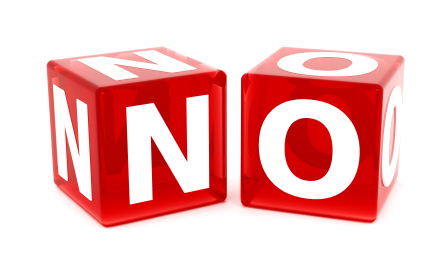
Saying “no” is hard. Often when I say no, I feel like I’m disappointing the other person, like I’ve somehow failed.

This probably sounds funny coming from someone who not too long ago wrote about her “no reflex” but there are two categories of no for me. There’s the reactive no–the one that just pops out because I can’t deal with change or spontaneity. I might feel momentarily bad but  don’t get all twisted up inside over it.

The other no–the one that hides and cowers and wakes up the butterflies in my stomach with its nervous pacing–is the no that makes me feel like I’m failing. The hard no is often a result of tension between what the other person wants and what I can feel like I can reasonably do. It’s often tied in with adult social obligations, the sort encountered by parents, spouses, adult children, employees: the neighborhood book club, the PTA committee, the office holiday party, the class research project.

When people ask others to join, volunteer, lead or otherwise participate in something, they do it with such a hopeful, expectant tone of voice. The implication is “how can you refuse this excellent thing that we’re all counting on you to be a part of?” And so often, that excellent thing just feels like a burden to me.

Saying no, however, is going to lead people to make assumptions. I’m not pulling my weight. I’m standoffish. We’re not as close as they assumed. I think I’m better than other people. I just don’t care.

All of the other moms are on a committee. All of the other parents have coached a season of rec sports. All of the other wives will be there. All of the other cousins are going to the wedding. All of the other students in the department are attending graduation. All of the other neighbors are baking for the fundraiser.

Of course not literally all of the other ______ are doing anything, but that’s what the person asking will imply. Everyone else is doing it, what aren’t you? Or worse, not enough people are doing it, I’m counting on you to help me out.

This is peer pressure at its most insidious. The hints that doing this thing makes you normal or a better person or not a bad person are powerful, especially when you’ve been raised and socialized to feel like fitting in and being normal are a primary goal.

And here is where we come to the crux of the issue. Autistic children are often grow up with a strong desire to fit in, to be liked, to be normal and/or to not get into trouble. We aren’t necessarily taught that we have the right to decline activities that uncomfortable or that we can sometimes put our needs first.
fq9w8jaofoef

Learning to Say No

No comes from different places for different people. Strong boundaries. Good social skills. Explicit instruction in saying no as a child. Good self-esteem. A general orneriness.

If no doesn’t come naturally or has been socialized out of us, we can still learn to say no. This is where scripts come in handy. Not only do scripts give us the words that we might find unnatural, they prevent us from accidentally saying yes when we mean no.

Social communication is fraught with code words and unspoken communication. If your no is too soft, it can be misconstrued as a yes. For example, if you mean “no” don’t say “I don’t think so” or “I shouldn’t.” This can be interpreted by the other person as an open invitation to persuasion, negotiation or further discussion. You may find yourself feeling bullied into a “yes” when you already thought you’d said no.

If you mean no, unless you clearly and unambiguously say “no” the other person may think you’re being polite or coy.

But how to do that?

Saying No 101

I’ve always secretly wished there were social skills classes for adults. Then, recently, I realized there is something very similar: etiquette. On a whim, I’d checked Emily Post’s aptly titled Etiquette out of the library. And guess what? It’s loaded with not just advice but scripts. Lots and lots of them.

Emily Post and the people who now edit her books have spent a great deal of time figuring out the polite thing to say in just about every imaginable situation. Did you know that saying no can be as simple as:

“Would you like to come with us to lunch?”

“No, but thank you for inviting me.”

That’s right, you can simply say “No, but thank you for [asking, inviting, including, thinking of] me.” No further explanation necessary! This was a revelation to me because I always thought I needed to provide an excuse when declining an invitation.

You can, of course provide an (honest) excuse if you have one:

“No, I have plans for this weekend, but maybe next time.”

“No, I can’t make it this time. Work/school is too hectic.”

When providing an excuse, be careful not to put off for the future something you have no intention of ever doing. Saying, “Work is really busy right now” opens the door to getting the same request next week. If the request is something you don’t want to do, remove the invitation for a repeat inquiry by saying, “My schedule is full right now. If that changes, I’ll let you know.

And for those of us with food sensitivities and allergies, here are a couple of simple, polite phrases for declining food offered by a host(ess):

For foods you don’t like, a simple “no, thank you” is fine.

For allergies, intolerances or diet restrictions, you can say, “________ is off limits for me, but everything else is wonderful.

Polite. Straightforward. Inoffensive to your host’s cooking. Again, no need to offer a lengthy explanation or get into why you couldn’t possibly put a single piece of creamed spinach in your mouth without dying of sensory overload.

Beware of Traps

Not everyone knows how to politely take no for answer. People often try to guilt or bully others into saying yes, even after they’ve said no. Don’t fall for mind games:

  • Just because someone compliments you, you don’t have to say yes to the request that follows. For example, Mary says, “You’re the best web designer/babysitter/cake baker in the world. I know this is last minute, but could you [do some task that you don’t have time or energy for]?” Instead of feeling flattered/guilted into saying yes, you can say, “Thank you, but I don’t have time right now.” Politely acknowledge the compliment, then follow with a firm unapologetic no.

  • Peer pressure doesn’t end in high school. If someone prefaces a request with “Everyone is . . .” or “You’ve got to . . . ” beware. Don’t cave in to the bullying–instead politely decline with a simple, “I can’t right now.” Repeat as necessary.

  • Don’t allow others to trick you into doing something by making you feel sorry for them. A simple “I’m sorry you’re feeling overwhelmed, but I have my own deadlines to meet” is sufficient for turning down an unreasonable or inappropriate request.

Even well meaning people sometimes have trouble taking no for an answer, as Mados vividly illustrated in her recent post “Parties & Irrelevant Pity“. Saying no can be a complex social exchange and one that requires a lot of practice to do well. Scripts like the ones Emily Post suggests are a good starting place, especially for those of us who struggle with how to phrase things as well as how to maintain boundaries.


one woman's thoughts about life on the spectrum