All posts by musingsofanaspie

Autism and Menopause: More Questions Than Answers

When I first realized that I was starting to experience the symptoms of menopause, I went in search of more information. The first thing I learned is that I’m not experiencing symptoms of menopause but of perimenopause, the period (heh) before menopause when a woman’s body starts producing less estrogen.

Menopause is the hormonal finish line; perimenopause is the roller coaster ride that gets you there.

There’s plenty of information out there for women experiencing all stages of “the change” but, of course, nearly nothing specifically for autistic women. I don’t know if autistic women experience menopause differently. It sounds like a difficult time for most women, with a lot of variation in symptom type and severity, so it’s hard to say if what I’m experiencing is different from the norm.

What caught my attention, though, is the overlap between some common traits of ASD and symptoms of perimenopause. Many autistic women–myself included–already struggle with sleep problems, temperature regulation, forgetfulness, mood swings (irritability, depression, anxiety), and fatigue.

My biggest question is will this make menopause less difficult because I have coping strategies in place that I can ramp up or will it make it more difficult by compounding my existing difficulties? A couple of years into this grand hormonal adventure, I feel like it might be a combination of the two.  Continue reading Autism and Menopause: More Questions Than Answers

Stepping Outside My Comfort Zone

I like my comfort zone. A lot.

I don’t want to break out of it or stretch it or push myself out of it. Mostly I’d like to build a blanket fort in my comfort zone and never leave. But I know that isn’t reasonable. As an adult with responsibilities, there are times when I have to step outside my comfort zone.

My approach to these times used to involve a lot of metaphorical pushing and breaking and stretching. I would power through, often with an angry determination to just get it over with. This made hard things harder, but I didn’t realize that I had a choice.

Recently–and entirely accidentally–The Scientist showed me that there’s a better way to go about getting out my comfort zone. After doing some post-game analysis of why what we did worked, here’s what I’ve come up as a framework for helping someone step out of their comfort zone in a gentle, supportive way:  Continue reading Stepping Outside My Comfort Zone

Monday Mourning

It’s been a hard few days in the autistic community. So much pain. Again.

I’ve been thinking a lot about what to write and honestly I don’t have the words. I cannot even begin to make sense of what I’d like to say. Instead of adding my voice to the conversation about Issy, I’m going to share some of the pieces that have impacted me over the past few days. In case it’s not obvious, these are all very difficult reads that talk about abuse of disabled children.

Again, We Mourn by Amy Sequenzia

Bodies and Behaviors by Michael Scott Monje

Where was I when Kelli needed help? by Beth Ryan

Dehumanizing by Ariane Zurcher

It Is Wrong to Murder Your Autistic Child by Judy Endow

Adult Responses to Autistic Children Lead to Escalation or Calm by Brenda Rothman

I’m turning off comments on this post and encouraging those who read any of the above to respond to the authors directly.

Links to resources:

Emergency Information for Autistic People and Parents/Caregivers/Others by Paula Durbin Westby

Emergency Information for those in the UK by Liam (thank you to Nat for the link)

Fact Sheets for Autistic Victims of Crimes and for those who work with Autistic Crime Victims (scroll down a couple of screens for the PDFs)

Weighted Blanket Giveaway

When I published “I Think I Might Be Autistic” as an e-book earlier this summer, I thought about giving part of the proceeds to a charity that supports autistic people. Then I thought some more and realized that, “Hang on, I know lots of autistic people!” Why not use the proceeds to give back to the community directly?

giveaway

Sooooo .  . . thanks to everyone who bought the e-book (or the print version!), I’m excited to announce the first giveaway for a 38″ x 50″ weighted blanket from Mosaic Weighted Blankets. The blanket pictured about is mine, which I absolutely love and use every day. The winner will be able to choose from the fabrics and colors that Mosaic currently has available.

To enter, do at least one of the following:

Some rules: 

  • Giveaway ends September 14th at 11:59 p.m. EST
  • US residents only (due to the shipping cost)
  • Max. 3 entries per person (1 for a comment here, 1 for a reblog on Tumblr, 1 for a comment/like on the Facebook status)
  • 1 winner will be chosen at random on September 15th

Good luck!

Under Control

Control. It sounds like a good thing.

Self-control. I’ve got this under control. Control yourself.

For years, I had everything under control. I swore I did. Everything from family activities to how people were allowed to feel around me. Is some small detail unplanned? I’ll plan it. Someone has a problem? I’ll fix it, whether they want me to or not. Something needs to be done? I’ll take care of it. In fact, I’ll do it myself because that’s the only way it will get done right. Because only I know what the right way is.

See, everything under control.

This should feel good. My entire universe working according to my grand plan. Only it doesn’t feel good. It’s exhausting and it drives the people around me up a wall.

It’s also an illusion.   Continue reading Under Control

Beyond The Talk: What Else Autistic Girls Need to Know About Puberty

This was originally posted at a group blog that I’m part of: We Are Like Your Child. It primarily addresses parents of young autistics, but I’m reposting here because I thought other autistic adults might have helpful tips to add or their own wishlist of things they’d known about puberty.

One request: if you talk about anything traumatic, please reference it obliquely. There are some younger readers here now and I could see others finding this post in a search for autism and puberty or adolescence.

———-

When it came to puberty, my parents did what many parents in the seventies did: they gave me a book about puberty written especially for girls. It was a slim cranberry hardback with an ambiguous title like “Everything is Changing.”

I was a voracious reader, so I would curl up in my beanbag and scour the pages for clues to the mysterious changes that were on the horizon. I think I had many of the same fears, anxieties and curiosities about puberty as my friends had. Certainly my body went through the same changes that other girls experienced. However, I think there are some areas where girls on the spectrum would benefit from additional information or guidance. That’s what I’m going to focus on in this post.

Many of the issues I want to touch on also apply to boys. I’m specifically addressing the issue of puberty in girls because I was once a girl and I raised a daughter. Girls are my wheelhouse. If you’re looking for information about boys, I hope you can adapt some of the ideas below but, honestly, boys are a mystery to me.

adolesence

In addition to talking to your autistic daughter about all of the things parents normally cover when talking about puberty, consider discussing the following when you feel the timing and circumstances are right:  Continue reading Beyond The Talk: What Else Autistic Girls Need to Know About Puberty

Building a Base

When I was sick earlier this summer, I had to take 6 weeks off from running–the longest break I’ve taken in years. I was concerned about how soon I could get back into shape, but happily, within two weeks I was back to running 60-70 minutes comfortably.

Runners often talk about building a base. By running a minimum distance every week, your body makes adaptations and the long distances eventually feel less long. When you take time off, it’s easier to get back to running long distances again than it would be for a new runner because you’ve already taught your body some important things about running. Things like: no, we’re not stopping, so quit grumbling and get on with it and yes, you can make it up that hill because you have before.

Each run makes the base a little stronger, a little deeper. Over the years, all those miles create a sort of long-term physical memory. Aerobic conditioning is a big part of being able to run for an hour or two or four, but the act of having done it before is the difference between this will be hard and this is impossible.

*

“What doesn’t kill you makes you stronger.”

I used to think this meant that surviving difficult things makes you tougher. Which it does. But tougher is not the only way to be stronger.

Surviving difficult things makes you fear less.

Not fearless, but less fearful.  Continue reading Building a Base

Monday Morning Musings (8/26)

Blogoversary!

One year ago Wednesday I made my first post on this blog. It was really scary until I realized that hardly anyone would see it . . .

Fortunately some people eventually found the blog and those people shared it with other people and things kind of snowballed from there. Rereading that post, I realize that my perception of what it means to be autistic has changed a lot in a year. (If you read that link, keep in mind that I had no idea what I was doing and I made some silly mistakes/assumptions that make me cringe now.) What hasn’t changed in the past year is my wish for this to be a place where people can share their experiences and knowledge and questions. You all have made that come true in ways I couldn’t have dreamed of a year ago.

Glitter stars for everyone!

glitterstars

Mail!

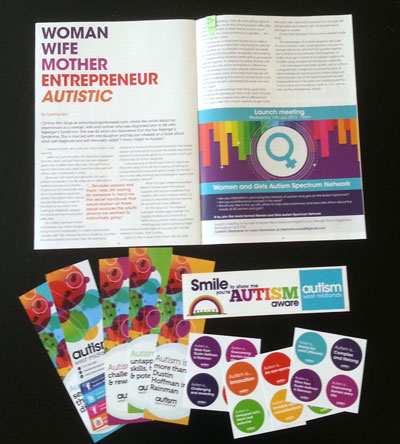
Earlier this summer I wrote an article for a quarterly magazine published by Autism West Midlands so I was very excited to get a copy of the magazine in the mail this week.  Julia, who is absolutely lovely to work with, also sent me rainbow-themed bookmarks and stickers.

Rainbow-themed autism swag and my first print article!

Continue reading Monday Morning Musings (8/26)

A Little Something Different

When I started blogging, one of the first topics I wrote about was motherhood.  Before posting, I gave the series to my daughter Jess to read because I wanted her permission before publishing such a detailed account of her childhood. I think she was a little shocked by some of what I wrote,  but she was fine with me publishing it. At the time, we talked about how it would be interesting if she wrote something for the blog from her point of view. She’s all grown up now, a thoughtful, well-adjusted adult with her own take on her childhood.

So, fast forward a year to yesterday morning.  I open my email and find that she’s sent me a post (which is right after this intro).  I was super excited because I’ve been hoping she still wanted to write something but I’m not the kind of mom who nags (much).

Also! Jess says she wasn’t sure what else people might want to know but if anyone has questions for her about being raised by an autistic mom, she’d love to answer them. You can leave comments or questions for her here or on my blog’s Facebook page. Maybe we’ll figure out some fun way to turn this into a mother-daughter conversation.

Okay, enough from me. The rest of this post was written by Jess . . .

———————

As a student in college a few years back, I studied identity, mostly related to race, which led to a lot of writing and talking about myself. Because my father is Korean, a lot of my discussions focused on him. One day, one of my professors asked me, “What’s your mom like?”

“What?” I laughed, surprised at such a vague question.

“What is she like? Does she live with you? You don’t talk about her.”  Continue reading A Little Something Different

Starting a Business Aspie Style (or What They’ll Never Tell You in Business School)

This is the final part in 4-part series on self-employment for people on the autism spectrum and the one I’m most nervous about posting. I nearly titled it “Don’t Try This at Home” because when I say this is what works for me, I’m not kidding. Your mileage may vary greatly. On the other hand, don’t be afraid to experiment and find what works for you. Starting a business is far from a textbook undertaking and there are as many ways to go about it as there are successful business owners.

——————

If you’ve read this far, you’re probably still wondering, but how exactly does this starting a business work? You can find a ton of advice about starting a business online. I feel like it would be irresponsible if I didn’t strongly advise you to read extensively, across many different sources, to get an understanding of what owning a business involves. It pays to know how deep the water is before you dive into the pool.

Having said that, I’ve always been more of a learning on the fly kind of gal. If I can doggie paddle, I’ll dive in and figure the rest out as I go. You can only learn so much about swimming by standing on the pool deck watching a YouTube video.

I’m going to close out this series by sharing the five things I’ve learned in the deep end that go counter to much of the formal business school type of advice you’ll encounter elsewhere. Keep in mind that this is what worked for me–what played to my strengths. It may or may not work for you, but I think it demonstrates that doing what works for you is often more important than doing things the way you think they should be done or the way someone else has told you they should be done.

feetarrows

1. Forget the Business Plan

If you Google “how to start a business” you’ll find lots of start-up checklists and on most of those checklists one of the steps will be “create a business plan.” I have a confession: the only time I ever wrote a business plan was last year, as part of an Entrepreneurship course. By that point I’d been a business owner for more than two decades.

I know that a business plan is necessary if you want to go to a bank or other investors for funding. Other than that, I’m not sure what purpose it serves. To me, it seems like a poor use of time. The business plan that I wrote for class required at least forty hours of work and I was just doing the minimum necessary to get a decent grade. If I was making a serious effort, it would have easily taken me five times as long. And still it would have been based on assumptions that inevitably go right out the window once you get down in the trenches of running a business.

As the old Yiddish proverb so wisely says: Man plans and God laughs.  Continue reading Starting a Business Aspie Style (or What They’ll Never Tell You in Business School)